
IE University
A private international university in Spain, with roots in Instituto de Empresa (founded 1973) and university status since 2009. More than 10,000 students, roughly 90 percent international, from 160 countries. Many programs are taught 100 percent in English. You apply directly online, without UNEDasiss. Generous merit-based scholarships can cover 30 to 100 percent of tuition.
About IE University
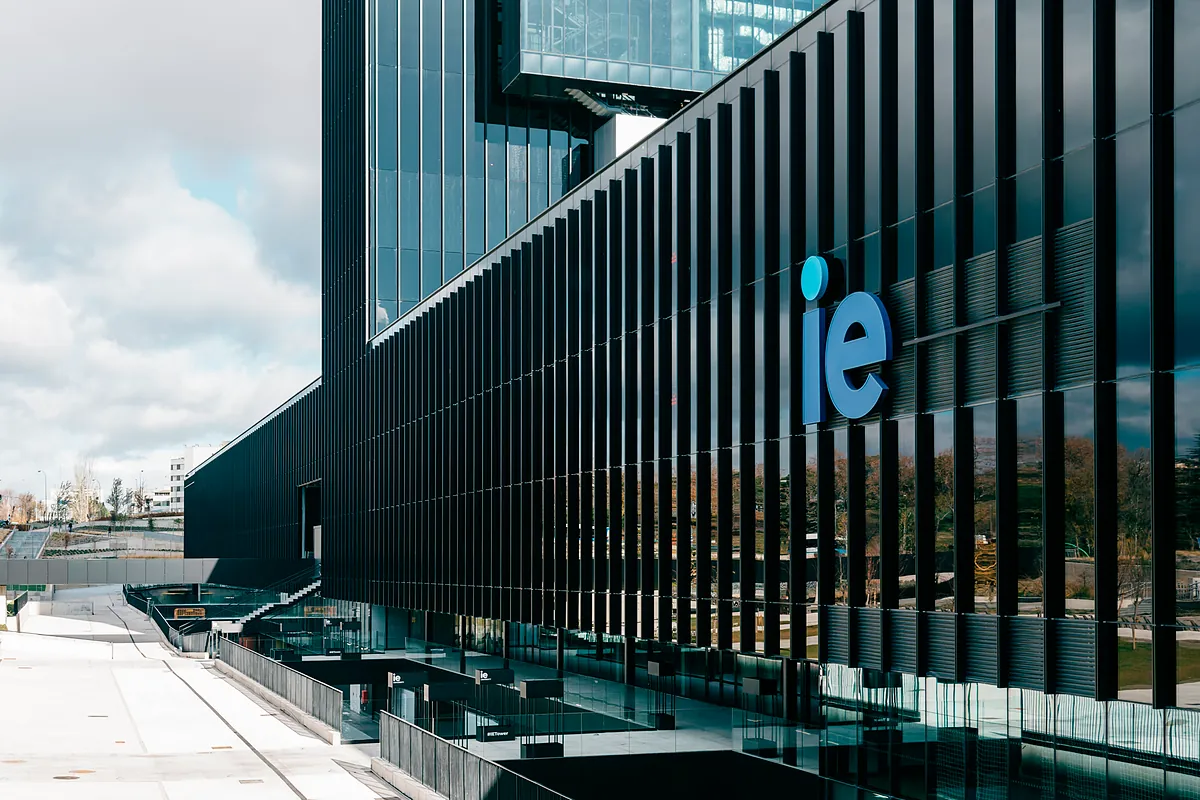
IE University is a private international university in Spain, born from Instituto de Empresa (IE), founded in 1973 as a business and law school. It opened bachelor programs in 2006 and received official university status in 2009. It has two campuses: Madrid (with IE Tower, the tower on the campus in the north of the city, opened in 2021) and Segovia (in the Convent of Santa Cruz la Real, a historic UNESCO city about an hour from Madrid).
The IE profile is strongly international and entrepreneurial. Over 10,000 bachelor and master students, of which roughly 90 percent international, from 160 countries, with a mix of almost half women. For a Romanian student this means an environment where English is the default language and where you are not an exception as a foreigner, but part of the norm. Many bachelor programs are taught 100 percent in English, so you do not necessarily need Spanish to study (although you will pick it up quickly living in Madrid).
Strong programs at IE: Business (IE Business School is the historic core, placed in the global top 10 for subjects such as Management or Master in Management in the QS rankings), Law (Bachelor of Laws, LL.B., including dual and international variants), International Relations and politics (School of Politics, Economics and Global Affairs), Economics, Computer Science and Data, plus Architecture and Design (IE School of Architecture and Design). Much of the bachelor offering is built modularly, with dual majors (for example Business plus Data, Law plus International Relations).
For Romanian students it is important to understand the model: IE is a private university, so you apply directly to the university, online, not through the Spanish public system (UNEDasiss or Accesnet, which you use at public universities such as Universitat de Barcelona). The process resembles an international-style application more closely: online form, motivation essay, proof of English (IELTS or TOEFL), an own admission test (ieGAT) and a personal interview. In the QS World 2026 ranking, IE University is around position 438 overall, but it clearly excels in business and management subjects, where it ranks in the global top 10. Bachelor tuition: approximately 26,500 to 29,000 euros per year, depending on the program.
How to apply to IE University
Direct online application (not UNEDasiss)
Unlike Spanish public universities, at IE you apply directly on the university portal, not through UNEDasiss or Accesnet. You create an account, choose the bachelor program, upload your diploma and transcript (Baccalaureate, in English or with an authorized translation) and your CV. Timing tip: the application works in waves (rolling), so start about 6 months before your desired start month, because spots and scholarships fill up over time.
Essays and motivation form
IE puts emphasis on the personal profile, not only on grades. You will complete short essays or motivation questions about who you are, why IE, what you want to study and what impact you want to have. For Romanian students this is where olympiads, projects, entrepreneurship, volunteering and genuine interests stand out. Write authentically, not generically.
Proof of English (IELTS or TOEFL)
Programs are taught largely in English, so you need an English certification: as a guide IELTS 6.5-7.0 or TOEFL iBT 90-100 (check the exact threshold of the program). Cambridge equivalents (C1 Advanced) are also accepted. If you have already studied in a high school taught in English, you can sometimes request a waiver.
Admission test (ieGAT) and interview
IE uses its own test, ieGAT (IE Global Admissions Test), which assesses numerical, verbal and logical reasoning (it lasts about 70-90 minutes and does not require knowledge-based preparation). This is followed by an online assessment with video and written questions and a personal interview with a member of the admissions committee, where communication, critical thinking and motivation matter.
Admission decision and scholarship
The committee evaluates the application as a whole (grades, essays, test, interview) and sends the decision. Important: you are automatically considered for merit-based scholarships, without a separate application, at the moment of admission. If you also want need-based aid or other specific scholarships, you apply for them in parallel. Merit scholarships can cover between 30 and 100 percent of tuition.
Enrollment and moving to Spain
After you accept the offer, you pay the deposit to reserve your spot and complete enrollment. As a Romanian (EU) citizen you do not need a study visa; after arrival you register for the NIE and the EU residency certificate. Arrange accommodation early (IE residences or apartments in Madrid or Segovia), because Madrid has a competitive rental market. The academic year usually begins in mid-September.
Costs and scholarships for Romanians
Bachelor tuition (indicative 2026-27)
Cost of living (Madrid or Segovia)
No EU statutory rate
This is a PRIVATE university, so tuition is similar to non-EU (you do not benefit from the EU statutory advantage as at public ones). In exchange, they have generous merit-based scholarships that can cover 30 to 100 percent of tuition. Compare this with a public one like UB, where a Romanian pays a few thousand euros per year at the EU rate.
30-100% of tuition
You are considered automatically for merit scholarships during the admission process, without a separate application. Usual coverage goes from 10-15 percent up to 100 percent for excellent profiles. Your Baccalaureate grades, test results, essays and interview all weigh here. A strong application can turn high tuition into an affordable one.
Income-based aid
Beyond merit, IE offers need-based scholarships, social impact or international profile scholarships, plus installment payment options and loans through partner banks. As a Romanian you are also eligible for external scholarships (for example national or local programs from Romania), which can be combined. Apply for all of them in parallel with admission.
Want to apply to IE University?
We help you build your application directly for IE: the motivation essays, preparation for ieGAT and the interview, English certification and the merit scholarship strategy to reduce tuition. Our mentors have been through international admission processes. The first mentoring session is 100 percent free.
Talk to a mentorFrequently asked questions
How do I apply to IE University as a Romanian student?
At IE you apply directly on the university portal, online, not through UNEDasiss or Accesnet (those are for Spanish public universities, like Universitat de Barcelona). The steps are: you create an account, choose the program, upload your Baccalaureate and transcript (translated), complete motivation essays, take the ieGAT admission test, do a video assessment and a personal interview, then receive the decision. Because admission is in waves (rolling), the recommendation is to start about 6 months before the start month, for better spots and scholarships.
How much does IE University cost per year for a Romanian?
Bachelor tuition is indicatively 26,500 to 29,000 euros per year (Bachelor in Business Administration at the top end, around 29,000 euros per year, the other programs around 26,500 euros per year). To this you add cost of living in Madrid or Segovia of roughly 12,000 to 18,000 euros per year (accommodation, food, transport, expenses). Important: IE is private, so tuition does not benefit from the reduced EU rate at public universities. But merit scholarships can cover 30 to 100 percent of tuition, so the real cost depends greatly on the scholarship you obtain.
Is IE University public or private and what does that mean for fees?
IE is a private international university. This means that tuition is similar to that for non-EU students and you do not benefit from the EU statutory advantage that you have at a Spanish public university, where an EU citizen (including a Romanian) pays only a few thousand euros per year. At IE there is no such reduced EU rate on tuition. In exchange, IE has generous merit-based scholarships that can cover 30 to 100 percent of tuition, plus income-based scholarships and financing. For a direct comparison, if you want a low EU rate, a public one like Universitat de Barcelona is cheaper; if you want a 100 percent English and very international environment, IE is worth it with a good scholarship.
Are IE programs in English or in Spanish?
Many bachelor programs are taught 100 percent in English, which is a big advantage for Romanians who do not speak Spanish. There are also bilingual programs or ones in Spanish, so check the exact language of the chosen program. For the English programs you need a certification (as a guide IELTS 6.5-7.0 or TOEFL iBT 90-100). Even if you study in English, living in Madrid or Segovia you will pick up Spanish naturally, which helps enormously in the job market.
What is the ieGAT test and how do I prepare?
ieGAT (IE Global Admissions Test) is IE's own admission test. It assesses numerical, verbal and logical reasoning, not memorized knowledge, so you cannot cram material for it. It lasts on average 70 to 90 minutes. Useful preparation means practicing reasoning under time pressure (logic and aptitude tests, time management). There are online practice sets that mimic the format. Besides ieGAT, IE may also accept other standardized tests in certain cases, but ieGAT is the university's own route.
What merit scholarships exist at IE and how do I get them?
IE offers merit-based scholarships for which you are considered automatically during admission, without a separate request. Coverage goes from 10-15 percent up to 100 percent of tuition for excellent profiles. Besides merit, there are scholarships based on income (need-based), on international profile and on social impact. What counts for a large scholarship: your Baccalaureate average, the ieGAT result, the quality of the essays, the interview and extracurricular achievements (olympiads, projects, leadership). Tip: apply early, because scholarship funds are distributed throughout the admission season.
What are the strongest IE programs for Romanians?
IE is renowned mainly for Business (IE Business School, placed in the global top 10 for management subjects in the QS rankings), Law (Bachelor of Laws LL.B., including international and dual variants), International Relations and politics (School of Politics, Economics and Global Affairs), Economics, Computer Science and Data, plus Architecture and Design (IE School of Architecture and Design). Many bachelors have a modular structure with dual majors (for example Business plus Data or Law plus International Relations), useful if you want a hybrid profile.
Do I need a visa to study at IE in Spain?
No. As a Romanian (EU) citizen you do not need a study visa for Spain. After you move, you register with the Spanish authorities for the NIE (Número de Identificación de Extranjero) and the residency certificate for an EU citizen. Common documents: Romanian passport or ID card, proof of admission to IE, proof of financial resources and medical insurance (the European Health Insurance Card or private insurance). Also as an EU citizen you have the automatic right to work in Spain after graduation, without a work visa, and the diploma is recognized throughout the European Union.
Our mentors from Europe
They studied at Bocconi, Sciences Po, TU Delft, ETH Zurich and other EU universities. Now they guide you.


