
Eindhoven University of Technology
A public technical university founded in 1956, the second technical university in the Netherlands after Delft. QS World 2026 number 140, 5th in the Netherlands. Around 14,000 students in the heart of Brainport Eindhoven, the tech ecosystem around ASML and Philips. Almost all bachelor's programmes are taught in English. As an EU citizen you pay the statutory EU fees (around €2,694 per year), not the international fee.
About TU Eindhoven
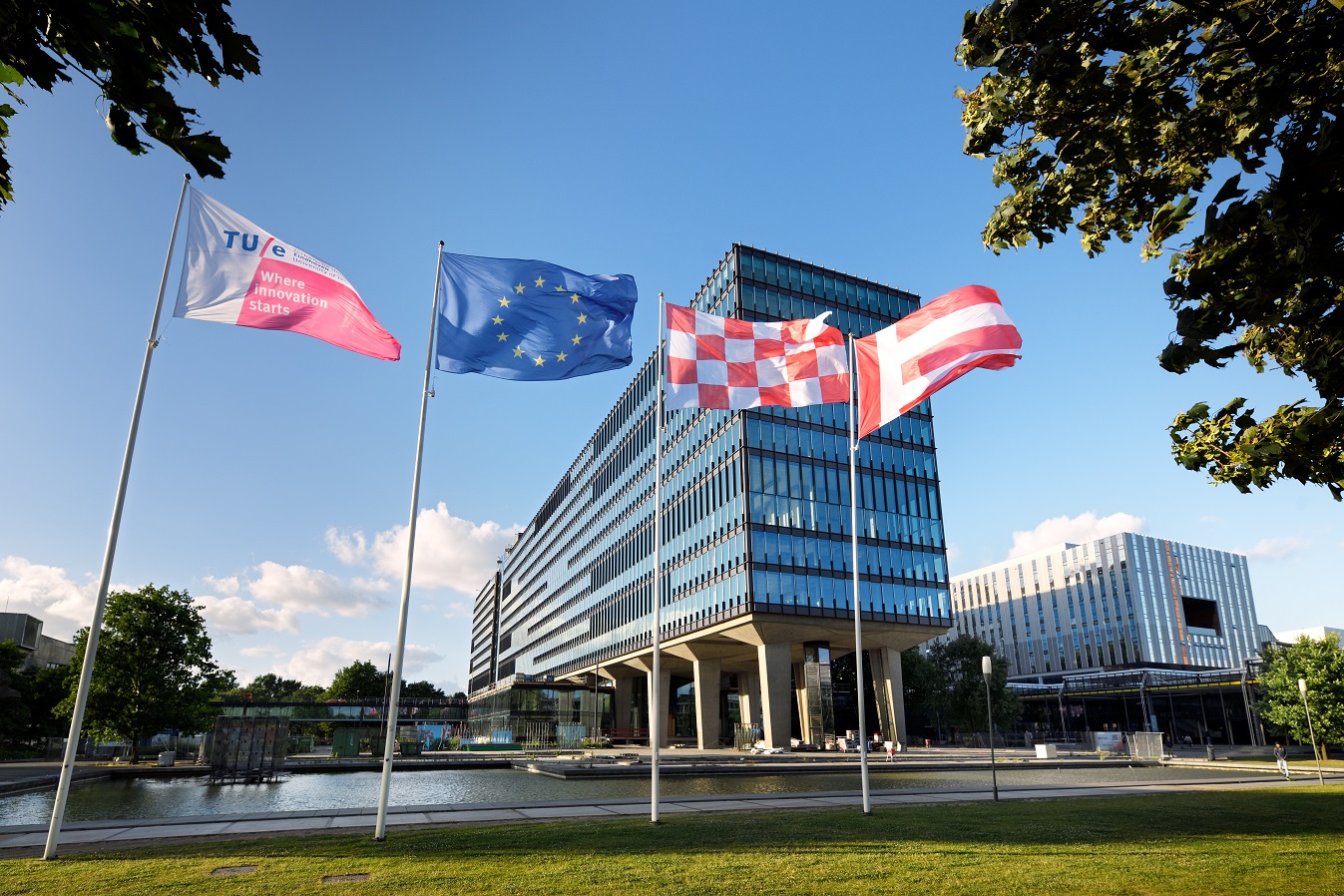
Eindhoven University of Technology (TU/e) is a public technical university founded in 1956, originally named Technische Hogeschool Eindhoven. It is the second technical university in the Netherlands after TU Delft and a European reference point for engineering and technology. In the QS World 2026 ranking it sits at number 140 worldwide and 5th in the Netherlands, but it climbs much higher in the engineering and technology subject areas. The compact, modern campus is right next to Eindhoven station.
What makes TU/e special for an international student is its position in Brainport Eindhoven, one of the densest technology ecosystems in Europe. This is home to the headquarters of ASML (the world leader in the photolithography machines that produce chips) and the roots of Philips, plus hundreds of deep-tech companies. The university works directly with industry through internships, projects and joint research, and many graduates stay to work in the region.
TU/e has around 14,000 students and a large international community. It offers 15 bachelor's programmes, of which almost all are taught entirely in English: Computer Science and Engineering, Data Science (a joint programme with Tilburg University), Electrical Engineering, Mechanical Engineering, Industrial Engineering, Applied Mathematics, Applied Physics, Chemical Engineering and Chemistry, Biomedical Engineering, Automotive Technology, Industrial Design, Architecture, Sustainable Innovation, Psychology & Technology and Medical Sciences and Technology. For a student who wants engineering at a European level, without the Dutch language barrier, the offer is a very good fit.
For EU students, TU/e is one of the best opportunities in Europe. As an EU citizen you pay the statutory EU fees set by the Dutch government, around €2,694 per year, compared with the institutional fee for non-EU students that exceeds €18,000 per year. Bachelor's programmes last 3 years (180 ECTS), in line with the Bologna system. Applications go through the Dutch national platform Studielink, and some programmes have selection (numerus fixus) with an additional procedure. A TU/e degree opens up the labour market across the whole EU without a visa.
How to apply to TU Eindhoven
Choose your programme and check selection
TU/e has 15 bachelor's programmes, almost all in English. Check on the programme page whether it has numerus fixus (selection with a limited number of places) or direct admission. Some programmes require an additional step: a cognitive aptitude test, matching or interview. The deadline for programmes with selection is usually 15 January, earlier than the others.
Create an account and apply on Studielink
Applying to any Dutch university is done centrally through Studielink, the national portal. You create an account with a DigiD code or as an international applicant, select TU/e and your desired programme. After this step, you receive instructions to upload your documents into the university's internal system (Osiris, the TU/e application).
Prepare your academic file
For engineering programmes you need a science-track high school diploma, with mathematics at a high level (and physics or chemistry, depending on the programme). You upload your high school diploma or certificate, a translated transcript and, where required, proof of your mathematics level. TU/e assesses equivalence with the Dutch VWO diploma.
Prove your English (IELTS or TOEFL)
Since the programmes are in English, you need proof of language: IELTS Academic minimum 6.0-6.5 (generally 6.0 in each component) or TOEFL iBT 90 plus, or Cambridge C1 Advanced. Check the exact threshold on the programme page, it can differ slightly. Plan your test early so you meet the application deadlines.
Register as an EU citizen (BSN)
As an EU citizen you do not need a study visa. After arriving in Eindhoven, you register at the city hall (gemeente) in the BRP register and receive a BSN (Burgerservicenummer), the Dutch personal number needed for a bank account, insurance and a job. You need a passport or ID card, proof of admission and a housing contract.
Enrolment and paying EU tuition
After admission, you complete enrolment through Studielink: you prove EU citizenship to receive the statutory EU fee (around €2,694 per year), pay tuition in instalments via direct debit and confirm your housing. The academic year starts on 1 September. Arrange housing early, Eindhoven has a competitive market for student accommodation.
Costs for EU students
Statutory EU tuition (EU citizens)
Total cost over 3-year bachelor's (all in)
Statutory EU fee
As an EU citizen, you automatically pay the statutory EU fee (around €2,694 per year), identical to that of a Dutch student. You do not have to do anything special, just prove your EU citizenship with a passport or ID card. The non-EU fee exceeds €18,000 per year, so the saving is over €15,000 annually simply through your EU citizen status.
European scholarships
Studiefinanciering (DUO): as an EU citizen who works part-time at least around 56 hours per month you can become eligible for Dutch financial support and for the transport pass. Erasmus+: if you come on an academic exchange for 1-2 semesters, you receive a monthly grant. Holland Scholarship and TU/e's own scholarships for international students round out the offer for those with strong results.
Scholarships from home
As a student admitted to a European university, you may be eligible for scholarship programmes offered by your home country's education ministry or your local city hall (many cities have scholarships for their students studying abroad). Check with your local authority. Important: these scholarships can be combined with Dutch support, but are applied for separately.
Want to apply to TU Eindhoven?
We help you choose the right engineering programme, check numerus fixus selection, apply correctly on Studielink and take advantage of the statutory EU fee (around €2,694 per year). Our mentors have been through the process. Your first mentoring session is 100% free.
Talk to a mentorFrequently asked questions
Where does TU Eindhoven rank?
TU/e is 140th in the world in QS World 2026 and 5th in the Netherlands in the overall ranking. In the engineering and technology subject areas it climbs significantly higher. It is the second technical university in the Netherlands after TU Delft and a European reference point for engineering, especially thanks to its direct link with industry in Brainport Eindhoven (ASML, Philips). For students interested in engineering taught in English, it is a very solid option.
Exactly how much does TU Eindhoven cost for EU students?
As an EU citizen, you pay the statutory EU fee set by the Dutch government: €2,694 in 2026-27, so around €2,700 per year. For comparison, a non-EU student pays the institutional fee that exceeds €18,000 per year at bachelor's level. Housing in Eindhoven: €450-€750/month. Food: €250-€350/month. Transport: ~€40-€60/month. Total cost over 3 years of a bachelor's, all in: around €45,000-€55,000, drastically lower than the UK or the United States. Bachelor's programmes at TU/e last 3 years (180 ECTS).
Are TU Eindhoven's bachelor's programmes in English?
Yes, almost all 15 TU/e bachelor's programmes are taught entirely in English. This includes Computer Science and Engineering, Data Science (a joint programme with Tilburg University), Electrical Engineering, Mechanical Engineering, Industrial Engineering, Applied Mathematics, Applied Physics, Chemical Engineering and Chemistry, Biomedical Engineering, Automotive Technology, Industrial Design, Architecture, Sustainable Innovation, Psychology & Technology and Medical Sciences and Technology. You do not need Dutch to study at TU/e, only proof of your English level (IELTS or TOEFL). You can learn Dutch optionally along the way, it is useful for part-time jobs and daily life. WIB note: the Dutch Wet internationalisering in balans law, currently being phased in, aims to rebalance internationalisation and may gradually reduce some English-taught programmes; check the exact language of your programme when you apply.
How do I apply to TU Eindhoven through Studielink?
Applying to any Dutch university, including TU/e, is done centrally through Studielink, the national portal. The steps: 1) Create an account on Studielink (as an international applicant or with DigiD). 2) Select TU/e and your desired programme. 3) Receive instructions to upload your documents into the university's internal system (Osiris): high school diploma, translated transcript, proof of English. 4) For programmes with selection (numerus fixus) you complete the additional procedure. Deadline: 15 January for programmes with selection, later for the rest (check on the programme page).
What is numerus fixus and which programmes have selection?
Numerus fixus means a programme has a limited number of places and applicants are selected through an additional procedure, rather than admitted automatically. At Dutch universities, popular programmes can have selection: it may include a cognitive aptitude test, assessment of grades, motivation or an interview. The deadline for these programmes is usually 15 January, earlier than the standard one. The other programmes have admission based on meeting the academic requirements (high school diploma with mathematics at the required level, proof of English). Always check on the programme's official page whether it has numerus fixus.
What grades and what high school diploma do I need for engineering at TU/e?
For engineering programmes you need a science-track high school diploma, with mathematics at a high level and, depending on the programme, physics or chemistry. TU/e assesses the equivalence of your diploma with the Dutch VWO diploma and checks whether you have covered the necessary subjects at the required level. There is no single public cutoff as in Spain; what matters is meeting the subject requirements plus proof of English (IELTS 6.0-6.5 or TOEFL 90 plus). For programmes with numerus fixus, good grades and a clear technically oriented profile help in selection. Recommendation: a good average in mathematics and physics in high school and a solid IELTS score.
What advantage does Brainport Eindhoven offer a future engineer?
Brainport Eindhoven is one of the densest technology ecosystems in Europe. This is home to the headquarters of ASML (the world leader in the machines that produce chips) and the roots of Philips, plus hundreds of deep-tech companies, startups and research centres. TU/e works directly with these companies through internships, applied projects and joint research, which means access to practical experience while still at university. Many TU/e graduates stay to work in the region. For a future engineer, it is one of the best geographical positions in Europe for a tech career.
Can I stay in the Netherlands or the EU after graduating from TU/e?
Yes, as an EU citizen you have the automatic right to work in the Netherlands without a visa. The Netherlands has a strong need for engineers, and the Eindhoven region concentrates strong demand in semiconductors, software, automotive and high-tech. Starting salaries for TU/e engineers: generally €40,000-€55,000 gross per year in tech and engineering, with rapid progression. The Netherlands also has the 30 percent ruling tax facility for certain employees, although the conditions have changed over time. In addition, with an EU-recognised degree, you can work in any country in the Union without a visa. The international community in the Netherlands is growing, especially in cities with tech hubs.
Our mentors from Europe
They studied at Bocconi, Sciences Po, TU Delft, ETH Zurich and other EU universities. Now they guide you.

