
TU Delft
The oldest and largest technical university in the Netherlands, founded in 1842. QS World 2026 number 47, number 1 technical in the Netherlands, with engineering and architecture among the strongest in the world (Architecture QS number 3 worldwide). Around 28,000 students, about 7,000 international from over 150 countries. As an EU citizen you pay the statutory EU fee (EUR 2,694 per year, ~EUR 1,300 the first year), not the EUR 17,000 plus a non-European pays. Most relevant programmes are in English. Motto: "Challenge the Future".
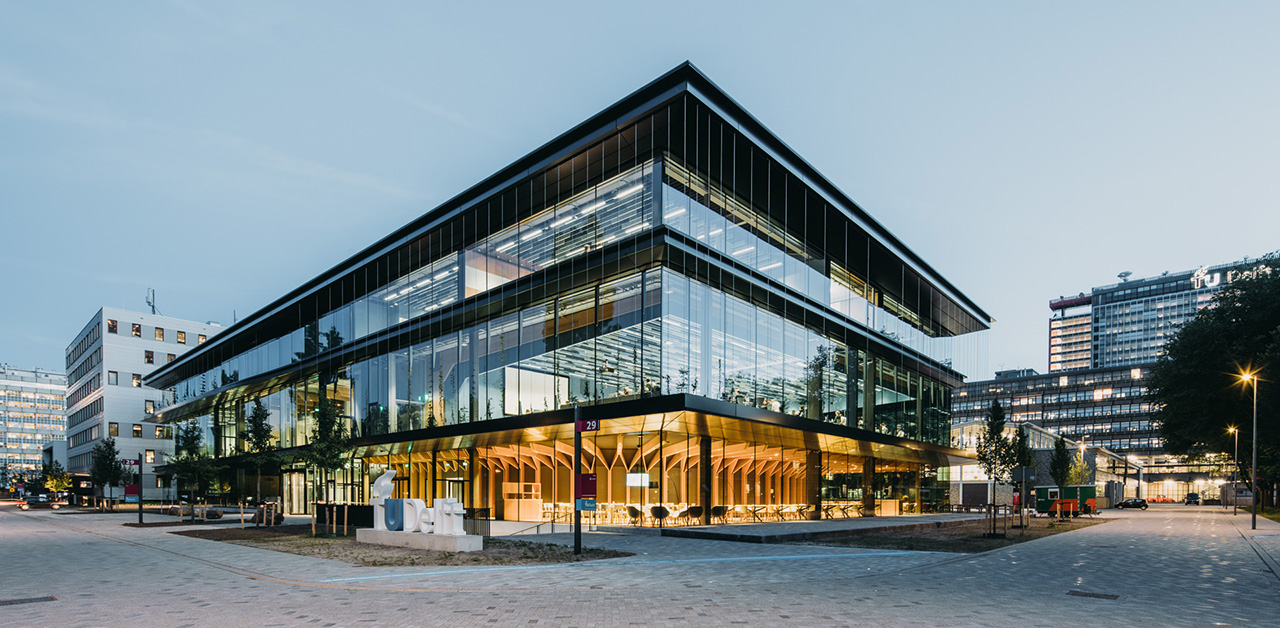
About TU Delft
TU Delft (Delft University of Technology) is a public technical university founded in 1842 by King Willem II of the Netherlands as a royal academy for training engineers. With over 180 years of tradition, it is the oldest and largest technical university in the Netherlands and one of the global references in engineering, technology and architecture. Its motto, "Challenge the Future", sums up its orientation toward applied innovation.
In the QS World 2026 ranking, TU Delft is number 47 worldwide and number 1 technical in the Netherlands. By field (QS by subject) it is exceptional: Architecture and the Built Environment number 3 worldwide, while in Engineering and Technology it sits consistently in the global top 15, with leading positions in Civil and Structural Engineering, Mechanical, Aerospace, Chemical and Water Resources. For a Romanian student passionate about engineering or architecture, it is one of the most serious destinations in Europe.
The main campus is in the city of Delft, between The Hague and Rotterdam, in the heart of the Randstad region. The university has 8 faculties, around 28,000 students (about 14,000 at bachelor's and 13,000 at master's level) and around 7,000 international students from over 150 countries. It offers 16 bachelor's programmes (BSc) and around 40 master's programmes (MSc). Under the European Bologna system: the bachelor's takes 3 years (180 ECTS), the master's usually 2 years.
For Romanian students, TU Delft has two major advantages. First, anglophone: master's programmes are almost entirely in English, and several bachelor's programmes are 100 percent in English (Aerospace Engineering, Computer Science and Engineering, Nanobiology, Applied Earth Sciences and others) or bilingual. Second, the EU fee: as an EU citizen you pay the statutory fee of EUR 2,694 per year (2026-27), and through the Dutch law that halves the first year (Wet halvering) you pay only around EUR 1,300 in the first year. A non-EU student pays around EUR 17,000 plus per year for a bachelor's. Many bachelor's programmes, however, have Numerus Fixus (a limited number of places) and selection, so your application matters.
How to apply to TU Delft
Choose the programme and check Numerus Fixus
TU Delft has 16 bachelor's programmes (BSc). Several are 100 percent in English (Aerospace Engineering, Computer Science and Engineering, Nanobiology, Applied Earth Sciences). Note: many have Numerus Fixus (limited places) plus selection, so you don't get in on grades alone. Check early whether your programme has Numerus Fixus and what selection criteria it uses.
Register on Studielink (max 4 programmes)
Applying to any Dutch university is done centrally through Studielink, the national portal. For Numerus Fixus programmes you can choose a maximum of 2 Numerus Fixus programmes at the same time, and a maximum of 4 enrolment requests in total. Deadline for Numerus Fixus: usually 15 January, much earlier than programmes with no cap on places.
Prove your English (IELTS 6.0-6.5)
For programmes in English you need proof of your level: IELTS Academic 6.0-6.5 (with minimums per component), TOEFL iBT equivalent or Cambridge C1 Advanced. The Romanian Baccalaureate does not replace the test. Check the exact threshold of the chosen programme, some require 6.5 with a minimum of 6.0 in each section.
Submit the selection file
For programmes with selection, after registering on Studielink you upload the selection file: transcript, predicted grades, motivation letter, sometimes a test or an online assessment (matching). For Architecture a portfolio or a specific assessment may be required. The quality of your high-school mathematics and physics carries a lot of weight.
Registration as an EU citizen (BSN)
As a Romanian (EU) citizen you do not need a visa or study permit. After arriving in the Netherlands you register at the town hall (gemeente) and receive the tax code BSN (Burgerservicenummer), needed for a bank account, insurance and a part-time job. You need proof of admission, a passport or ID card and an address.
Enrolment and tuition payment
After acceptance you finalise enrolment on Studielink and pay the statutory EU fee (€2,694/year, ~€1,300 the first year through Wet halvering), via a payment authorisation in instalments (digital direct debit) or in full. Start: the academic year begins on 1 September. Arrange accommodation early, in Delft the market is in very high demand.
Costs for Romanians
EU tuition 2026-27 (EU citizens)
Cost of living in Delft (estimate)
Statutory EU fee
As an EU citizen you automatically pay the statutory EU fee (€2,694/year, ~€1,300 the first year through Wet halvering), identical to that of a Dutch student. Nothing special is required, just proof of Romanian citizenship via passport or ID card. Compared with the ~€17,000 plus a non-EU student pays, that means over €14,000 in savings per year simply because you are an EU citizen.
NL scholarships
Holland Scholarship: a grant for international students (usually in the first year). Justus and Louise van Effen Scholarship: a TU Delft excellence scholarship. Erasmus plus: a monthly grant if you come on an academic exchange. As an EU citizen you can also apply for Dutch DUO funding and for the student public-transport pass, if you work part-time in the Netherlands.
Netherlands scholarship
As a Romanian student, you are eligible for the scholarships of the Romanian Ministry of Education dedicated to studies abroad, if you secure admission to a public university in the Netherlands. Many town halls and county councils in Romania also have scholarship programmes for students. Important: these scholarships apply in parallel and can be combined with the Dutch ones.
Want to apply to TU Delft?
We help you choose the right programme, check Numerus Fixus and selection, apply correctly on Studielink, prepare your file and IELTS, and make the most of the EU fee (€2,694/year, ~€1,300 the first year). Our mentors have been through the process. The first mentoring session is 100% free.
Talk to a mentorFrequently asked questions
How hard is it to get into TU Delft as a Romanian?
It depends a lot on the programme. Many TU Delft bachelor's programmes have Numerus Fixus (a limited number of places) plus selection, so you don't get in on grades alone. Programmes such as Aerospace Engineering, Computer Science and Engineering, Architecture, Clinical Technology or Nanobiology are among the most sought-after and competitive. Mathematics and physics from high school count strongly, along with the motivation letter and (for some) a test or matching. For Romanians, a solid profile: a Baccalaureate average of 9 plus, high grades in maths and physics, IELTS 6.0-6.5 and a clear motivation for the technical field.
How much does TU Delft cost for Romanians exactly?
As an EU citizen you pay the statutory EU fee: EUR 2,694 per year (2026-27). Through the Dutch law that halves the first year (Wet halvering collegegeld) you pay only around EUR 1,300 in the first year. Across all 3 years of the bachelor's (180 ECTS) the total EU tuition is around EUR 6,700-EUR 7,300. A non-EU student pays around EUR 17,000 plus per year for the same bachelor's. Cost of living in Delft: accommodation EUR 450-EUR 800/month, food EUR 250-EUR 350/month, insurance ~EUR 130/month, transport and miscellaneous ~EUR 100-EUR 150/month. Total per year with living included: around EUR 13,000-EUR 17,000, drastically below the UK or USA.
What is Numerus Fixus and how does it affect applying?
Numerus Fixus means a programme has a fixed, limited number of places per year. When demand exceeds the places, the university runs a selection procedure (decentralised), based on grades, the motivation letter and sometimes a test. For Numerus Fixus programmes, the Studielink registration deadline is earlier, usually 15 January, and the selection result comes in April. You can apply to a maximum of 2 Numerus Fixus programmes at the same time. At TU Delft, programmes such as Aerospace Engineering, Computer Science and Engineering, Architecture or Clinical Technology usually have Numerus Fixus.
Are the bachelor's programmes at TU Delft in English?
A significant share, yes. Several bachelor's programmes are 100 percent in English: Aerospace Engineering, Computer Science and Engineering, Nanobiology, Applied Earth Sciences and others. Some bachelor's programmes are bilingual (English plus Dutch) or taught in Dutch. At master's level, the offer is almost entirely in English (~40 MSc programmes). For any programme in English you need IELTS 6.0-6.5 or equivalent. Check the exact language of the programme on its official page before applying. WIB note: the Dutch Wet internationalisering in balans law, currently being phased in, aims to rebalance internationalisation and may gradually reduce some English-taught programmes; check the exact language of your programme when you apply.
How do I apply through Studielink and how many programmes can I choose?
Studielink is the Dutch national portal through which you apply to any university. You create an account, choose the programme and university, then upload the documents required by TU Delft. You can submit a maximum of 4 enrolment requests in total, but for Numerus Fixus programmes you can choose a maximum of 2 at the same time. Deadlines: Numerus Fixus programmes usually have a deadline of 15 January; those with no cap on places have a later deadline (often 1 May for EU citizens). Recommendation: prepare your file and IELTS from the autumn, so you don't miss the January deadline.
Is the Romanian Baccalaureate accepted at TU Delft?
Yes. The Romanian Baccalaureate diploma is recognised as an access diploma for the bachelor's, provided you cover the specific subject requirements of the chosen programme. For technical programmes TU Delft usually requires a good level in Mathematics and, frequently, Physics or Chemistry, depending on the specialisation. The Baccalaureate does not replace the English test (IELTS 6.0-6.5). For Numerus Fixus programmes with selection, high-school grades (especially in maths and physics) carry a lot of weight in the ranking. Check the exact subject requirements and thresholds on the programme's official page.
Do I need a visa to study in the Netherlands as a Romanian?
No. As a Romanian (EU) citizen you do not need a visa or study permit for the Netherlands. After arriving you register at the town hall (gemeente) and receive the BSN (Burgerservicenummer) code, needed for a bank account, health insurance and any part-time job. You automatically have the right to work in the Netherlands without a permit. You need valid health insurance (the European Health Insurance Card at first, and if you work part-time, mandatory Dutch insurance). The process is much simpler than for destinations outside the EU.
Can I stay in the Netherlands to work after graduation?
Yes, as an EU citizen you automatically have the right to work in the Netherlands without a visa or work permit. The Netherlands has a very strong tech and engineering market: ASML, Philips, Shell, NXP, Booking.com, plus a dense startup ecosystem in the Randstad area (Delft, The Hague, Rotterdam, Amsterdam, Eindhoven). TU Delft graduates in engineering, CS and architecture are highly sought-after, with starting salaries frequently EUR 38,000-EUR 55,000 gross per year in technical fields. English is enough for many tech jobs, although Dutch helps. With a TU Delft diploma recognised across the EU, you can work anywhere in Europe without a visa.
Our mentors from Europe
They studied at Bocconi, Sciences Po, TU Delft, ETH Zurich and other EU universities. Now they guide you.


