
Sapienza Università di Roma
Founded in 1303 by the papal bull of Boniface VIII, the oldest university in Rome and one of the largest in Europe. QS World 2026 ranked number 128 (its best position ever) and number 1 worldwide in Classics and Ancient History for the sixth consecutive year. Around 110,000 students, more than 11,000 international. As an EU citizen with an ISEE certificate, tuition is reduced based on income (roughly EUR 0 to EUR 2,800 per year).
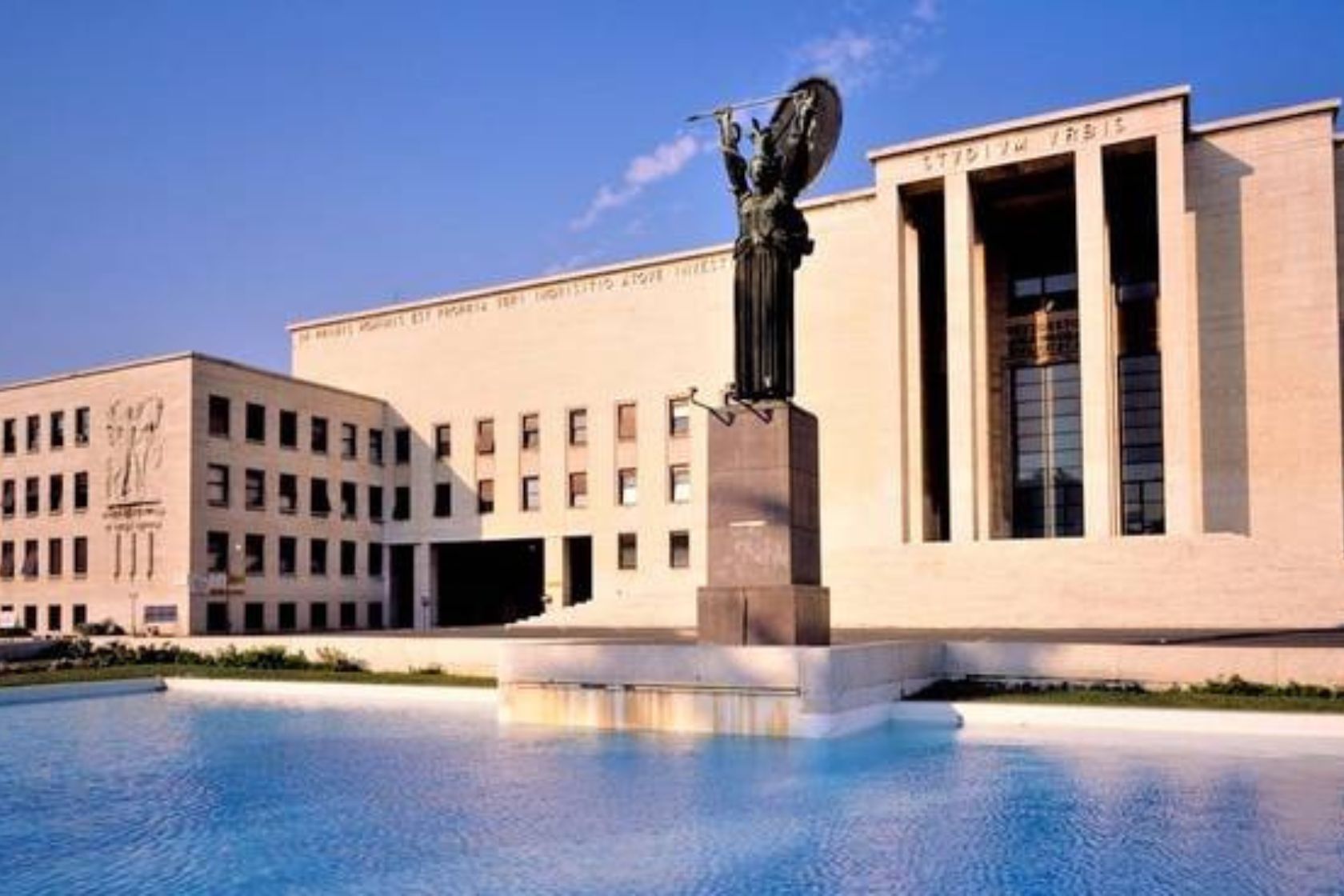
About Sapienza Università di Roma
Sapienza Università di Roma is a public university founded in 1303 by the papal bull In Supremae praeminentia Dignitatis, issued by Pope Boniface VIII. It is the oldest university in Rome and, with around 110,000 students, one of the largest universities in Europe. The main campus, Città Universitaria, designed in the 1930s, is an academic city in its own right, in the heart of the Italian capital.
In the QS World University Rankings 2026 edition, Sapienza is number 128 worldwide, its best position ever, the top generalist university in Italy and the second in the country after Politecnico di Milano. For graduate employability it is number 1 in Italy (number 92 worldwide). The university is a global powerhouse in QS by Subject: number 1 worldwide in Classics and Ancient History for the sixth consecutive year, the only Italian university to hold such a leading global position, plus a presence in the top 10 in Archaeology and History of Art.
Strong specializations at Sapienza: archaeology and classical studies (a global reference), physics (Enrico Fermi taught here), engineering, medicine (with the affiliated Policlinico Umberto I), plus history of art, social sciences, law, economics and architecture. Sapienza has more than 270 programs at bachelor's and master's level, of which around 59 taught entirely in English (bachelor's and master's) and more than 240 in Italian. The university awards more than 1,500 scholarships and grants each year for EU and non-EU students.
For Romanian students, Sapienza is one of the most accessible opportunities in Europe. As an EU citizen you pay EU fees, and the annual fee is calculated based on the ISEE income certificate: families with low income may pay as little as EUR 0, while the typical ceiling reaches up to roughly EUR 2,800 per year for higher incomes. The Romanian Baccalaureate is recognized for admission (with a Dichiarazione di Valore or an equivalence certificate). Applications go through the national platform Universitaly, and many programs require an admission test (often a TOLC administered by CISIA) or, for English-taught programs, proof of B2 level English. Rome offers a lower cost of living than the major capitals of Western Europe, with a huge international student community.
How to apply to Sapienza
Pre-enrollment on Universitaly
The first mandatory step for all international students: pre-enrollment on the national platform Universitaly. You choose Sapienza and your desired program, and upload your Baccalaureate diploma and transcript. The typical deadline is the end of June. As an EU citizen you do not need a visa, but the Universitaly file remains the basis for recognition of your diploma.
Take the admission test (TOLC or Sapienza test)
Many programs have restricted access and require a test. The most common is a TOLC (Test On Line CISIA), for example TOLC-I for engineering or English TOLC-E for economics, which can be taken online or at a CISIA center. Clinical and architecture programs may have a national test or a Sapienza-specific one. Check the program page to see which test and date are required.
Calculate ISEE for reduced tuition
Tuition at Sapienza is set based on the ISEE certificate (the family income indicator). You obtain it from a CAF (tax assistance center) or on the INPS website. It must be prepared at least 30 days before the pre-enrollment deadline. Without ISEE you pay a higher flat fee; with ISEE submitted, low-income families can reach EUR 0.
Prove the language (Italian CILS B2 or English)
For Italian-taught programs you need B2 level, proven through certificates such as CILS, CELI or PLIDA (or the Italian test organized by Sapienza). For English-taught programs you need B2 English: IELTS 5.5-6.0, TOEFL iBT 80 or a Cambridge equivalent. Sapienza offers Italian courses for international students.
Registration in Italy and codice fiscale
As an EU citizen, you do not need a study visa. On arrival in Rome you obtain your codice fiscale (the Italian tax code, the equivalent of the CNP, issued free of charge by the Agenzia delle Entrate), required for enrollment, rental contract and bank account. For stays longer than 3 months you register with the municipality (iscrizione anagrafica) and arrange health insurance (the European health card or private cover).
Enrollment (immatricolazione)
After admission is confirmed you complete the immatricolazione on Sapienza's Infostud portal: you upload your documents, submit the ISEE certificate and pay the first installment of the fee (the regional tax plus the contribution calculated on ISEE). The academic year generally begins at the end of September or the start of October. Arrange accommodation in good time, as Rome has a competitive rental market, plus dormitory options through DiSCo Lazio.
Costs for Romanian students
EU tuition 2026-27 via ISEE (EU citizens)
Annual cost of living in Rome (estimate)
EU fees via ISEE
As a Romanian (EU) citizen, you pay EU fees identical to those of an Italian. The key is the ISEE certificate: with it submitted on time, the contribution drops based on family income, from EUR 0 for low incomes up to the ceiling of roughly EUR 2,800 per year. ISEE is mandatory for any reduction.
Regional scholarships
DiSCo Lazio (the regional agency for the right to study) offers scholarships based on ISEE income and merit, which can cover the fee, meals and sometimes dormitory accommodation. Sapienza awards more than 1,500 scholarships and grants each year for EU and non-EU students, plus fee waivers for good results.
Italy scholarship plus Erasmus
As a Romanian student, you are eligible for scholarships from the Romanian Ministry of Education for studies at public universities in the EU and for the Erasmus plus mobility programs (a monthly grant if you come on an academic exchange). Also check the scholarship programs of your local council in Romania; many can be combined with the Italian ones.
Want to apply to Sapienza?
We help you complete pre-enrollment on Universitaly, prepare for the TOLC test, obtain the ISEE certificate for reduced tuition and choose the right program (in Italian or English). Our mentors have been through the process. The mentoring session is 100% free.
Talk to a mentorFrequently asked questions
How hard is it to get into Sapienza as a Romanian?
It depends a lot on the program. Many programs have open access (you enroll and start), while others have restricted access (numero programmato) with an admission test. The most competitive programs are Medicine and Dentistry (national test, very selective) and Architecture. For engineering you usually take TOLC-I, and for economics English TOLC-E. For Romanians, the basis is recognition of the Baccalaureate through the Universitaly file. A good Baccalaureate average plus a solid TOLC score secures your place in most programs.
How much does Sapienza cost for Romanians exactly?
As an EU citizen, you pay EU fees, and the annual contribution is calculated based on the ISEE certificate (family income). Low-income families can pay EUR 0, while the typical ceiling rises to roughly EUR 2,800 per year for higher incomes. Important: ISEE is mandatory for reduced tuition; without it you pay a higher flat fee. Cost of living in Rome: accommodation EUR 400 to EUR 700/mo, food EUR 250 to EUR 350/mo, transport EUR 25 to EUR 35/mo. Total cost of living: approximately EUR 9,000 to EUR 13,000 per year, drastically lower than the UK or USA.
What does ISEE mean and why is it mandatory?
ISEE (Indicatore della Situazione Economica Equivalente) is the official Italian certificate that measures your family's economic situation, based on income and assets. At Sapienza, the contribution you pay is calculated directly from ISEE: the lower the declared income, the lower the fee, down to EUR 0.
You obtain it free of charge from a CAF (tax assistance center) or on the INPS website, and it must be prepared at least 30 days before the pre-enrollment deadline. For Romanians whose income is in Romania, there is an ISEE procedure for income earned abroad. Without ISEE submitted on time, the university automatically applies the maximum flat fee, which is why submitting it is the key step to paying little or nothing.
Are Sapienza's programs in English or in Italian?
Most of the more than 270 programs are in Italian (more than 240), but Sapienza also has around 59 programs taught entirely in English, at bachelor's and master's level, especially in economics, engineering, sciences and international relations. For Italian-taught programs you need B2 Italian level (CILS, CELI or PLIDA certificate), and for English-taught ones B2 English (IELTS 5.5-6.0, TOEFL iBT 80 or equivalent). Sapienza offers Italian courses for international students, useful if you want to settle quickly into life in Rome.
What are Sapienza's strongest programs?
Sapienza is a global reference for classical studies and archaeology: it is number 1 worldwide in Classics and Ancient History in QS by Subject for the sixth consecutive year and in the top 10 in Archaeology and History of Art, the first Italian university with three disciplines in the global top 10. Other strengths: physics (Enrico Fermi taught here), engineering, medicine (with Policlinico Umberto I), plus law, economics, social sciences and architecture. For graduate employability, Sapienza is number 1 in Italy.
Is the Romanian Baccalaureate accepted at Sapienza?
Yes. The Romanian Baccalaureate is recognized for admission to bachelor's programs, through the file submitted on Universitaly. You usually need the Baccalaureate diploma and transcript, plus, where applicable, a Dichiarazione di Valore (issued by the Italian consulate) or an equivalence certificate through the ENIC-NARIC / CIMEA network. For some programs the diploma must have been obtained after at least 12 years of schooling, a condition met by the Romanian system. Recommendation: start the recognition procedure in spring, before the end-of-June pre-enrollment deadline.
What is the codice fiscale and how do I get it?
Codice fiscale is the Italian tax code, the equivalent of the Romanian CNP. You need it for almost everything in Italy: enrollment at Sapienza, rental contract, bank account, transport pass. It is issued free of charge by the Agenzia delle Entrate (tax authority) and can sometimes also be obtained through the Italian consulate in Romania before departure.
As an EU citizen, you do not need a study visa. For stays longer than 3 months you register with the Rome municipality (iscrizione anagrafica) and arrange health coverage through the European health card or private insurance.
Can I stay in Italy after graduation?
Yes, as an EU citizen. Unlike the United Kingdom or the USA where you need a work visa, as a Romanian (EU) citizen you have the automatic right to work in Italy without a visa. Italy is the third-largest economy in the eurozone, and Rome and Milan are hubs for engineering, energy, fashion, tourism and the public sector. A degree from Sapienza, recognized across the EU, then lets you work anywhere in the European Union without visa formalities. The Romanian community in Italy is one of the largest in Europe, which makes integration easier.
Our mentors in Europe
They studied at Bocconi, Sciences Po, TU Delft, ETH Zurich and other EU universities. Now they guide you.


