
Università di Bologna
Founded in 1088, the oldest university in the world ("Alma Mater Studiorum", 937 years of tradition). QS World 2026 number 138, number 2 in Italy. Around 90,000 students, one of the largest universities in Italy, with over 200 programmes (about 105 international, many in English). As an EU citizen and through ISEE, tuition can be from €0 up to around €4,000 per year. Motto: "Alma Mater Studiorum".
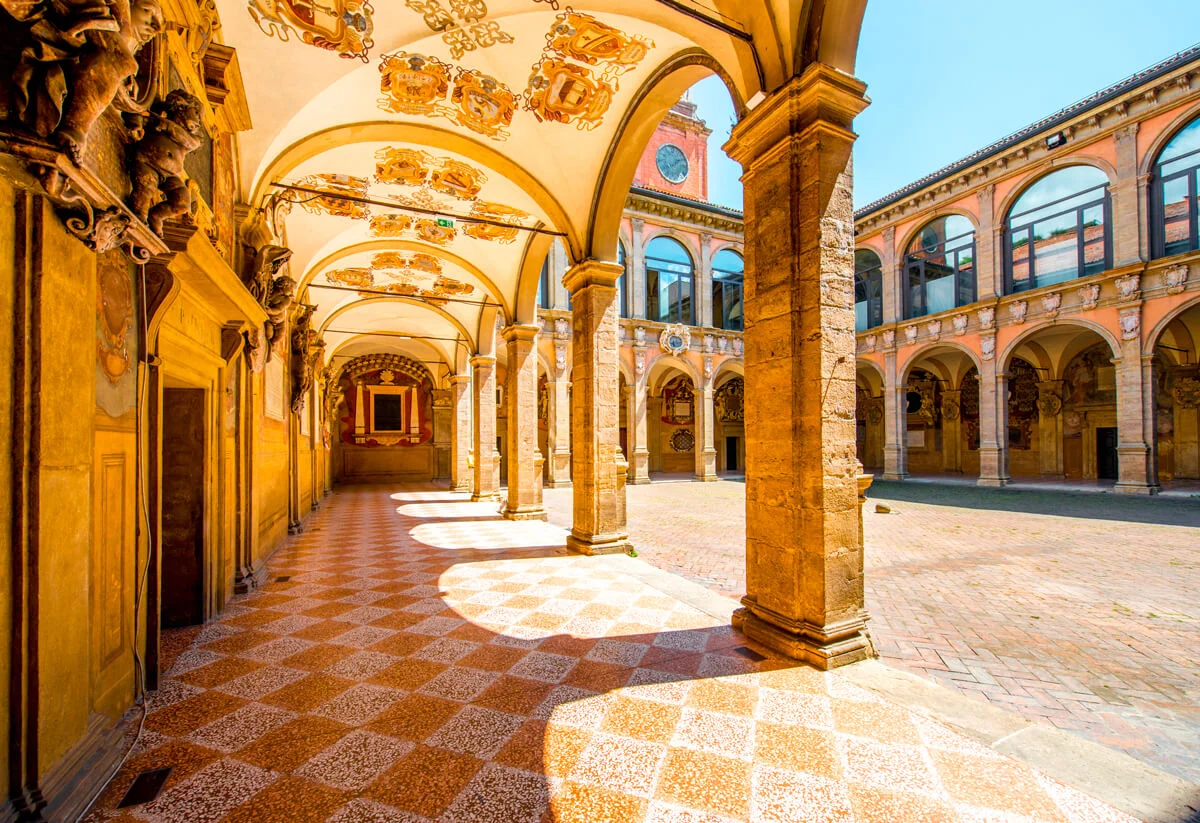
About Università di Bologna
Università di Bologna (UNIBO) is a public university founded in 1088 and recognised as the oldest university in the world in continuous operation. With 937 years of academic tradition, it bears the emblem and motto "Alma Mater Studiorum" (Nourishing Mother of Studies) alongside the year A.D. 1088. It is a comprehensive institution, one of the most prestigious in Italy and a global reference in research and education.
UNIBO is QS World 2026 number 138 and number 2 in Italy (in the top 60 in Europe in the QS Europe ranking). Main location: Bologna, Emilia-Romagna region, with a multicampus system that also includes sites in Cesena, Forlì, Ravenna, Rimini plus a campus in Buenos Aires. It has 31 departments and around 90,000 students, one of the largest universities in Italy, of whom about 7,000 international students are regularly enrolled, plus approximately 3,000 who come each year through mobility programmes such as Erasmus plus. It is a member of the Una Europa and Coimbra Group networks.
Strong programmes at UNIBO: Law (the oldest law faculty in Europe), Political Science and International Relations, Economics and Management, Engineering, Medicine and Surgery, Humanities (History, Philology, Literature, Arts), Agriculture and Food Sciences, Physics and Astronomy, Communication. UNIBO has over 200 programmes at bachelor's and master's level, of which about 105 are international. Many bachelor's degrees are taught in Italian (B2 level required), but UNIBO has an increasingly wide set of programmes in English, especially at master's level and across a number of bachelor's degrees (for example International Studies, Business and Economics, Engineering).
For international students, UNIBO is one of the most accessible prestigious universities in Europe. As an EU citizen you pay EU rates, and fees are calculated through ISEE (the indicator of the family's economic situation). If the family's ISEE is below a threshold (around €27,000), you are fully exempt from the variable part and pay only the fixed fee (~€157 per year plus regional and stamp duty). For higher ISEE, the variable part rises gradually to around €4,000 per year at the upper thresholds. A foreign secondary diploma must be validated through the Dichiarazione di Valore (or the CIMEA alternative), and the application for EU citizens is made through the national Universitaly portal and directly with the university. Cost of living in Bologna: ~€700-€1,000 per month. Important note: bachelor's degrees in Italy last 3 years (180 ECTS), while Medicine lasts 6 years.
How to apply to UNIBO
Register on Universitaly and prepare your file
First step: an account on Universitaly, the national portal of the Italian Ministry of Education for students who want to study in Italy. Here you choose the university (UNIBO) and the programme. As an EU citizen, the process is simpler than for non-EU applicants, but you still need to prepare your file: your secondary school diploma, transcript and identity documents. Recommended timing: start in February-March for the academic year beginning in September-October.
Validate your secondary diploma (Dichiarazione di Valore or CIMEA)
Your foreign diploma must be recognised in Italy. The classic route is the Dichiarazione di Valore in Loco, issued by the Italian Consulate in your country, which confirms the value and nature of your diploma. Alternatively, UNIBO increasingly accepts CIMEA comparability statements (Statement of Comparability), which are faster and online. Check on the programme page which document is required. For EU citizens, the specific non-EU pre-enrolment procedure is not needed.
Take the admission test (TOLC or programme-specific test)
Many bachelor's degrees at UNIBO have admission by test. The most common is the TOLC (Test OnLine CISIA), available in subject variants: TOLC-E (Economics), TOLC-I (Engineering), TOLC-F (Pharmacy), TOLC-SU (Humanities) or the Medicine test. Open-access programmes do not require a test, but may have an assessment of prior knowledge (OFA). You register for the TOLC on the CISIA platform, choose a session and location (it can also be taken in your country or online, TOLC@home). Tip: book a session early, places fill up quickly.
Prove your language (Italian CILS B2 or English IELTS)
For programmes in Italian you need a B2 level of Italian, proven with a certificate such as CILS, CELI, PLIDA or UNIBO's own Italian test. For programmes in English (many at master's level and a number of bachelor's degrees) you need IELTS 6.0-6.5, TOEFL iBT 80-90 or equivalent (Cambridge B2 First/C1 Advanced). UNIBO offers Italian courses for international students in the first year.
Get your codice fiscale and submit ISEE for tuition
To calculate the reduced tuition, you submit ISEE (Indicatore della Situazione Economica Equivalente), the document that reflects your family's economic situation. For income earned abroad there is the ISEE Parificato version. You will also need a codice fiscale (the Italian tax code), which you obtain from the Agenzia delle Entrate or through the Consulate. Important: without ISEE submitted, you pay the maximum fee, so submit it without fail and on time in order to benefit from €0-€4,000 instead of the upper cap.
Enrolment (immatricolazione) and start of studies
After your admission is confirmed, you complete the immatricolazione (the actual enrolment) online on UNIBO's Studenti Online portal. You pay the first fee instalment (the fixed fee plus any variable part depending on ISEE), upload the validation documents and your photo. As an EU citizen, you register with the Anagrafe if you stay longer than 3 months. Start of the academic year: September-October. Tip: arrange your accommodation (ER.GO student housing, colleges or private apartments) at least 2 months in advance, Bologna is a university city with high demand.
Costs for students
EU tuition 2026-27 (calculated through ISEE)
Total cost 3-year bachelor's (all in)
EU rates through ISEE
As an EU citizen, you pay EU rates identical to those of an Italian, calculated through ISEE. With ISEE below the threshold, you are exempt from the variable part and pay almost €0 tuition (only the fixed fee ~€157). For families with modest household income, UNIBO thus becomes one of the cheapest prestigious universities in Europe. Submit ISEE (or ISEE Parificato for income earned abroad) without fail and on time.
European scholarships
The ER.GO grant (Azienda Regionale per il Diritto agli Studi Superiori, Emilia-Romagna): for EU students with a low ISEE, it covers an annual sum plus meals and sometimes free accommodation. UNIBO scholarships (Unibo Study Grants, Action 1 and 2): for international students with strong results, tuition exemption plus a stipend. Erasmus plus: if you come initially on an exchange of 1-2 semesters, you receive between €350-€500 per month.
National study-abroad grants
As an EU student, you may be eligible for study-abroad scholarship programmes from your home country's education ministry if you secure admission to a public European university. Many cities and regions also run support programmes for their students going abroad to study (check with your local or regional authority). Important: these grants can be combined with the Italian ER.GO scholarships, but they must be applied for in parallel.
Want to apply to UNIBO?
We help you register on Universitaly, validate your secondary diploma through the Dichiarazione di Valore or CIMEA, prepare for the TOLC, submit ISEE correctly and take advantage of EU rates (from €0 per year). Our mentors in Europe have been through the process. The mentoring session is 100% free.
Talk to a mentorFrequently asked questions
How hard is it to get into Università di Bologna?
It depends a lot on the programme. Many bachelor's degrees at UNIBO have access by test, most often the TOLC (TOLC-E for Economics, TOLC-I for Engineering, TOLC-F for Pharmacy, TOLC-SU for Humanities) or the national Medicine test, which is the most competitive. Other programmes have open access, with no selection test, but may include an assessment of prior knowledge (OFA). For international applicants, what matters is the validation of your secondary diploma (Dichiarazione di Valore or CIMEA) plus your TOLC result where required. A good secondary-school average (8 plus) and serious preparation for the TOLC give you solid chances at most programmes.
Exactly how much does UNIBO cost?
As an EU citizen, you pay EU rates, and fees are calculated through ISEE (the family's economic indicator). With ISEE below approximately €27,000, you are exempt from the variable part and pay only the fixed fee (~€157 per year) plus regional and stamp duty, so in practice almost €0 tuition. For higher ISEE, the variable part rises gradually to around €4,000 per year. So EU tuition is between €0 and €4,000 per year depending on ISEE. Accommodation in Bologna: €350-€650 per month. Food: €200-€350 per month. Transport: ~€30 per month student pass. Total cost per year: ~€10,000-€14,000. 3-year bachelor's all-in: ~€30,000-€42,000, far below the UK (£180k plus) or the USA ($280k plus). ISEE is mandatory; without it you pay the maximum fee.
What is ISEE and why is it mandatory?
ISEE (Indicatore della Situazione Economica Equivalente) is the official Italian document that reflects your family's economic situation (income plus assets, relative to the number of members). UNIBO, like all Italian public universities, calculates tuition based on ISEE: the lower the ISEE, the lower the fees, up to a full exemption from the variable part below the threshold of approximately €27,000. For income earned abroad there is the ISEE Parificato, calculated by a CAF (tax assistance centre) based on translated income documents. Important: if you do not submit ISEE, you are automatically charged at the maximum cap (~€4,000 per year). That is why ISEE is the mandatory step in order to benefit from the reduced rates.
Are UNIBO's programmes in English?
UNIBO has over 200 programmes, of which about 105 are international, many taught entirely in English. The English-taught offer is widest at master's level, but there are also bachelor's degrees in English (for example International Studies, Business and Economics, certain Engineering programmes). For programmes in English you need IELTS 6.0-6.5, TOEFL iBT 80-90 or equivalent. For most bachelor's degrees in Italian you need a B2 level of Italian, proven with CILS, CELI, PLIDA or UNIBO's test. UNIBO offers Italian courses for international students, useful if you want to apply to programmes in Italian.
What are the strongest programmes at UNIBO?
UNIBO is renowned for: Law (the oldest law faculty in Europe), Political Science and International Relations, Economics and Management (the Bologna, Forlì, Rimini campuses), Engineering (from civil to computer science and automation), Medicine and Surgery, Humanities (History, Philology, Literature, Arts, Philosophy), Agriculture and Food Sciences (the Emilia-Romagna region is the heart of Italian gastronomy), Physics and Astronomy, Communication. UNIBO ranks number 1 in Italy in several subjects in the QS subject rankings. Many of these programmes also have English-taught versions.
What is student life like at UNIBO in Bologna?
Bologna is the oldest university city in the world and one of the liveliest in Italy: a medieval historic centre, porticoes (a UNESCO heritage site), famous gastronomy (tagliatelle al ragù, tortellini, mortadella), an intense student nightlife. Students make up a large part of the city's population, so the atmosphere is young and international. UNIBO has a multicampus system: Bologna (the main seat), plus Cesena, Forlì, Ravenna, Rimini. Getting around the city is done by bus (student pass ~€30 per month) or on foot and by bicycle. A solid international community: ~7,000 international students enrolled plus ~3,000 on mobility, with an active Erasmus Student Network (ESN). Accommodation through ER.GO (regional housing) or private apartments.
Can I stay in Italy after graduating?
Yes, as an EU citizen! Unlike the United Kingdom or the USA where a work visa is needed, as an EU citizen you have the automatic right to work in Italy without a visa. Italy is the 3rd largest economy in the EU, with strong industrial and technology hubs: Emilia-Romagna ("Motor Valley", home to Ferrari, Lamborghini, Ducati), Milan (finance, fashion, design), the industrial north. Main industries: engineering and automotive, fashion and design, agri-food, pharma, tourism, finance. Graduate salaries (indicative, at start): Engineering/IT €28-€40k; Economics/Business €25-€35k; Law €24-€34k; Medicine variable through the residency system. With an EU degree you can work anywhere in the European Union without a visa.
How long is a bachelor's at UNIBO and what about the ECTS system?
Bachelor's degrees (Laurea) at UNIBO last 3 years (180 ECTS), in line with the European Bologna system, a system invented right here and named after the city. ECTS (European Credit Transfer System): 1 ECTS = ~25-30 hours of total study (lectures plus individual work). A standard academic year has 60 ECTS = 2 semesters. After the bachelor's you can continue with a Laurea Magistrale (master's, 2 years, 120 ECTS). Exceptions: Medicine and Surgery lasts 6 years (360 ECTS) as a single-cycle programme, while some programmes (for example Pharmacy, single-cycle Law) last 5 years. Advantage of the ECTS system: you can transfer credits to other European universities, useful for Erasmus exchanges, in which UNIBO is one of the most active universities in Europe.
Our mentors in Europe
They studied at Bocconi, Sciences Po, TU Delft, ETH Zurich and other EU universities. Now they guide you.


