
RCSI University
A university specialised exclusively in medicine and health sciences, founded in 1784 as the Royal College of Surgeons in Ireland. Ranked top 161 worldwide in Medicine (QS Subject 2026) and one of the most international medical schools in the world, with students from more than 95 countries. Campus in central Dublin, taught entirely in English. Motto: "Consilio Manuque".
About RCSI
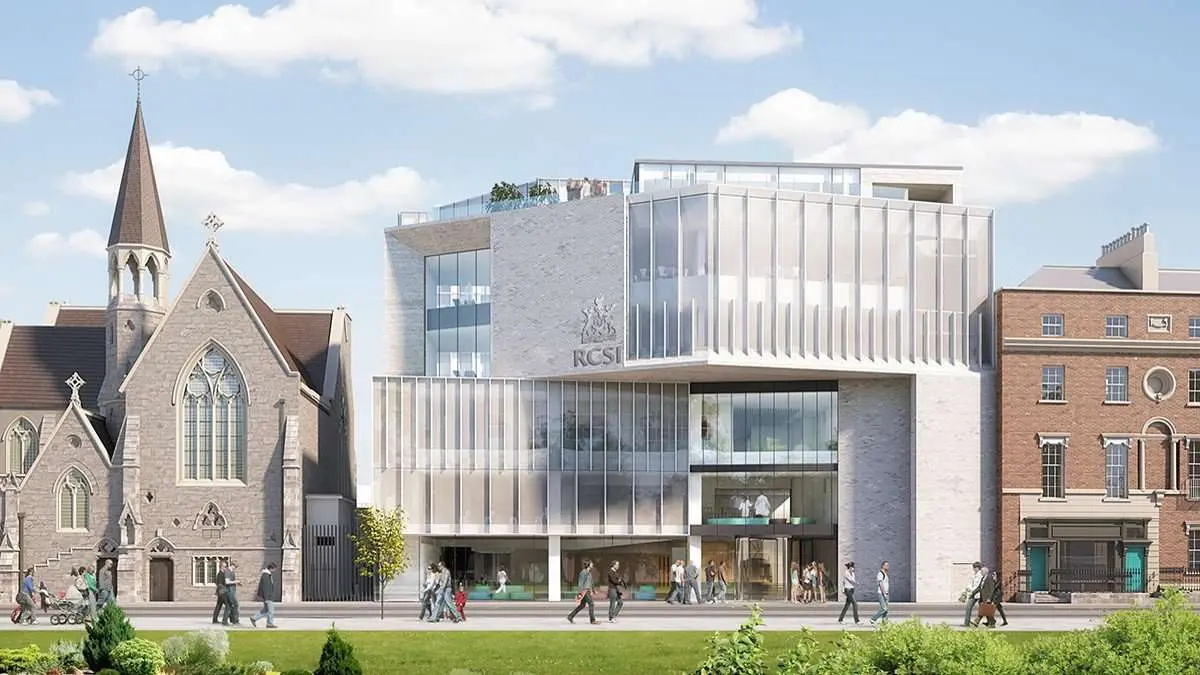
RCSI University of Medicine and Health Sciences (Royal College of Surgeons in Ireland) was founded in 1784 as Ireland's national body for surgical training. Today it is an independent university specialised exclusively in medicine and health sciences, based in the historic building at 123 St Stephen's Green, in central Dublin, on this site since 1810. In December 2019 it was officially granted university status, becoming Ireland's ninth university.
Unlike a general university, RCSI has no faculties of law, business or engineering. Everything taught here is health-related: Medicine (the largest medical school in Ireland), Pharmacy (MPharm, 5 years), Physiotherapy (4 years), Nursing and Midwifery, plus Advanced Therapeutic Technologies and biomolecular sciences. Teaching is delivered entirely in English, which means you do not need to learn an additional foreign language, unlike in Spain, Italy or Germany.
RCSI is one of the most international medical institutions in the world: more than 95 countries are represented in the student body, and a large share of the medicine places are taken by non-EU students. It operates not only in Ireland, but also in the Middle East (Bahrain) and Southeast Asia. On rankings: top 161 worldwide in Medicine (QS World University Rankings by Subject 2026), top 250 worldwide in Medical & Health (Times Higher Education 2026), and at overall university level THE World 2026 places it in the 251-300 band. RCSI was ranked number 1 in the world for SDG3 (good health and well-being) in the THE Impact Rankings 2025.
For Romanian students: the big advantage is English plus your status as an EU citizen. Watch out, though, for a key detail about medicine at RCSI: as an EU citizen you apply through CAO (the Irish national admissions system), and for Medicine you must also sit the HPAT-Ireland test. Medicine at RCSI is highly competitive (in 2025 the combined score required was around 732 points). On fees, the situation depends on the Irish state's Free Fees scheme: if you qualify (EU citizen plus residency of at least 3 of the last 5 years in an EEA state, the typical case for a student from Romania), the state covers your medicine tuition, and you pay only a student contribution plus administrative fees (approximately EUR 3,490 per year, or ~EUR 990 with a SUSI grant). If you do NOT qualify for Free Fees, you pay the EU rate: tuition EUR 6,267 plus fees, a total of ~EUR 9,757 per year. All the figures below are verified on rcsi.com.
How to apply to RCSI (Medicine)
Apply through CAO as an EU citizen
For Medicine, as a Romanian (EU) citizen you apply through CAO (Central Applications Office), the Irish national system, under code RC001 (Undergraduate Medicine). The online application usually runs 5 November - 1 February. For Pharmacy, Physiotherapy or Nursing you also apply through CAO, but under separate codes. (Non-EU students apply directly to RCSI or through agents, not through CAO.)
Sit the HPAT-Ireland test (Medicine only)
For Medicine you must sit the HPAT-Ireland test in February, in the year of admission. HPAT assesses logical reasoning, understanding of interpersonal situations and non-verbal reasoning. The HPAT score is added to the academic score. Note: Pharmacy, Physiotherapy and Nursing do NOT require HPAT, only the CAO academic score.
Convert your Baccalaureate into CAO points
The Romanian Baccalaureate is converted into a score on the Irish scale (Leaving Certificate points), assessed by CAO/RCSI. Medicine is highly competitive: in 2025, the median academic scores of those admitted were 553-565, with HPAT scores of 163-241, and a combined score around 732. You need a Baccalaureate with very strong grades in the relevant subjects (biology, chemistry).
Prove your English
As a non-native speaker, you need proof of English: IELTS Academic 6.5+ (usually no section below 6.5) or equivalent (TOEFL iBT, Cambridge C1). Check the exact requirement for your programme on rcsi.com, since the thresholds can differ between Medicine and the other health programmes.
Check your fee status and Free Fees
First of all, clarify which fees you will pay. As an EU citizen with residency of 3 of the last 5 years in the EEA, you usually qualify for Free Fees (the state covers tuition, you pay ~EUR 3,490/year in contribution and fees). If you do not meet the residency condition, you pay the EU rate (~EUR 9,757/year). RCSI classifies every applicant; check early so you avoid surprises.
CAO offer and enrolment
Offers are made through the CAO rounds (usually from August), based on your combined score. If you receive a place, you accept the offer online, pay the student contribution plus fees and enrol. As an EU citizen you do not need a study visa for Ireland. Arrange accommodation in Dublin early, the rental market is very tight.
Medicine costs (honest)
Medicine, EU citizen with Free Fees 2026-27
Medicine, EU citizen WITHOUT Free Fees
Free Fees
If you are an EU/EEA citizen with residency of at least 3 of the last 5 years in the EEA and you are on your first undergraduate programme, the state covers tuition. You pay only the student contribution plus administrative fees (~EUR 3,490/year). The key condition is residency, not just citizenship.
SUSI
The state SUSI grant (Student Universal Support Ireland) can cover the student contribution for families with income below a threshold. Combined with Free Fees, the annual cost of medicine can drop towards ~EUR 990. You apply separately, in parallel with CAO.
Aim High
RCSI offers scholarships such as the Aim High Medicine Scholarships, designed to reduce the financial burden for certain students entering Medicine through CAO. There are also separate international scholarships. Check the current criteria on rcsi.com, since eligibility varies from year to year.
Want to study medicine at RCSI?
We help you understand exactly your fee status (Free Fees vs EU rate), prepare for HPAT, apply correctly through CAO and maximise your combined score. Our mentors in Europe have been through the process. The first mentoring session is 100% free.
Talk to a mentorFrequently asked questions
How much does medicine at RCSI cost for a Romanian, honestly?
It depends on the Irish state's Free Fees scheme. If you qualify (EU citizen plus residency of at least 3 of the last 5 years in the EEA, the typical case for a student from Romania), the state covers your medicine tuition and you pay only the student contribution plus fees: approximately EUR 3,490 per year, or ~EUR 990 if you also qualify for the SUSI grant.
If you do NOT meet the residency condition, you pay the EU rate: tuition EUR 6,267 plus fees, a total of ~EUR 9,757 per year. For comparison, a non-EU student pays around EUR 61,000 per year in tuition alone. All figures are those published by RCSI for 2026-27. Recommendation: check your fee status before you apply, because it makes the difference between ~EUR 3,490 and ~EUR 9,757 per year.
How do I apply to medicine at RCSI as an EU citizen?
As a Romanian (EU) citizen you apply through CAO (Central Applications Office), the Irish national admissions system, under code RC001 (Undergraduate Medicine). The online application usually runs 5 November - 1 February. In addition, for Medicine you must sit the HPAT-Ireland test in February. Your final score is a combination of academic score (from the Baccalaureate, converted) plus the HPAT score.
Important to know: non-EU students do NOT apply through CAO, but directly to RCSI or through agents. For you, as an EU citizen, the standard route is CAO plus HPAT.
What is HPAT and is it mandatory?
HPAT-Ireland (Health Professions Admission Test) is an aptitude test required for admission to Medicine in Ireland. It assesses logical reasoning, understanding of interpersonal situations and non-verbal reasoning. It is taken in February, in the year of admission, and the score is added to the academic score.
HPAT is mandatory only for Medicine. For Pharmacy, Physiotherapy or Nursing at RCSI you do not need HPAT, only the CAO academic score. If you are aiming for medicine, preparing for HPAT is a serious part of the application, because it can make the difference for such a competitive programme.
How hard is it to get into medicine at RCSI?
Very hard. Medicine at RCSI is among the most competitive programmes in Ireland. In 2025, admitted candidates had median academic scores of 553-565 points (on the Leaving Certificate scale), HPAT scores between 163 and 241, and a combined score around 732. For Romanians, that means a Baccalaureate with very strong grades in the relevant subjects (biology, chemistry) plus a solid HPAT score.
The good news: RCSI is the largest medical school in Ireland, so the number of places is larger than at other universities. But competition remains high, especially for the places funded through Free Fees.
Are RCSI programmes in English?
Yes, teaching at RCSI is entirely in English. It is a major advantage over Spain, Italy, Germany or France, where you often have to learn the local language for EU-rate medicine programmes. At RCSI you do not need a second foreign language for your courses.
As a non-native speaker, you still need proof of English for admission: usually IELTS Academic 6.5+ or equivalent (TOEFL iBT, Cambridge C1). Check the exact threshold of your programme on rcsi.com, since it can differ between Medicine and the other health programmes.
What programmes can I study at RCSI?
RCSI is a university specialised exclusively in medicine and health sciences, so you will not find law, business or engineering here. The main undergraduate programmes are: Medicine (the largest medical school in Ireland, direct entry or Graduate Entry), Pharmacy (MPharm, 5 years), Physiotherapy (4 years), plus Advanced Therapeutic Technologies and programmes in biomolecular sciences.
RCSI also has schools of Nursing and Midwifery and a rich offering of postgraduate programmes in surgery, public health and healthcare management. If you want a career in healthcare, RCSI is a very focused option. If you want something else, choose a general university.
Do I need a visa to study in Ireland?
No. As a Romanian (EU/EEA) citizen, you do not need a study visa for Ireland. You have the right to enter, study and work in Ireland without a special permit. It is one of the big advantages over the USA (F-1 visa) or the United Kingdom (Student visa, international fees).
After arrival, you open an Irish bank account, get a PPS number (Personal Public Service Number, the equivalent of the CNP for public services) and register with a family doctor. The European Health Insurance Card (EHIC) covers part of basic medical services.
Can I stay and work in Ireland after graduation?
Yes. As an EU citizen, you have the automatic right to work in Ireland without a work permit. Ireland has a strong labour market in healthcare, and a medicine graduate from RCSI can continue with the medical internship and then specialty training in the Irish system (HSE) or in another EU state.
A medicine degree from RCSI is internationally recognised, and the institution has a global alumni network. As an EU citizen, you can also practise in other EU states, subject to recognition of the professional qualification under European directives. To practise in Romania, you will follow the diploma recognition procedure with the College of Physicians (Colegiul Medicilor).
Our mentors in Europe
They studied at Bocconi, Sciences Po, TU Delft, ETH Zurich and other EU universities. Now they guide you.