
Maynooth University
An Irish public university, 25 km from Dublin, with a flexible model: you enter a general faculty (Arts, Science, Social Science) and only choose your specialisation after the first year. Taught entirely in English, a native language. As an EU citizen you pay, through the Free Fees scheme, only the annual contribution of around EUR 2,500, not full tuition.
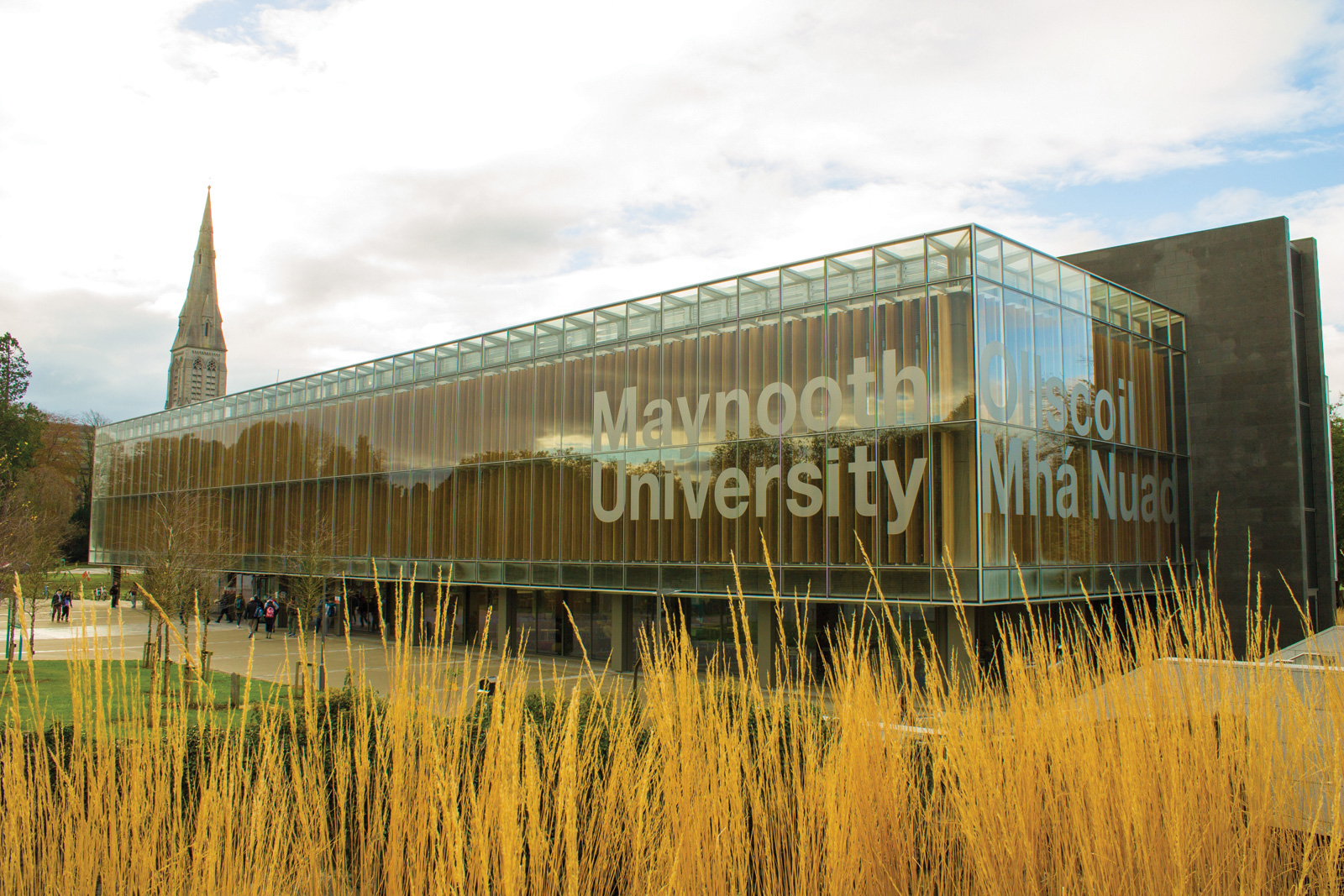
About Maynooth University
Maynooth University (MU) is an Irish public university, located in the historic town of Maynooth, in County Kildare, just 25 km from Dublin (roughly 30-40 minutes by train or bus). It was founded as an independent university through the Universities Act 1997, splitting off from the secular faculties of the famous St Patrick's College, Maynooth, founded in 1795. In practice, it is a young university with academic roots going back more than 230 years: the campus blends historic Gothic buildings with a modern, brand-new side.
In the QS World University Rankings 2026, Maynooth sits in the 771-780 band. Being a young university (under 30 years old as an independent institution), it frequently appears in the rankings dedicated to young universities, where it performs better than in the overall ranking. Let's be honest: it does not compete with Trinity College Dublin or University College Dublin in terms of prestige, but it offers a solid academic environment, a close-knit community and a flexible study model that is hard to find elsewhere. It has roughly 16,000 students, of whom more than 1,700 are international from 120 plus countries.
Maynooth's real strength is its flexible liberal arts model. You apply to a general faculty, not a narrow specialisation: the most popular paths are Bachelor of Arts (MH101), with over 30 subjects from which you choose 2, 3 or 4 in year 1, Bachelor of Science (MH201) and Bachelor of Social Science (MH107). You don't have to decide on your specialisation at the time of applying: you have up to four weeks after the start of year 1 to try out the subjects and choose your combination, then you specialise gradually. Institutional strengths: humanities, social sciences and sciences.
For Romanian students, Maynooth has two huge advantages. First, everything is taught in English, an official and native language in Ireland, so you don't have to learn a new foreign language for your studies. Second, as an EU citizen, you fall under the Irish state's Free Fees Initiative: the state covers your tuition in full, and you pay only the annual Student Contribution, around EUR 2,500 per year for the 2026-27 academic year (permanently cut by EUR 500 through Budget 2026, down from around EUR 3,000). A non-EU student would pay EUR 16,500-EUR 18,000 per year in full tuition, so the difference for a Romanian is enormous. You apply through CAO (Central Applications Office), the centralised Irish system, with a points conversion from the Romanian Baccalaureate.
How to apply to Maynooth
Apply through CAO (Central Applications Office)
All Irish bachelor's degrees are applied for centrally through CAO (cao.ie), not directly to the university. You create an account, choose up to 10 level 8 (degree) courses in order of preference and pay the application fee. Standard deadline: 1 February; there is also a late deadline (1 May) with a higher fee. As an EU citizen you apply exactly like an Irish student, through CAO.
Points conversion from the Baccalaureate
The Romanian Baccalaureate is not expressed in "CAO points", so CAO converts it onto the Irish scale through an official equivalence grid for EU diplomas. Your Baccalaureate average is converted into CAO points, which are then compared with the cut-off of each course. Recommendation: submit your diploma and transcript for CAO assessment in good time, because processing non-Irish documents takes a while.
Choose the flexible path (MU degree)
Maynooth's advantage: you apply to a general faculty, not a narrow specialisation. The most popular: Bachelor of Arts (MH101) with 30 plus subjects, Bachelor of Science (MH201), Bachelor of Social Science (MH107). You choose your subjects at registration in September and have up to 4 weeks to change them after year 1 begins. Specialisation comes gradually, over time.
Proof of English
Even though teaching is in native English, as an applicant whose mother tongue is not English you must prove your level. Maynooth accepts IELTS Academic 6.5 (with a minimum of 6.0 per component) or equivalent (TOEFL iBT ~90, Cambridge C1 Advanced, Duolingo). Check the exact threshold for your target course, because some programmes require a higher score.
PPS number and EU citizen status
As a Romanian (EU) citizen you do not need a visa to study in Ireland; you enter and live freely. To benefit from Free Fees and from administrative services you need a PPS number (Personal Public Service Number), the Irish equivalent of the CNP. You obtain it after arrival, through the Department of Social Protection (MyWelfare), based on proof of address and the letter from the university.
Registration
Once CAO makes you an offer (in August) and you accept it, you complete registration online on the Maynooth portal: you pay the annual Student Contribution (~EUR 2,500), choose your MH101/MH201 subjects and sign up for accommodation. The academic year starts in September. MU has an orientation week for international students, with campus tours and integration support.
Costs for Romanians
EU contribution 2026-27 (Free Fees)
Estimated total cost per year (all included)
Free Fees
As a Romanian (EU) citizen who meets the residency criterion, the Irish state covers your tuition through the Free Fees Initiative. You pay only the annual contribution (~EUR 2,500), not the EUR 16,500-EUR 18,000 required of a non-European. Nothing special is needed, just proof of EU citizenship and eligibility.
EU scholarships
Maynooth offers merit scholarships (entrance scholarships) for strong academic results at admission, plus scholarships for sport and activities. As an EU student you can also benefit from Erasmus+ mobilities (EUR 350-EUR 500/month during the exchange period) in the intermediate years. Check the MU scholarships page for the categories open to international EU students.
Romania scholarships
As a Romanian admitted to an EU university, you can apply, in parallel, to the scholarship programmes of the Romanian Ministry of Education and to those offered by some city or county councils for their students going abroad. These can be combined with the Irish support. Important: you apply separately and in good time, before the year begins.
Want to apply to Maynooth?
We help you navigate CAO, correctly convert your Baccalaureate points, choose the right flexible path (Arts, Science or Social Science) and make the most of the Free Fees scheme (~EUR 2,500/year). Our mentors have been through the process. Your first mentoring session is 100% free.
Talk to a mentorFrequently asked questions
How hard is it to get into Maynooth University?
Maynooth is more accessible than Trinity College Dublin or University College Dublin, but admission remains competitive for popular courses. Entry is through CAO, on a points basis: each course has a cut-off (points requirement) set each year by supply and demand. The flexible general courses (Arts MH101, Social Science MH107) usually have more accessible thresholds, while programmes with a limited number of places require more points. For Romanians, the Baccalaureate average is converted into CAO points through an official grid, so a good Baccalaureate average (over 8) opens up most programmes.
How much does Maynooth cost for a Romanian student?
As an EU citizen, you fall under the Free Fees Initiative: the Irish state covers your tuition, and you pay only the annual Student Contribution, roughly EUR 2,500 per year for the 2026-27 academic year (permanently cut by EUR 500 through Budget 2026, down from about EUR 3,000). For comparison, a non-EU student pays EUR 16,500-EUR 18,000 per year in tuition alone. On top of that comes the cost of living: accommodation EUR 500-EUR 900/month, food EUR 250-EUR 400/month, transport and expenses EUR 150-EUR 250/month. Estimated total per year: roughly EUR 13,000-EUR 18,000, dramatically lower than in the US or the UK.
What is the flexible system (MU degree) at Maynooth?
Unlike many European universities where you apply directly to a narrow specialisation, at Maynooth you apply to a general faculty and specialise as you go. The most popular flexible paths are Bachelor of Arts (MH101), with over 30 subjects from which you choose 2, 3 or 4 in year 1, Bachelor of Science (MH201) and Bachelor of Social Science (MH107). You don't have to decide at application: you choose your subjects at registration in September and have up to 4 weeks after the start of year 1 to change them. It is an ideal model if you are still exploring what you want to study.
Are the programmes at Maynooth in English?
Yes, all programmes are taught entirely in English, an official and native language in Ireland. This is a major advantage over Spain, Germany or France, where you need an additional foreign language. As an applicant whose mother tongue is not English, you still need to prove your level through IELTS Academic 6.5 (minimum 6.0 per component) or equivalent (TOEFL iBT ~90, Cambridge C1 Advanced, Duolingo). Some courses may require a higher threshold, so check the specific requirement of the programme.
How is the Romanian Baccalaureate converted into CAO points?
The Baccalaureate is not expressed in "CAO points", so CAO converts it onto the Irish scale through an official equivalence grid for EU diplomas. In practice, you submit your Baccalaureate diploma and transcript, and CAO calculates a points equivalent based on your average, which is then compared with the cut-off of each course. Recommendation: send the documents for assessment in good time, because processing non-Irish diplomas takes longer. A high Baccalaureate average maximises your chances at competitive courses.
What are the strongest fields at Maynooth?
Maynooth is known in particular for humanities (languages, literature, history, philosophy, media studies), social sciences (sociology, anthropology, law, economics, psychology, geography) and sciences (mathematics and computer science, experimental physics, biology, chemistry, electronics). The flexible MH101/MH201 model lets you combine subjects from different areas in the first years, before specialising. It is a young university (independent since 1997), so its position in the overall QS ranking reflects this, but its performance by discipline and its close-knit academic environment are real strengths.
Do I need a visa to study in Ireland as a Romanian?
No. As a Romanian (EU) citizen you have the automatic right to enter, live and study in Ireland without a visa and without a residence permit. To benefit from the Free Fees scheme and from administrative services you need a PPS number (Personal Public Service Number), the Irish equivalent of the CNP. You obtain it after arrival, through the Department of Social Protection, based on proof of address in Ireland and the registration letter from Maynooth. Important: Ireland is not part of the Schengen area, but EU free movement applies in full.
Can I stay and work in Ireland after graduation?
Yes, as an EU citizen! Unlike non-EU students, who depend on work permit schemes, as a Romanian citizen you have the automatic right to work in Ireland without a visa or permit. Ireland has a strong economy, with major tech and financial services hubs in Dublin (the European headquarters for Google, Meta, Microsoft, Apple, LinkedIn, Stripe), plus strong industries in pharma and medical devices. Maynooth's proximity to Dublin (25 km) makes access to internships and jobs easier. With a degree earned in the EU, you can then work anywhere in the European Union, without a visa.
Our mentors from Europe
They studied at Bocconi, Sciences Po, TU Delft, ETH Zurich and other EU universities. Now they guide you.