
University of Limerick
A public, English-speaking university, founded as an institute in 1972 and granted university status in 1989. It pioneered the first Cooperative Education in Ireland: over 2,000 students go each year on paid placements of 6 to 8 months, integrated and credited within the degree. As an EU citizen you enter through the Free Fees scheme and pay only the Student Contribution (around 2,500 EUR per year). All undergraduate programmes are in English.
About University of Limerick
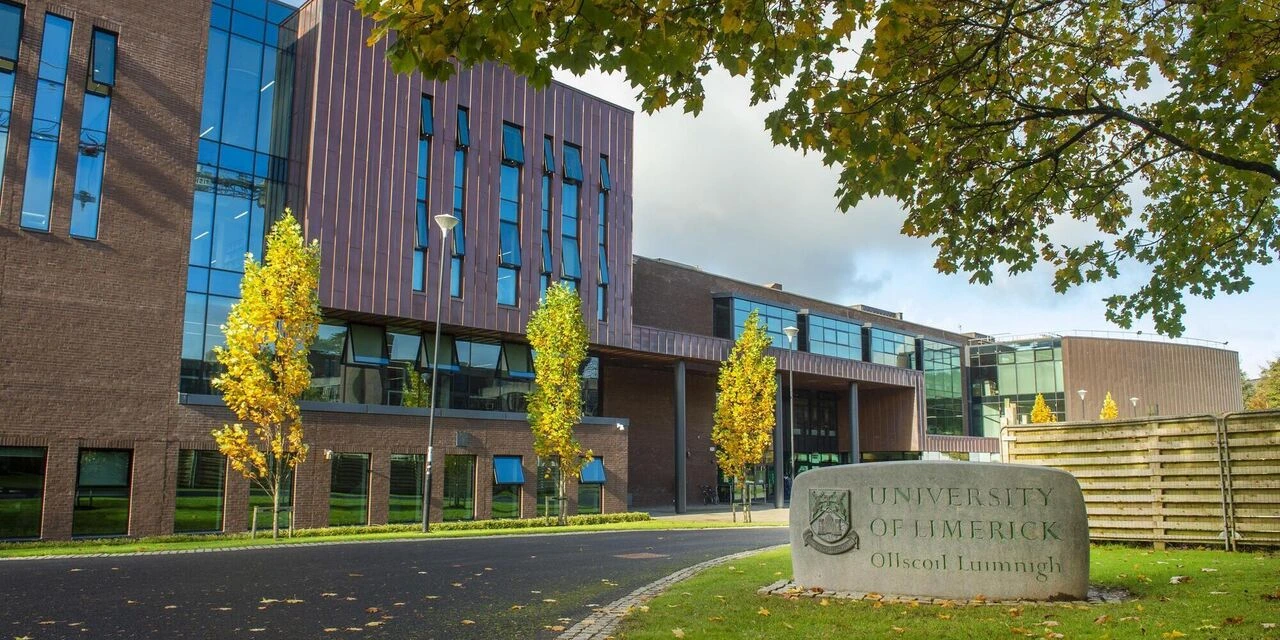
University of Limerick (UL) is a public university in the city of Limerick, in the west of Ireland. It was founded in 1972 as the National Institute for Higher Education, Limerick, and in 1989 it was granted university status through the University of Limerick Act, becoming the first university established in Ireland after independence in 1922. The campus, spread along the banks of the River Shannon, is one of the most modern in the country, with pedestrian bridges over the river, world-class sports facilities and a parkland setting.
UL's hallmark is Cooperative Education. The university introduced the first integrated placement programme in Ireland and today runs one of the largest placement schemes in Europe. Over 2,000 students are sent each year on paid placements of 6 to 8 months with companies in Ireland and abroad. These placements are not optional: they are a compulsory, integrated and academically credited component of many undergraduate programmes, which means you graduate with real work experience already on your CV.
UL is strong in engineering (mechanical, electronic, civil, biomedical, software), business through the Kemmy Business School (AACSB accredited), sciences (computer science, materials science, biochemistry) and education, being a major centre for teacher training in Ireland. All undergraduate programmes are taught in English, the official and everyday language in Ireland, so you do not need to learn a new language in order to study or to do your placement.
For Romanian students, UL is one of the most accessible routes in Europe. As an EU citizen you enter through the Free Fees scheme: the Irish state covers the tuition fee, and you pay only the Student Contribution, around 2,500 EUR per year (plus a small student levy). You apply through the CAO (Central Applications Office), the Irish national system, and your Baccalaureate grade is converted into CAO points on an official scale. As an EU citizen, you automatically have the right to stay and work in Ireland after graduation, without a visa.
How you apply to UL
Create a CAO account
Undergraduate applications in Ireland are centralised through the CAO (Central Applications Office), not directly with the university. You create an online account on cao.ie and pay the application fee (around 30-45 EUR if you apply early). A single CAO account covers all Irish universities, including UL.
Convert your Baccalaureate grade into CAO points
The CAO allocates places strictly on the basis of points. The Romanian Baccalaureate diploma is converted on an official scale into points equivalent to the Irish Leaving Certificate (maximum 625). Your average and your grades in the relevant subjects determine how many points you receive. Each UL programme has a points requirement that varies depending on demand.
Choose programmes in order of preference
On the CAO you list up to 10 level 8 (honours degree) programmes in order of preference. Put the UL programmes you want most at the top of the list. The system offers you the highest programme on your list for which you meet the points requirement. Look at the Cooperative Education programmes that interest you (engineering, business, computing).
Prove your English (if required)
The language of instruction is English. As a Romanian student, you need proof of your level: IELTS 6.0-6.5, TOEFL iBT 80-90 or equivalent (Cambridge C1). In some cases, a good English grade in your Baccalaureate may be accepted. Check the exact requirement of your chosen programme on ul.ie.
Register and obtain a PPS Number
As an EU citizen you do not need a visa to study and live in Ireland. After arrival, you obtain a PPS Number (Personal Public Service Number), the Irish equivalent of a national ID number, needed for work, the paid Cooperative Education placement and services. You get it at an Intreo centre with your ID document and proof of address.
Enrolment and start of studies
Once you accept the CAO offer (usually in August), you complete your registration online on the UL portal, pay the Student Contribution (around 2,500 EUR) and choose your accommodation. The academic year begins in September. UL runs an Orientation Week programme for international students, with campus tours and support for settling in.
Costs for Romanians
EU fees 2026-27 (EU citizens)
Estimated cost of living per year
Free Fees
As a Romanian citizen resident in the EU, you automatically come under the Irish state's Free Fees scheme for eligible undergraduate programmes. The state pays the tuition, you pay only the Student Contribution (~2,500 EUR/year). That means a saving of 14,000 to over 50,000 EUR per year compared with a non-EU student.
Cooperative Education
The 6 to 8 month placement in the Cooperative Education programme is paid. Many students earn enough to cover a significant part of their living costs for the year. It is a direct advantage, not a scholarship you have to apply for: it comes integrated into the structure of the degree.
Scholarships and SUSI
UL offers merit scholarships for international students with strong academic results. EU students who meet the residency criteria can also apply for the SUSI grant, which may cover the Student Contribution partly or in full. Also check the scholarship programmes of your local council in Romania for studies abroad.
Want to apply to University of Limerick?
We help you convert your Baccalaureate into CAO points, choose the right Cooperative Education programmes and make the most of the Free Fees scheme (you pay only ~2,500 EUR/year). Our mentors have been through the process. The first mentoring session is 100% free.
Talk to a mentorFrequently asked questions
How much does University of Limerick cost for a Romanian?
As an EU citizen you enter through the Irish state's Free Fees scheme, which covers the tuition fee for eligible undergraduate programmes. You pay only the Student Contribution, around 2,500 EUR per year (reduced in Budget 2026), plus a small student levy (~102 EUR).
For comparison, a non-EU student pays tuition from 16,900 to 55,600 EUR per year, depending on the programme (Medicine is the most expensive). The cost of living in Limerick is around 9,000-12,000 EUR per year, so the annual total for a Romanian is around 12,000-15,000 EUR, far below the UK or the USA.
What is Cooperative Education and why is it important at UL?
Cooperative Education is the hallmark of University of Limerick. UL introduced the first integrated placement programme in Ireland and today runs one of the largest placement schemes in Europe. Over 2,000 students are sent each year on placements of 6 to 8 months with companies in Ireland and abroad.
Unlike an optional internship, these placements are compulsory, integrated and academically credited in many undergraduate programmes, and most are paid. That means you graduate with real work experience on your CV and, often, with a job offer from the company where you did your placement.
How is the Baccalaureate converted into CAO points?
Undergraduate applications in Ireland are made through the CAO (Central Applications Office), which allocates places strictly on the basis of points. The Romanian Baccalaureate diploma is converted on an official scale into points equivalent to the Irish Leaving Certificate (the maximum being 625 points).
Your Baccalaureate average and your grades in the relevant subjects determine how many points you receive. Each UL programme has a points requirement (the points threshold) that varies from year to year, depending on how many candidates apply. Competitive programmes require more points. We help you estimate where you stand.
Are the programmes at UL in English?
Yes. Ireland is a natively English-speaking country, and all undergraduate programmes at UL are taught in English. You do not need to learn a new language in order to study, to do the Cooperative Education placement or to live in Limerick.
As a Romanian student you need proof of your English level: usually IELTS 6.0-6.5, TOEFL iBT 80-90 or equivalent (Cambridge C1 Advanced). In some cases, a good English grade in your Baccalaureate may be accepted directly. Check the exact requirement of your chosen programme on ul.ie.
What are the strongest programmes at UL for Romanians?
UL is renowned for: Engineering (mechanical, electronic, civil, biomedical, software, aeronautical), Business through the Kemmy Business School (AACSB accredited), Sciences (computer science, materials science, biochemistry, sport sciences) and Education, with UL being a major centre for teacher training in Ireland.
Most of these programmes include Cooperative Education, that is the paid placement of 6 to 8 months. For a Romanian student with a technical or business profile, the combination of Free Fees, teaching in English and an integrated paid placement is highly advantageous.
What visas or documents do I need as a Romanian citizen?
As an EU citizen, you do not need a study visa to study and live in Ireland. You can move freely with your Romanian ID card or passport.
After arrival, you obtain a PPS Number (Personal Public Service Number), the Irish equivalent of a national ID number. It is needed in order to be paid on the Cooperative Education placement, for a part-time job and for public services. You get it at an Intreo centre with your ID document and proof of your address in Ireland. Recommended: a European health insurance (the European Health Insurance Card) or private cover.
How well ranked is University of Limerick?
In the QS World University Rankings 2026, UL is ranked 401 worldwide, a jump of around 20 places from the previous year, and 5th among universities in Ireland.
More important than the raw ranking position is the employability of graduates: through Cooperative Education, UL students enter the job market with 6 to 8 months of real work experience already on record. That makes them very attractive to employers, especially in engineering, business and technology.
Can I stay in Ireland after graduation?
Yes, as an EU citizen! Unlike the UK or the USA, where you need a work visa, as a Romanian (EU) citizen you automatically have the right to work in Ireland without a visa, as soon as you graduate or even during your studies.
Ireland hosts the European headquarters of many technology and pharma companies (Google, Meta, Apple, Microsoft, Stripe, Analog Devices, Johnson and Johnson, Regeneron), many with a presence in the Mid-West region around the city of Limerick. Many UL students receive job offers from the very company where they did their Cooperative Education placement. With an Irish degree recognised across the EU, you can then work anywhere in the European Union, without a visa.
Our mentors from Europe
They studied at Bocconi, Sciences Po, TU Delft, ETH Zurich and other EU universities. Now they guide you.