
University of Galway
Public university founded in 1845, formerly NUI Galway. QS World 2026 ranked 284th. Over 20,000 students, 21 percent international from 120 countries. All programmes taught in English, the official and native language of Ireland. As an EU citizen you benefit from Free Fees: the state pays your tuition, you pay only the student contribution of approximately EUR 2,500 per year.
About University of Galway
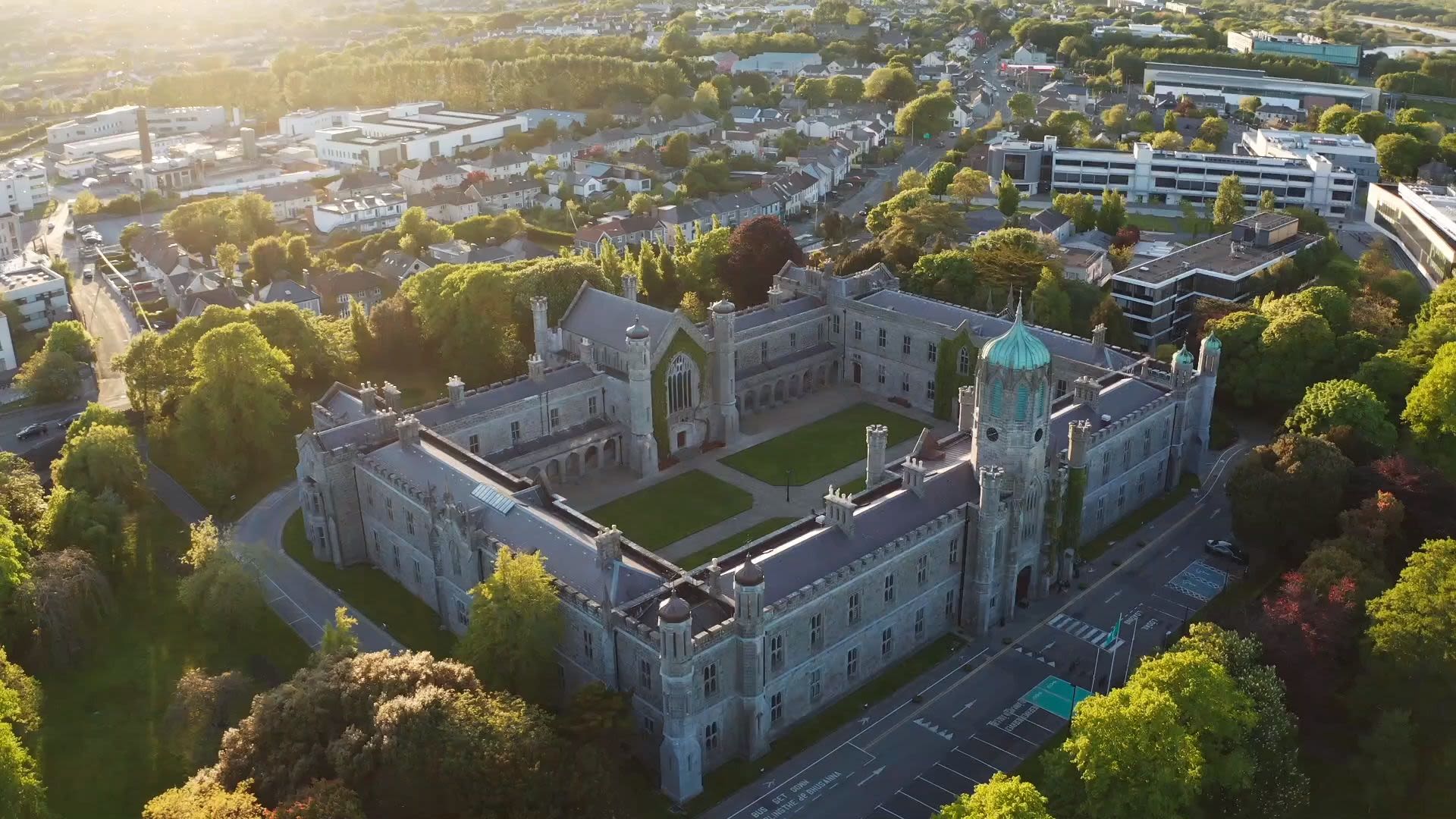
University of Galway is a public university founded in 1845, originally under the name Queen's College Galway. It was later named University College Galway, and from 1997 to 2022 it was National University of Ireland, Galway (NUI Galway). In September 2022 it adopted its current name, University of Galway. With 180 years of tradition, it is one of the oldest and most respected universities in Ireland.
The 105-hectare campus sits on the bank of the River Corrib, in the city of Galway, the cultural capital of Ireland's west coast. In the QS World University Rankings 2026, the university is ranked 284th worldwide, consistently among the best in Ireland. It has over 20,000 students (2024/25 academic year), of whom approximately 21 percent are international, coming from 120 countries. The graduate employment rate is 95.7 percent.
The university is organised into 4 colleges: College of Medicine, Nursing and Health Sciences; College of Science and Engineering; College of Business, Public Policy and Law; and College of Arts, Social Sciences and Celtic Studies. It offers 66 undergraduate programmes and 146 postgraduate programmes. Recognised strengths: medicine, sciences, humanities, law and business. Very important for international students: all programmes are taught in English, the official and native language of Ireland, so you do not need to learn a new foreign language in order to study.
For international students, Galway is one of the most accessible routes in Europe. As an EU citizen you benefit from the Free Fees Initiative: the Irish state pays your undergraduate tuition, and you pay only the student contribution of approximately EUR 2,500 per year (student contribution). Applications are made through the national CAO system (Central Applications Office), and grades from the Romanian Baccalaureate are converted into CAO points. The degree you earn is recognised throughout the European Union, and as an EU citizen you can stay and work in Ireland without a visa.
How to apply to Galway
Apply through CAO (Central Applications Office)
Undergraduate admission in Ireland is centralised through CAO, the national system, not directly with the university. As an EU citizen who studied in an EU country, you apply through CAO by the standard deadline of 1 February. You tick "Other School Exams" for qualifications obtained outside Ireland. You choose up to 10 honours degree courses (Level 8) in order of preference.
Converting the Baccalaureate into CAO points
Grades from the Romanian Baccalaureate are converted into CAO points (the Irish system goes up to 625 points). The conversion takes into account the overall average and the grades in relevant subjects. Each programme has a points requirement set annually by supply and demand. Competitive programmes such as Medicine require very high scores plus additional tests.
Choose programmes and check requirements
Galway offers 66 undergraduate programmes across 4 colleges: medicine and health sciences, science and engineering, business, law and public policy, arts and social sciences. On each course page you check the points required and the specific subject requirements (for example mathematics or a science for technical and medical programmes).
Prove your level of English
All programmes are in English, so you need proof of proficiency: usually IELTS 6.5 (minimum 5.5-6.0 per component) or an equivalent TOEFL iBT, Cambridge or Duolingo. Galway accepts several certificates. Check the exact threshold for your programme, as some require higher scores (for example medicine or nursing).
Obtain your PPS number as an EU citizen
As an EU citizen you do not need a study visa for Ireland. After arrival you obtain your PPS number (Personal Public Service Number), the Irish equivalent of a personal identification number, required for a bank account, part-time work and services. You register with your passport or national ID card and proof of address.
Registration and starting your studies
Once you receive your offer through CAO (generally in August, in "rounds"), you accept it online and complete registration on the Galway portal. You pay the student contribution of approximately EUR 2,500 (under Free Fees), arrange accommodation and begin the academic year in September. There is an orientation week for international students, with campus tours and integration support.
Costs for EU students
Fees under Free Fees (EU citizens)
Cost of living in Galway per year
Free Fees
As an EU citizen who has been resident in the EU, EEA, Switzerland or the UK for at least 3 of the last 5 years, you are eligible for Free Fees on your first bachelor's degree. The state pays your tuition, you pay only the student contribution of approximately EUR 2,500 per year. Check the residency criteria before applying, they are the key to eligibility.
Scholarships Galway
University of Galway offers several merit and academic excellence scholarships for students starting a bachelor's degree, some dedicated to EU students. Amounts vary depending on the programme and results. Check the university's Scholarships page and the application deadlines, which usually overlap with the admissions season.
Romanian scholarships
As a Romanian student admitted to a university in the EU, you may be eligible for scholarship programmes from certain town halls or foundations in Romania for students abroad. Check with your local town hall and educational foundations. These scholarships can be combined with support from Ireland, but they must be applied for separately and well in advance.
Want to apply to University of Galway?
We help you apply through CAO, correctly convert your Baccalaureate grades into points, choose the right programmes and take advantage of Free Fees as an EU citizen (contribution ~€2,500/year). Our mentors have been through the process. The first mentoring session is 100% free.
Talk to a mentorFrequently asked questions
How much does University of Galway cost for a Romanian student?
As an EU citizen, you benefit from the Free Fees Initiative: the Irish state pays your tuition for your first bachelor's degree, and you pay only the student contribution of approximately EUR 2,500 per year. For comparison, a non-EU student pays between EUR 16,000 and EUR 27,000 per year, depending on the programme. To this you add the cost of living in Galway, estimated at EUR 1,000-EUR 1,500 per month (accommodation, food, transport). In total, a year of studies for a Romanian student costs approximately EUR 12,000-EUR 17,000 all-in, drastically less than in the UK or the USA.
How is the Romanian Baccalaureate converted into CAO points?
Applying for a bachelor's degree in Ireland is done through CAO (Central Applications Office), the national system. Grades from the Romanian Baccalaureate are converted into CAO points, with the Irish scale going up to 625 points. The conversion takes into account the overall average and the grades in subjects relevant to the chosen programme. Each course has a points requirement set annually by supply and demand. When applying, you tick "Other School Exams" for a qualification obtained outside Ireland. Recommendation: ask the university or a mentor for an estimate of your points before choosing programmes.
Are the programmes at Galway taught in English?
Yes. All programmes at University of Galway are taught in English, which is the official and native language of Ireland. This is a huge advantage for Romanian students: you do not need to learn a new foreign language (such as Spanish, German or Dutch for other European destinations). You only need proof of language proficiency, usually IELTS 6.5 or equivalent. You study in English, live in an English-speaking country and earn a degree recognised worldwide.
What level of English do I need for Galway?
Galway requires proof of English proficiency for students whose first language is not English. The standard threshold is around IELTS 6.5 (with a minimum of 5.5-6.0 per component), or an equivalent TOEFL iBT, Cambridge English (C1 Advanced) or Duolingo. Some high-demand programmes, such as medicine or nursing, may require higher scores. Check the exact threshold on each course page before applying and book the test in good time, results take a few weeks.
What are the strongest programmes at Galway?
University of Galway is recognised for medicine and health sciences (College of Medicine, Nursing and Health Sciences), science and engineering, humanities and social sciences (College of Arts, Social Sciences and Celtic Studies, including strong Celtic studies), law and public policy and business (College of Business, Public Policy and Law). In total it offers 66 undergraduate programmes and 146 postgraduate programmes. The graduate employment rate is 95.7 percent, a solid indicator of how the degree is recognised in the job market.
Do I need a visa to study in Ireland as a Romanian?
No. As a Romanian (EU) citizen you do not need a study visa for Ireland. You can move freely and have the right to study and work. After arrival you obtain your PPS number (Personal Public Service Number), the Irish equivalent of a personal identification number, required for a bank account, part-time work and public services. You register with your Romanian passport or national ID card and proof of an address in Ireland. Note: Ireland is not part of the Schengen area, but free movement for EU citizens remains in place.
Can I stay in Ireland to work after graduation?
Yes. As an EU citizen you have the automatic right to work in Ireland without a visa or work permit, unlike non-EU students who depend on special schemes. Ireland has a strong economy, with the European headquarters of many large technology and pharma companies, plus a solid financial and medical services sector. The degree from Galway is recognised throughout the European Union, so you can later work anywhere in the EU without a visa. Galway's graduate employment rate is 95.7 percent.
What is student life like in Galway?
Galway is considered the cultural capital of Ireland, a young city on the west coast, on the shore of the ocean and the River Corrib. It has a friendly atmosphere, a vibrant music and festival scene and is small enough to get around easily on foot or by bike. The 105-hectare campus is right in the city. The international community is large: 21 percent of students come from outside Ireland, from 120 countries, so you integrate easily. There are numerous student clubs and societies, plus dedicated support for international students.
Our mentors from Europe
They studied at Bocconi, Sciences Po, TU Delft, ETH Zurich and other EU universities. Now they guide you.