
Dublin City University
Public university in Dublin, with university status since 1989, focused on employability and links with industry. Ranked 410th in QS World 2026 and 4th in Ireland. More than 20,000 students from over 120 countries. All programmes are taught in English, the official and native language in Ireland. As an EU citizen you pay only the student contribution of around EUR 2,500 per year through the Free Fees Initiative.
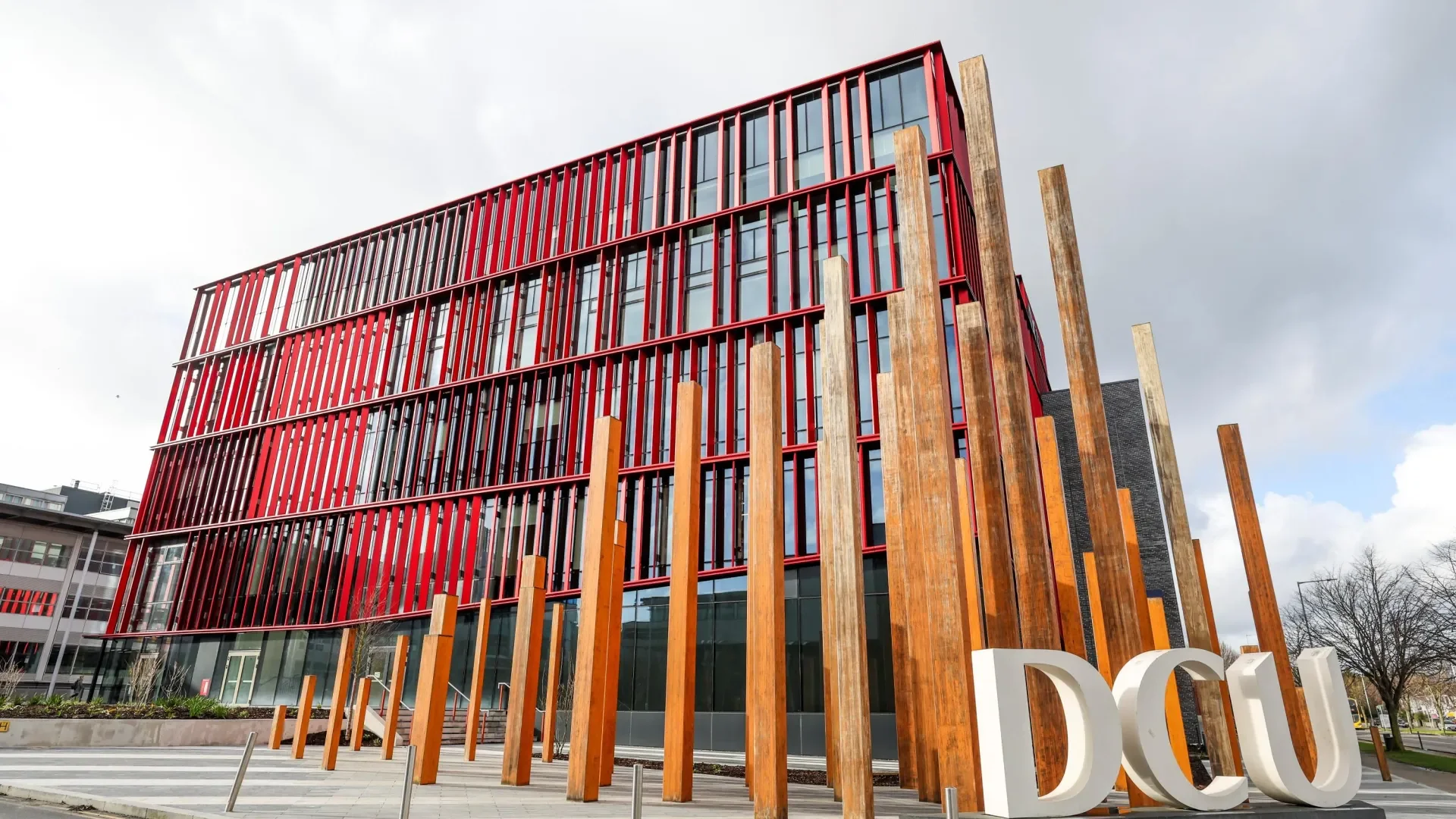
About Dublin City University
Dublin City University (DCU) is a public university in the north of Dublin, the capital of Ireland. It was established in 1975 as the National Institute for Higher Education, Dublin, took in its first students in 1980 and gained full university status in September 1989. It is one of the youngest universities in Ireland, but it has climbed steadily in the rankings: in the QS World University Rankings 2026 it is 410th in the world, a rise of 11 places compared with the previous year, which places it 4th among Irish universities. It is honestly a young and growing university, not one that is centuries old, but with a solid reputation for employability.
DCU describes itself as "Ireland's University of Enterprise". Its identity is built around its links with industry and graduate employability. Its distinctive hallmark is the INTRA (INtegrated TRAining) programme, the first work placement programme in Ireland, part of the DCU experience for more than 40 years. INTRA is an accredited placement and, for many programmes, a mandatory component of the degree, in which you typically spend 6 to 8 months actually working in a company in Ireland or abroad before graduating.
The university has approximately 20,000 students from over 120 countries, organised into 5 faculties: DCU Business School, Faculty of Engineering and Computing, Faculty of Humanities and Social Sciences, DCU Institute of Education and Faculty of Science and Health. DCU's strengths: business, computing and data science, electronic and mechanical engineering, communications and journalism and education (DCU Institute of Education is the largest provider of teacher training in Ireland). The main campus is in Glasnevin, complemented by the St Patrick's and All Hallows campuses.
For Romanian students, DCU has a clear advantage over the UK or the USA: Ireland is a natively English-speaking country (English is an official language), so you study in English in an environment where English is spoken in everyday life, without the requirement to learn an additional language. As an EU citizen, you are eligible for the Irish state's Free Fees Initiative: the state covers the cost of tuition fees, and you pay only the student contribution of around EUR 2,500 per year, far less than the non-EU rates (EUR 15,000 to over EUR 25,000 per year). You apply through the national CAO (Central Applications Office) system, with your Baccalaureate grades converted into equivalent Leaving Certificate points.
How to apply to DCU
Create a CAO account (Central Applications Office)
Applying for a bachelor's degree in Ireland is centralised through the CAO, not directly with the university. You create an account on cao.ie, fill in your personal details and pay the application fee (~EUR 30-EUR 45 if you apply early). A single CAO account covers all Irish universities, including DCU, Trinity, UCD, UCC, Galway.
Convert your Baccalaureate into CAO points
The CAO converts EU/EEA/UK qualifications into a Leaving Certificate points equivalent. Your Romanian Baccalaureate average is turned into a CAO points score, with which you compete alongside all the other candidates. The higher your Baccalaureate average, the more points you have. Check the DCU website for the equivalence table for Romania.
Choose your programmes in order of preference
On the CAO you select up to 10 bachelor's programmes (level 8) in your order of preference. Each programme has a points requirement (the cut-off in points), set annually by supply and demand. Strong DCU programmes: Business, Computing, Engineering, Communications, Education. Choose strategically, mixing ambitious options with some safe ones.
Prove your English (if required)
Although Ireland is English-speaking, as a Romanian applicant you may be asked for proof of English: IELTS Academic 6.5 (with no band below 6.0) or equivalent (TOEFL iBT ~90, Cambridge C1). Good English grades from high school or the Baccalaureate may be taken into account, but check DCU's exact requirement for your chosen programme before you apply.
Get a PPS number as an EU citizen
As a Romanian (EU) citizen you do not need a study visa for Ireland. After arrival you obtain a PPS number (Personal Public Service Number), the Irish equivalent of the personal ID number, needed to open a bank account, work part-time and access services. EU citizenship also gives you the automatic right to work in Ireland during and after your studies.
Accept your offer and register
CAO offers come in rounds, the first in August. If you receive an offer from DCU, you accept it online on the CAO, then complete registration directly with DCU, pay the student contribution (~EUR 2,500) and arrange your accommodation. The academic year usually starts in mid-September. DCU has an orientation programme for international students.
Costs for Romanians
Fees as an EU citizen (Free Fees)
Total cost of living per year (Dublin)
Free Fees
As an EU citizen who meets the residency criteria, you are eligible for the Free Fees Initiative: the state covers tuition, and you pay only the student contribution of around EUR 2,500 per year. That means a saving of EUR 12,000 to over EUR 22,000 per year compared with a non-EU student, simply by being an EU citizen.
DCU scholarships
DCU offers merit scholarships (DCU Scholarships) for academic, sporting or community-involvement achievements, plus support through the Student Assistance Fund for students with financial difficulties. Check the DCU scholarships page, as the criteria and deadlines are updated annually.
Romanian scholarships
As a Romanian student, you can apply in parallel for scholarships from Romania: Ministry of Education programmes for study abroad and scholarship schemes offered by some town halls or county councils for young people from your area. These can be combined with support from Ireland. Check the deadlines with the local authorities.
Want to apply to DCU?
We help you navigate the CAO, convert your Baccalaureate into points, choose the right programmes at DCU and make the most of the Free Fees Initiative (~EUR 2,500/year). Our mentors have been through the process. The first mentoring session is 100% free.
Talk to a mentorFrequently asked questions
Where does DCU rank and how good is it?
DCU is 410th in the world in the QS World University Rankings 2026, a rise of 11 places compared with the previous edition, which places it 4th among Irish universities. It is fair to call it a young university (university status only since 1989), not one that is centuries old like Trinity College Dublin, but it has grown steadily in academic reputation, employer reputation and citations. Its strong point is not historical prestige, but employability and links with industry, realised through the INTRA work placement programme.
How much does DCU cost for a Romanian student?
As an EU citizen who meets the residency criteria, you are eligible for the Free Fees Initiative: the Irish state covers tuition fees, and you pay only the student contribution of around EUR 2,500 per year (plus a Student Centre Levy of about EUR 43). A non-EU student instead pays full tuition, between EUR 15,000 and over EUR 25,000 per year, depending on the programme.
Adding the cost of living in Dublin (accommodation EUR 700-EUR 1,200/month, food EUR 300-EUR 450/month, transport EUR 30-EUR 50/month), the estimated total per year for a Romanian is around EUR 13,000-EUR 18,000, drastically lower than the UK or the USA.
What is the Free Fees Initiative and why does it matter for Romanians?
The Free Fees Initiative is an Irish state scheme through which the government covers the cost of tuition fees for eligible undergraduate students, and the student pays only the student contribution, currently around EUR 2,500 per year. Eligibility usually requires EU/EEA/UK citizenship plus meeting the residency criteria.
For Romanians it matters enormously: as an EU citizen, you pay a fraction of what a student from outside the EU would pay (EUR 15,000-EUR 25,000+ per year). It is one of the biggest financial advantages of studying in Ireland compared with the UK (where, after Brexit, Romanians pay international rates) or the USA.
Are programmes at DCU taught in English?
Yes, all programmes at DCU are taught in English. Ireland is a natively English-speaking country, with English an official language spoken in everyday life. This means that, unlike Spain, Germany or the Netherlands, you do not need to learn an additional foreign language in order to study and live there.
As a Romanian applicant you may be asked for proof of your English level, usually IELTS Academic 6.5 or equivalent (TOEFL iBT ~90, Cambridge C1). Check the exact requirement for your chosen programme, as some also accept your English grade from high school or the Baccalaureate.
How does applying through the CAO and converting the Baccalaureate work?
Applying for a bachelor's degree in Ireland is centralised through the CAO (Central Applications Office), not directly with the university. You create a single account on cao.ie, valid for all Irish universities (DCU, Trinity, UCD, UCC, Galway), and select up to 10 programmes in order of preference.
The CAO converts your Romanian Baccalaureate average into a Leaving Certificate points equivalent. With this points score you compete alongside all the other candidates for each programme, which has a points requirement (the cut-off in points) set annually. The higher your Baccalaureate average, the more CAO points you have. Check the DCU website for the equivalence table for Romania.
What is the INTRA programme and why is it important?
INTRA (INtegrated TRAining) is DCU's work placement programme, the first of its kind in Ireland and part of the DCU experience for more than 40 years. It is an accredited placement and, for many programmes, a mandatory component of the degree.
In practice, you typically spend 6 to 8 months actually working in a company in Ireland or abroad, before graduating. INTRA is the main reason DCU has a reputation as an employability-focused university: you leave with real work experience on your CV, industry connections and, often, a job offer from the company where you did your placement.
Can I stay and work in Ireland after graduation?
Yes, as an EU citizen you have the automatic right to work in Ireland during your studies (part-time) and after graduation (full-time), without a visa or work permit. Unlike the post-Brexit UK, where Romanians need a work visa, in Ireland you work freely on the basis of EU citizenship.
Ireland hosts the European hubs of major tech and financial companies (Google, Meta, Microsoft, Apple, Amazon, LinkedIn, Pfizer, Accenture), many headquartered right in Dublin. DCU's profile, focused on business, computing and engineering, plus the INTRA placement experience, positions you well in this market. In addition, with an EU degree you can work anywhere in the Union without a visa.
What are the strongest programmes at DCU for Romanians?
DCU is organised into 5 faculties and has clear strengths in: business (DCU Business School, with international accreditations), computing and data science, electronic and mechanical engineering (Faculty of Engineering and Computing), communications and journalism (DCU has a recognised tradition in media communications) and education (DCU Institute of Education is the largest provider of teacher training in Ireland).
For a Romanian student interested in an applied, employment-focused career, especially in tech, business or engineering, DCU's profile plus the INTRA placement are a very good fit. All of these programmes are taught in English.
Our mentors from Europe
They studied at Bocconi, Sciences Po, TU Delft, ETH Zurich and other EU universities. Now they guide you.