
Universität Tübingen
Founded in 1477, one of the oldest universities in Germany and one of the 11 Universities of Excellence. Today it is a strong European hub for artificial intelligence (Cyber Valley, Tübingen AI Center). QS World 2026 number 215, 12th place in Germany. Around 27,000 students, over 4,000 international from 140 plus countries. As an EU citizen you pay zero tuition, only the Semesterbeitrag of around 198 euros per semester. Motto: "Attempto!" (I dare!).
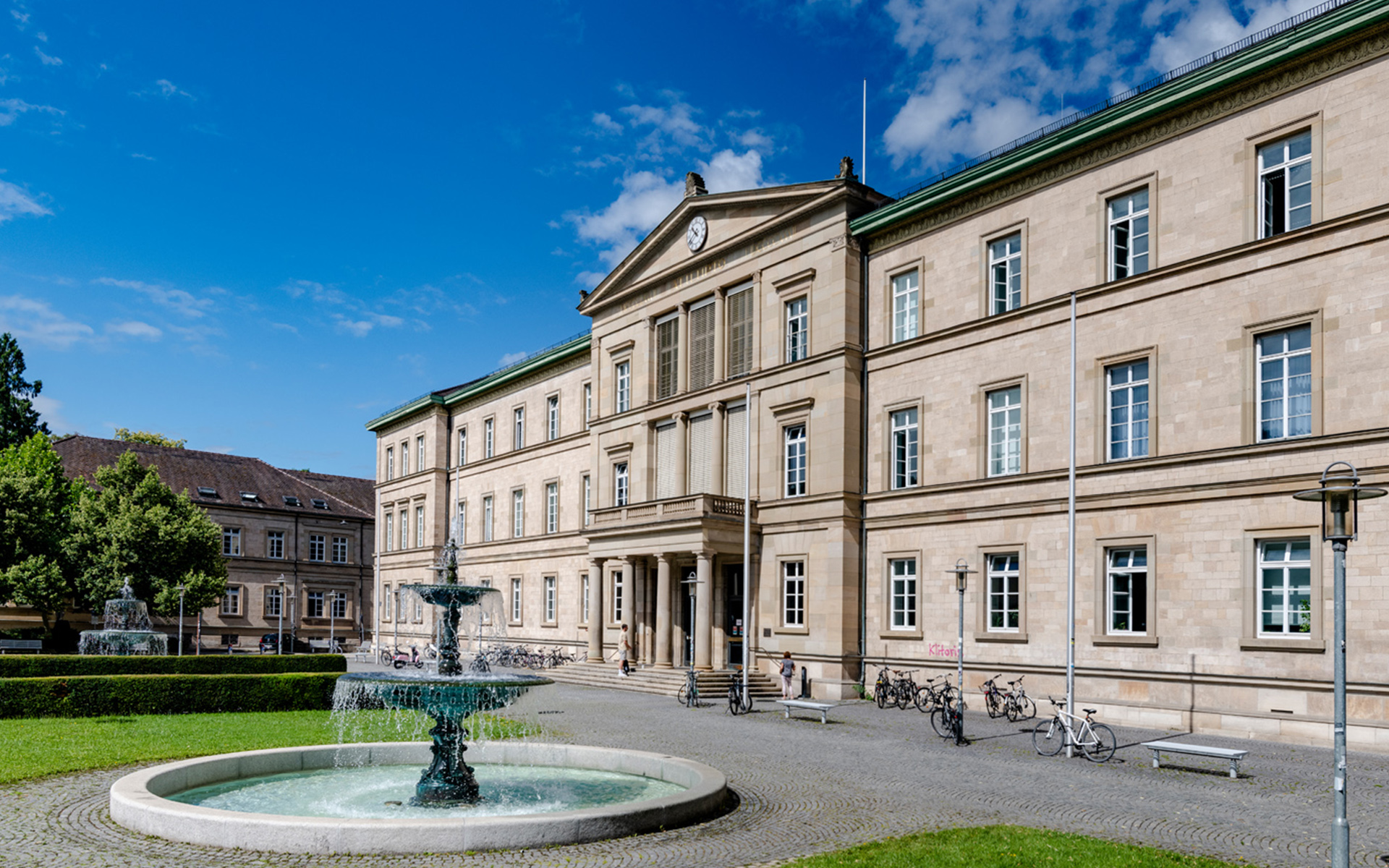
About Universität Tübingen
Eberhard Karls Universität Tübingen is a public university founded in 1477 by Count Eberhard im Bart, one of the oldest universities in Germany. It is located in Tübingen, the state of Baden-Württemberg, a classic university town in south-western Germany, where almost one in three residents is a student. The Latin motto, "Attempto!" (I dare!), sums up its spirit from 1477 to today. Tübingen is one of Germany's 11 Universities of Excellence, a distinction earned within the federal government's Excellence Strategy.
Tübingen has a deep academic tradition in theology, the humanities, philosophy, law, archaeology and ancient cultures, as well as an international reputation in medicine (with its affiliated university hospital) and life sciences. In recent years, however, it has established itself above all as a European hub for artificial intelligence and machine learning. The university is the core of Cyber Valley, the largest AI research consortium in Europe, and of the Tübingen AI Center, which brings together machine learning research groups with over 300 doctoral and postdoctoral researchers, alongside the Max Planck Institute for Intelligent Systems.
The university counts around 27,000 students, of whom over 4,000 are international from 140 plus countries, with more than 500 academic partnerships in dozens of countries. The structure follows the German model (Bachelor, Master, Staatsexamen for medicine and law) and the European ECTS system. Tübingen has 11 Nobel laureates associated with it throughout its history, in fields such as medicine and chemistry.
For Romanian students, Tübingen is one of the best opportunities in Europe, largely thanks to EU citizenship status. In the state of Baden-Württemberg, non-EU students pay 1,500 euros per semester, but EU citizens, including Romanians, pay zero tuition. You only pay the Semesterbeitrag (the semester fee, around 198 euros), which covers administration, student services and usually a transport pass. The language of most bachelor's programmes is German (C1 level required), but the offer of master's programmes in English is growing, especially in the area of AI, machine learning and sciences.
How to apply to Tübingen
Check recognition of your Baccalaureate
First step: you confirm that your Romanian Baccalaureate diploma gives you direct access to university in Germany. For most Romanians, the Baccalaureate with the right grade average offers direct access (HZB) to bachelor's programmes, without a preparatory year (Studienkolleg). You check the exact requirement of the programme on the Tübingen portal and in the anabin database.
Apply through uni-assist
Most international applications to Tübingen go through uni-assist, the central service that evaluates foreign diplomas. You upload your Baccalaureate diploma and transcript (certified translations), pay the uni-assist fee (around 75 euros for the first application, 30 euros for each additional one) and receive the VPD (the preliminary documentation evaluation).
Prove the language: German C1 or English at master's level
For programmes in German (most bachelor's degrees) you need C1 German level: TestDaF (TDN 4 in all sections), DSH-2 or Goethe C1. For master's programmes in English (AI, machine learning, sciences) you need IELTS 6.5 plus or TOEFL iBT 90 plus, or an equivalent.
Submit your file to Tübingen
After the uni-assist evaluation, your file reaches the university. For programmes with limited places (numerus clausus, e.g. medicine) the selection takes the admission average into account. Deadlines: generally 15 July for the winter semester (start in October) and 15 January for the summer semester. Check the exact deadline of your programme.
Register as an EU citizen (Anmeldung)
As a Romanian (EU) citizen you do not need a study visa. After arriving in Tübingen, you register at the town hall (Anmeldung at the Bürgeramt) with your passport or ID card and a housing contract. You need health insurance (the European Health Insurance Card or German public insurance, around 130 euros per month under the age of 30) and a German bank account.
Immatrikulation and payment of the Semesterbeitrag
Final step: Immatrikulation (the actual enrollment) at the university. As an EU citizen you do not pay tuition; you only pay the Semesterbeitrag (around 198 euros per semester), which covers administration, student services and usually the transport pass. You receive your student card and access to classes. The winter semester begins in October.
Costs for Romanians
EU citizen (Romanian) 2026-27
Comparison: non-EU student
Zero tuition
As an EU citizen you automatically pay zero tuition at Tübingen, identical to a German student. You do not have to do anything special, just prove your Romanian citizenship with a passport or ID card. You only pay the Semesterbeitrag of around 198 euros per semester, compared to the 1,500 euros tuition per semester that a non-European pays in Baden-Württemberg.
German scholarships
Deutschlandstipendium: 300 euros per month for students with good results, open to internationals from the EU as well. DAAD: scholarships for international students, especially at master's and doctoral level. Tübingen scholarships: in-house programmes and funds for deserving students. Many scholarships combine with a part-time job (EU citizens can work without restrictions).
State scholarship
As a Romanian student admitted to a university abroad, you may be eligible for scholarships from the Romanian Ministry of Education or for local scholarship programmes (check with your town hall or county council). Erasmus plus also offers mobility grants if you initially come on academic exchange. These sources can be combined with the German scholarships.
Want to apply to Tübingen?
We help you check recognition of your Baccalaureate, navigate uni-assist, choose the right programme (including the AI and machine learning master's degrees) and make the most of your EU citizenship status: zero tuition, only the Semesterbeitrag. Our mentors have been through the process. The mentoring session is 100% free.
Talk to a mentorFrequently asked questions
How much does Universität Tübingen cost for a Romanian student?
As an EU citizen, you pay zero tuition. In the state of Baden-Württemberg, students from outside the EU pay 1,500 euros per semester (3,000 euros per year), but Romanians are completely exempt. You only pay the Semesterbeitrag of around 198 euros per semester (roughly 396 euros per year), which covers administration, student services and usually a transport pass.
On top of that you add the cost of living in Tübingen, around 850 to 1,100 euros per month (housing, food, transport, insurance), considerably lower than in Munich or Berlin. In practice, you pay over 8 times less in fees than a non-European fellow student.
Why do Romanians pay zero tuition in Baden-Württemberg?
Since 2017, the state of Baden-Württemberg has reintroduced study fees of 1,500 euros per semester for non-EU students (from outside the European Union and the European Economic Area). This fee does not apply to EU citizens.
As a Romanian citizen, you are an EU citizen, so you are treated exactly like a German student: zero tuition. The only amount you pay is the Semesterbeitrag (the semester fee, around 198 euros), an administrative contribution paid by all students, regardless of nationality. It is one of the strongest advantages of EU citizenship for education.
What does Semesterbeitrag mean and what does it cover?
Semesterbeitrag (the semester contribution) is a mandatory administrative fee paid by all students in Germany, EU citizens or not. At Tübingen it is around 198 euros per semester.
It covers: the contribution for Studierendenwerk (student services, canteens, subsidized housing), the university's administrative fee, the contribution for student representation (Studierendenschaft) and, as a rule, a transport pass for the Tübingen area. It is not a tuition fee; it is a contribution to the campus services infrastructure.
Do I need to know German or can I study in English at Tübingen?
It depends on the programme. Most bachelor's programmes are taught in German, so you need C1 German level, proven through TestDaF (TDN 4 in all sections), DSH-2 or Goethe C1.
For master's programmes, especially in the area of artificial intelligence, machine learning and the sciences, the offer in English is growing. There you need IELTS 6.5 plus or TOEFL iBT 90 plus. The recommendation for Romanian students who want a bachelor's at Tübingen: start German early, so that you reach C1 before applying. For a master's in AI or ML, English may be enough.
How do I apply through uni-assist as a Romanian student?
uni-assist is the central service that evaluates international diplomas for German universities. The steps: 1) you create an account on the uni-assist portal and choose Tübingen plus your desired programme. 2) You upload your Baccalaureate diploma and transcript, with certified translations. 3) You pay the fee (around 75 euros for the first application, 30 euros for each additional one). 4) uni-assist checks the documents and issues a preliminary evaluation (VPD).
After the evaluation, your file reaches Tübingen for the final decision. Recommended timing: apply at least 6-8 weeks before the programme deadline (15 July for the winter semester), because uni-assist processing takes time.
How strong is Tübingen in artificial intelligence and machine learning?
Very strong. Tübingen is one of the most important AI research centers in Europe. The university is the core of Cyber Valley, the largest artificial intelligence research consortium in Europe, and of the Tübingen AI Center, which brings together machine learning groups with over 300 doctoral and postdoctoral researchers.
The ecosystem includes the Max Planck Institute for Intelligent Systems and partnerships with major technology companies. For a student interested in AI, machine learning, computer vision or data science, Tübingen offers access to cutting-edge research, relevant master's programmes and a solid academic and industrial network, while, as a Romanian, you pay no tuition.
Does the Romanian Baccalaureate give me direct access to Tübingen?
For most Romanians, yes. The Romanian Baccalaureate with an appropriate average generally offers direct access (Hochschulzugangsberechtigung, HZB) to bachelor's programmes in Germany, without the need for a preparatory year (Studienkolleg).
The exact requirement depends on the programme and is checked in the anabin database and on the Tübingen portal. For programmes with numerus clausus (limited places, e.g. medicine, psychology), the admission average counts in the selection, so a high Baccalaureate average helps. Recommendation: an overall average of 9 plus at the Baccalaureate for competitive programmes, plus proof of language (German C1 or English for master's).
Can I stay and work in Germany after graduation?
Yes, as an EU citizen. Unlike a non-European graduate who needs a work permit, as a Romanian (EU) citizen you automatically have the right to work in Germany without a visa or special permit.
Germany is the largest economy in the EU, with high demand for graduates in engineering, IT, AI and machine learning, sciences, medicine and economics. The Baden-Württemberg region hosts companies such as Bosch, Daimler/Mercedes-Benz, Porsche and SAP nearby, plus the AI ecosystem around Cyber Valley. Starting salaries for graduates in technical fields are frequently in the range of 45,000 to 60,000 euros gross per year. With a German degree recognized in the EU, you can later work anywhere in the European Union without a visa.
Our mentors in Europe
They studied at Bocconi, Sciences Po, TU Delft, ETH Zurich and other EU universities. Now they guide you.


