
RWTH Aachen University
Germany's strongest technical university, founded in 1870. Ranked QS World 2026 number 105, number 6 in Germany and number 1 nationally in mechanical engineering. Around 44,000 students, of whom more than 15,000 are international, from 141 countries. As an EU citizen you pay no tuition: only the semester contribution (Semesterbeitrag) of about €300, which includes your transport ticket. Motto: "Zukunft denken" (Thinking the Future).
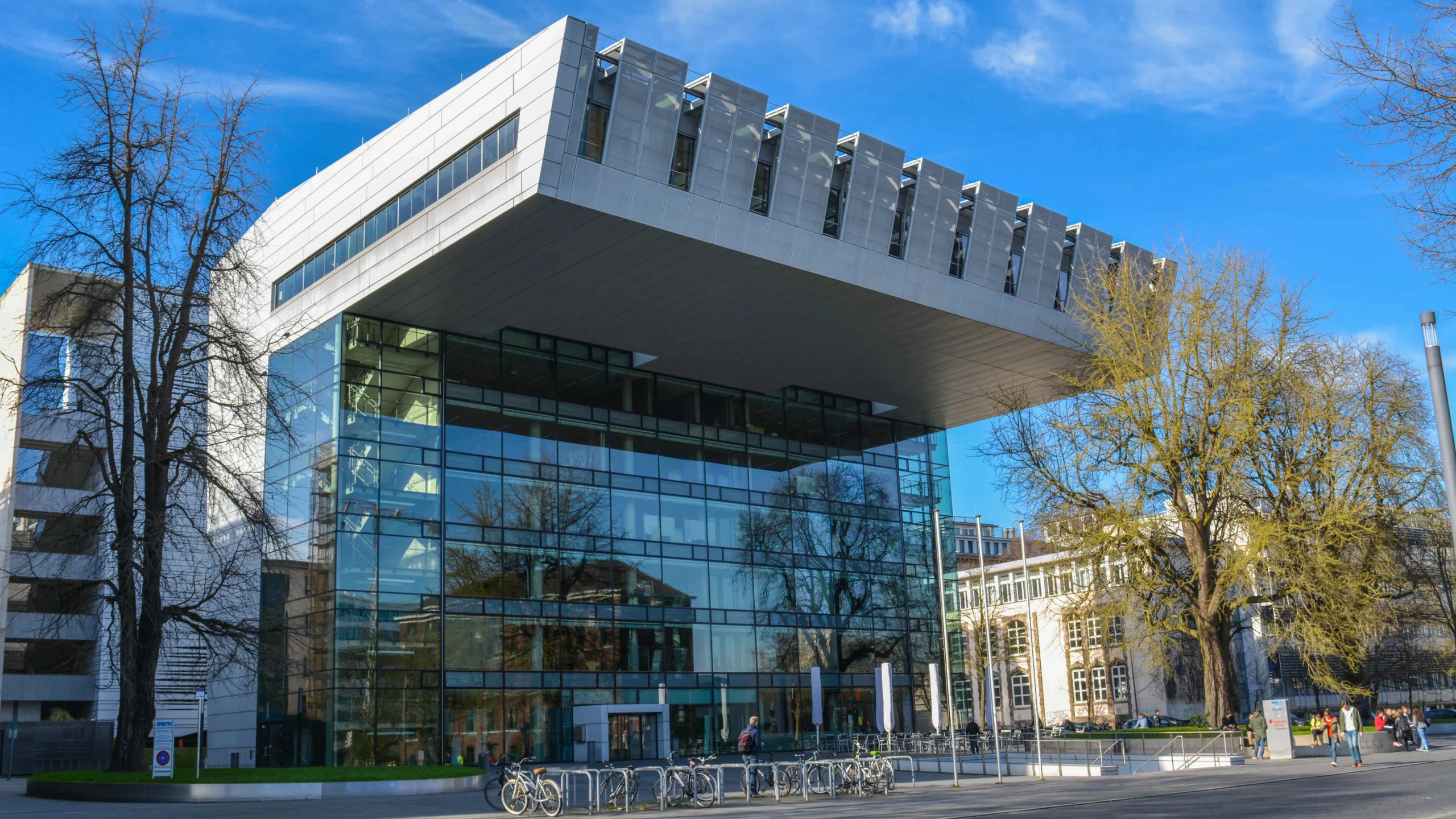
About RWTH Aachen
RWTH Aachen University (Rheinisch-Westfälische Technische Hochschule Aachen) is a public technical university founded in 1870, located in Aachen, in the state of North Rhine-Westphalia, in western Germany, very close to the border with Belgium and the Netherlands. It is the largest technical university in Germany and a founding member of TU9, the alliance of the nine strongest German technical universities (alongside TU München, KIT, TU Berlin and others). Its motto, "Zukunft denken" (Thinking the Future), sums up its focus on engineering and applied innovation.
RWTH Aachen is ranked QS World 2026 number 105 (its best result ever) and number 6 in Germany. By subject area it is number 1 in Germany in mechanical engineering and materials science, with strong positions in electrical engineering, computer science and automotive engineering too. The university has 10 faculties and around 290 institutes, plus close partnerships with German industry (Volkswagen, Ford, Siemens, Bosch) and the Jülich research centre. Aachen is a classic student town: roughly a quarter of its residents are students.
Around 44,000 students are enrolled at RWTH, of whom more than 15,000 are international, from 141 countries, one of the largest international communities in Germany. Many Bachelor's programmes are taught in German, so you need a C1 level of German (TestDaF or DSH). At Master's level, however, the offering in English is much broader, especially in the international technical programmes (for example the engineering Master's, Data Science, Robotic Systems Engineering), where you prove your English through IELTS or TOEFL.
For Romanian students, RWTH Aachen is one of the best engineering opportunities in Europe. As an EU citizen you pay no tuition: studies are free, you pay only the semester contribution (Semesterbeitrag) of about €300 per semester, which includes your transport ticket (Deutschlandticket plus the extension into South Limburg, the Netherlands) and the student services fee. The Romanian Baccalaureate is recognised through the uni-assist platform, which reviews your academic file. Cost of living in Aachen: about €850 to €1,100 per month, below Munich or Frankfurt.
How to apply to RWTH Aachen
Choose your programme and language of instruction
First step: decide between a Bachelor's (mostly in German, C1 required) or a Master's (many in English). RWTH is number 1 in Germany in mechanical engineering, plus electrical engineering, computer science, automotive and materials science. Check on the RWTH website whether your programme has open or restricted admission (Numerus Clausus) and the deadline: generally 15 July for the winter semester.
Get your Baccalaureate recognised through uni-assist
As a Romanian student, your academic file is assessed through uni-assist, the central service that reviews international diplomas for German universities. You upload your Baccalaureate diploma, transcript and certified translations, and uni-assist confirms whether you have direct access (Hochschulzugangsberechtigung) or whether you need a preparatory year (Studienkolleg). The uni-assist fee is around €75 for the first application.
Prove your German (TestDaF or DSH) for a Bachelor's
For Bachelor's programmes in German you need a C1 level, proven through TestDaF (TDN 4 level in all four sections) or DSH-2 (the German exam administered by the university). Goethe C2 or telc C1 Hochschule certificates are also accepted. Note: German is built over time, so start preparing 1 to 2 years before applying.
Or prove your English (IELTS/TOEFL) for a Master's
For technical Master's in English (for example engineering, Data Science, Robotic Systems Engineering) you do not need German for admission, but rather English: IELTS 6.5+ or TOEFL iBT 90+, plus a relevant Bachelor's degree. Many programmes also require a motivation letter and, sometimes, the GRE. Recommendation: even if you study in English, learn basic German for everyday life and for industry internships.
Register as an EU citizen in Germany (Anmeldung)
As a Romanian (EU) citizen, you do not need a student visa. After arriving in Aachen, within the first 14 days you complete the Anmeldung (address registration) at the Bürgeramt and obtain a proof of residence (Meldebescheinigung). You need a rental contract and a German bank account. Recommended: open an account with a German bank and take out health insurance (public, for example TK or AOK, ~€120/month for students).
Enrolment (Einschreibung) and paying the Semesterbeitrag
After your admission letter you complete enrolment (Einschreibung) on the RWTH portal (RWTHonline) and pay the Semesterbeitrag of about €300 per semester. This is not tuition (studies are free for EU citizens), but a contribution that includes your transport ticket (Deutschlandticket plus the extension into South Limburg), the student services fee (Studierendenwerk) and the student union fee (AStA). You then receive your student card and access to all services.
Costs for Romanians
Tuition and fees (EU citizens)
Cost of living in Aachen per month
€0 tuition
As an EU citizen you automatically pay zero tuition, identical to a German student. You do not have to do anything special, just prove your Romanian citizenship with a passport or ID card. The only fee is the Semesterbeitrag (~€300/semester), of which the transport ticket is already included. That means thousands of euros saved per year compared with a technical university in the UK or the USA.
German scholarships
DAAD (German Academic Exchange Service): scholarships for international students, especially at Master's and doctoral level. Deutschlandstipendium: €300/month for high-achieving students, funded 50% by the state and 50% by private sponsors, available at RWTH too. Erasmus+: if you come initially on an academic exchange of 1-2 semesters, you receive between €350 and €600/month as a grant.
Romania scholarship
As a Romanian student, you are eligible for the scholarships of Romania's Ministry of Education for studies abroad, if you gain admission to an EU university. Many cities in Romania also run scholarship programmes for their students going abroad (check with your local town hall). Important: these scholarships can be combined with the German ones, but they must be applied for in parallel.
Want to apply to RWTH Aachen?
We help you choose the right programme (Bachelor's in German or Master's in English), navigate uni-assist for Baccalaureate recognition, prepare your language proof and make the most of zero tuition as an EU citizen. Our mentors have been through the process. The mentoring session is 100% free.
Talk to a mentorFrequently asked questions
How much does RWTH Aachen cost for Romanians?
As an EU citizen you pay no tuition: studies at RWTH Aachen are free, exactly as for a German student. The only mandatory fee is the Semesterbeitrag of about €300 per semester (so ~€600 per year), which includes your transport ticket (Deutschlandticket plus the extension into South Limburg, the Netherlands) and the student services fee.
Plus a one-off uni-assist fee of about €75 at application. Your real cost comes down to accommodation and living: about €850 to €1,100 per month in Aachen, so roughly €10,000 to €13,000 per year, drastically below the UK or the USA.
Do I need to know German to study at RWTH Aachen?
It depends on the level. Many Bachelor's programmes are taught in German, so you need a C1 level, proven through TestDaF (TDN 4 in all sections) or DSH-2. At Master's level the offering in English is much broader, especially in international technical programmes (engineering, Data Science, Robotic Systems Engineering), where you prove your English through IELTS 6.5+ or TOEFL iBT 90+.
Recommendation: even if you choose a Master's in English, learn basic German for everyday life, for industry internships and to stay and work in Germany after graduation.
What is uni-assist and how do I apply through it?
uni-assist is the central service that reviews international diplomas for most German universities, including RWTH Aachen. In practice, you do not send your Baccalaureate diploma directly to the university, but to uni-assist, which confirms whether you have direct access to studies (Hochschulzugangsberechtigung) or whether you need a preparatory year (Studienkolleg).
You upload your Baccalaureate diploma, transcript and certified translations. The fee is around €75 for the first application and less for additional applications. The typical deadline for the winter semester is 15 July, but start the process earlier, because the review takes a few weeks.
Where does RWTH Aachen rank?
RWTH Aachen is ranked QS World 2026 number 105 (its best result ever) and number 6 in Germany. By subject area it is number 1 in Germany in mechanical engineering and materials science, with very strong positions in electrical engineering, computer science and automotive engineering too.
It is the largest technical university in Germany and a founding member of TU9, the alliance of the nine strongest German technical universities, alongside TU München, KIT and TU Berlin. It has 10 faculties and around 290 institutes.
Is the Romanian Baccalaureate accepted at RWTH Aachen?
Yes, the Romanian Baccalaureate is recognised, but the review is done through uni-assist, not directly by the university. uni-assist confirms whether your average and your profile give you direct access to the programme you are targeting or whether you need a year of Studienkolleg (rare for students with a strong Baccalaureate on a science track).
For programmes with Numerus Clausus (restricted admission, for example some engineering or computer science specialisations), your Baccalaureate average counts directly towards ranking. Recommendation for Romanians: an overall average of 9 plus at the Baccalaureate and good grades in mathematics and physics place you competitively for technical programmes.
Which are the strongest programmes at RWTH for Romanians?
RWTH Aachen is recognised first and foremost for engineering. Strengths: mechanical engineering (number 1 in Germany), electrical engineering, computer science, automotive engineering and materials science. Plus strong programmes in civil engineering, physics, chemistry, mathematics and industrial engineering (Wirtschaftsingenieurwesen, a combination of engineering plus business).
The university has close partnerships with German industry (Volkswagen, Ford, Siemens, Bosch) and the Jülich research centre, so internships and projects with companies are accessible. For Romanian students passionate about engineering or tech, RWTH is one of the best choices in Europe, especially free as an EU citizen.
What is student life like in Aachen?
Aachen is a classic student town: roughly a quarter of its residents are students, so the atmosphere is young and friendly. The city is in the state of North Rhine-Westphalia, in western Germany, right on the border with Belgium and the Netherlands, so you can easily reach Cologne, Brussels or Maastricht.
The cost of living is below Munich or Frankfurt: about €850 to €1,100 per month. Accommodation can be found in halls of residence (Studierendenwerk) or in shared flats (WG), and transport is included in the Semesterbeitrag (Deutschlandticket valid throughout Germany). The international community is huge, more than 15,000 international students from 141 countries.
Can I stay in Germany to work after graduation?
Yes, as an EU citizen! Unlike in the UK or the USA where you have to apply for a work visa, as a Romanian (EU) citizen you have the automatic right to work in Germany without a visa. Germany is the largest economy in Europe and has huge demand for engineers.
A degree from RWTH Aachen, number 1 in Germany in mechanical engineering, opens doors at Volkswagen, BMW, Mercedes-Benz, Siemens, Bosch, SAP and countless companies in North Rhine-Westphalia, Germany's industrial region. Starting salaries for engineers in Germany are generally between €45,000 and €60,000 per year. Plus, with an EU degree, you can work anywhere in the EU without a visa.
Our mentors in Europe
They studied at Bocconi, Sciences Po, TU Delft, ETH Zurich and other EU universities. Now they guide you.


