
Freie Universität Berlin
Founded in 1948, one of Germany's universities of excellence. Ranked number 88 in the QS World 2026 and the 4th best university in Germany. Around 38,000 students in Berlin-Dahlem, with a strong international community. As an EU citizen you pay no tuition fees, only a semester contribution (Semesterbeitrag) of approximately €360. Strong in social sciences, political science, humanities and life sciences. Motto: "Veritas, Iustitia, Libertas".
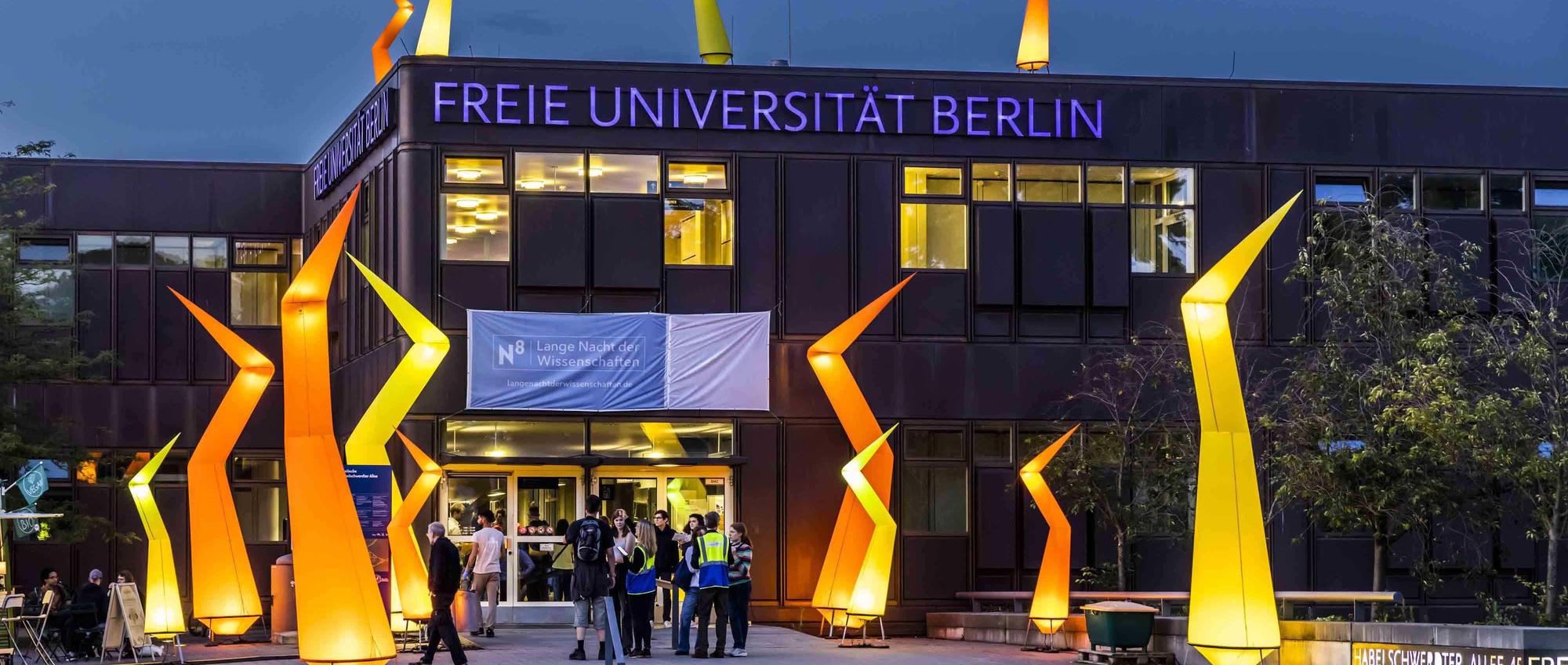
About Freie Universität Berlin
Freie Universität Berlin (FU Berlin) is a public university founded on 4 December 1948 by professors and students in West Berlin, in response to restrictions on academic freedom. The name means "Free University", and its Latin motto, "Veritas, Iustitia, Libertas" (Truth, Justice, Freedom), reflects exactly the context in which it came into being. The main campus is in Berlin-Dahlem, a green and quiet district in the south-west of Berlin, with easy access via the U-Bahn metro (U3).
FU Berlin is one of Germany's universities of excellence (Exzellenzuniversität), a distinction earned in all three rounds of the German Excellence Strategy (2007, 2012 and 2019). Today it is part of the Berlin University Alliance, together with Humboldt-Universität, Technische Universität Berlin and Charité. In the QS World University Rankings 2026 it is 88th worldwide and the 4th best university in Germany, after TU München, LMU München and Heidelberg University.
The university has approximately 38,000 students and stands out for its extensive international community, with over 200 partnerships with universities around the world and over 400 collaborations in the Erasmus+ network. Its traditional strengths are social sciences, political science, humanities (modern languages, literature, history) and the life sciences (biology, pharmacy, veterinary medicine). Five current and former members of the academic staff have received the Nobel Prize.
For Romanian students, FU Berlin is one of the most accessible elite opportunities in Europe. As an EU citizen you pay no tuition fees for bachelor's programmes, only a semester contribution (Semesterbeitrag) of approximately €360, which also includes the public transport pass in Berlin (Semesterticket). Most bachelor's programmes are taught in German (C1 level required), but there are also programmes or courses in English, especially at master's level. Applications for candidates with a degree obtained abroad are generally made through uni-assist.
How to apply to FU Berlin
Check recognition of your Baccalaureate (HZB)
First step: confirm that you have Hochschulzugangsberechtigung (HZB), the right of access to university studies. The Romanian Baccalaureate is generally recognised, but it often needs to be supplemented. Check in the anabin database and on the FU Berlin portal how your profile is assessed and what minimum grades are required for the programme you are targeting.
Choose the programme and check the Numerus Clausus
FU Berlin is strong in social sciences, political science, humanities and life sciences. Many programmes have a Numerus Clausus (NC), a cut-off grade set each year by supply and demand. Check whether your programme has open access (zulassungsfrei) or is restricted (zulassungsbeschränkt) and what the indicative grade was in previous years.
Apply through uni-assist
Candidates with a degree obtained abroad usually apply through uni-assist, the service that evaluates and equates documents. You upload your translated Baccalaureate diploma, your transcript and the grade calculation (VPD / Vorprüfungsdokumentation). The uni-assist fee is approximately €75 for the first application and ~€30 for each additional application in the same session.
Prove your German or English
For programmes in German you need C1 level, proven through TestDaF, DSH or the Goethe-Zertifikat C1. For programmes or courses in English you need IELTS 6.5+ or TOEFL iBT 90+. Start your language preparation early; the language certificate is an admission requirement, not a formality.
Enrolment as an EU citizen (Anmeldung + Immatrikulation)
As a Romanian (EU) citizen you do not need a study visa. After acceptance, you move to Berlin, complete your Anmeldung (registering your address at the Bürgeramt), open a bank account and obtain health insurance (the European Card or a private German one). Then you complete your Immatrikulation (the actual enrolment) at FU Berlin.
Pay the Semesterbeitrag and start the semester
There are no tuition fees, but for each semester you pay the Semesterbeitrag (~€360), which covers the contribution to the student organisation, the student services (Studierendenwerk) and the Semesterticket (the Berlin public transport pass). The winter semester usually starts in October, and the summer semester in April.
Costs for Romanians
EU tuition fees 2026-27 (EU citizens)
Total cost of living in Berlin (estimate)
No tuition fees
As an EU citizen you automatically get the same conditions as a German student: zero tuition fees at bachelor's level. You do not need to do anything special, just prove your Romanian citizenship through your passport or ID card. The only cost is the Semesterbeitrag of approximately €360 per semester, with public transport included.
German scholarships
DAAD (Deutscher Akademischer Austauschdienst) offers scholarships for students from the EU, including from Romania. Deutschlandstipendium: €300 per month for students with good results, funded half by the state and half by private sponsors. Erasmus+: if you initially come on an exchange of 1-2 semesters, you receive a grant of €350-€600 per month.
Support from Romania
As a Romanian student, you can apply for the Romanian Ministry of Education scholarship for studies abroad if you gain admission to a university in the EU. Many town halls and county councils in Romania have their own scholarship programmes for their students who go abroad to study. These can often be combined with German scholarships, but must be applied for in parallel.
Want to apply to FU Berlin?
We help you check the recognition of your Baccalaureate, choose the right programme, apply through uni-assist and take advantage of tuition-free studies as an EU citizen. Our mentors have been through the process. The mentoring session is 100% free.
Talk to a mentorFrequently asked questions
How much do admissions and studies at FU Berlin cost for Romanians?
As an EU citizen, you pay no tuition fees for bachelor's programmes at FU Berlin. The only recurring cost is the Semesterbeitrag of approximately €360 per semester (~€720 per year), which also includes the public transport pass in Berlin (Semesterticket). When you apply you also pay a uni-assist fee of approximately €75. The main cost of studying in Germany is the cost of living in Berlin: accommodation €450-€750 per month, food €250-€350 per month, health insurance ~€120 per month, so approximately €900-€1,300 per month in total.
How hard is it to get into FU Berlin?
Unlike American universities, FU Berlin does not use a holistic admissions process with essays and interviews. Many programmes are zulassungsfrei (open access, you get in if you meet the requirements), while others have a Numerus Clausus (NC), a cut-off grade set each year by supply and demand. For competitive programmes in social sciences, psychology or the life sciences, the NC may require a high Baccalaureate average. The decision is made predominantly on the basis of the grade, not on an extracurricular profile.
Is the Romanian Baccalaureate accepted at FU Berlin?
Yes, but with an assessment. The Romanian Baccalaureate can constitute Hochschulzugangsberechtigung (HZB), the right of access to university, but sometimes it has to be supplemented depending on the programme and grades. Check in the anabin database how your profile is recognised. The documents (diploma, transcript) are translated and usually submitted through uni-assist, which calculates the equivalent average on the German scale (1.0 the best, 4.0 the minimum passing grade).
What is uni-assist and why is it needed?
uni-assist is a centralised service that evaluates and equates degrees obtained abroad for many German universities, including FU Berlin. Instead of each university checking the documents individually, uni-assist does it once and issues a pre-verification document (VPD). The fee is approximately €75 for the first application and ~€30 for each additional application in the same session. Watch the deadlines: processing takes a few weeks, so apply early.
Are the programmes at FU Berlin in German or in English?
Most bachelor's programmes at FU Berlin are taught in German, so you need C1 level, proven through TestDaF, DSH or the Goethe-Zertifikat C1. There are also programmes or courses in English, more numerous at master's level (for example in political science, international relations, the life sciences). For programmes in English you need IELTS 6.5+ or TOEFL iBT 90+. If you want to study in German but do not yet have C1 level, plan a year of language preparation before applying.
What are the strongest programmes at FU Berlin?
FU Berlin is recognised in particular for social sciences and political science (the Otto Suhr Institute, one of the largest political science centres in Germany), humanities (modern languages, literature, history, regional studies), and the life sciences (biology, biochemistry, pharmacy, veterinary medicine). In the QS subject rankings, the university achieves very good positions in English, modern languages, politics, sociology and social sciences. It is also a university of excellence (Exzellenzuniversität) in all three rounds of the German Excellence Strategy.
Do I need a visa to study in Germany?
No. As a Romanian (EU) citizen you have the automatic right to study and work in Germany without a study visa. After arriving in Berlin you only need to complete your Anmeldung (registering your address at the Bürgeramt in the first few days), open a bank account and have health insurance (the European Health Insurance Card or a private German one). Then you complete your Immatrikulation at FU Berlin and pay the Semesterbeitrag. The process is much simpler than for a non-EU student.
Can I stay in Germany to work after graduation?
Yes, as an EU citizen you have the automatic right to work in Germany without a visa or work permit, both during your studies (part-time) and after graduation. Germany is the largest economy in the EU, with strong demand for graduates in fields such as IT, engineering, life sciences, research, consulting and the public sector. Berlin in particular is a European hub for startups and tech companies. With a degree from FU Berlin recognised throughout the EU, you can later work anywhere in the European Union without a visa.
Our mentors from Europe
They studied at Bocconi, Sciences Po, TU Delft, ETH Zurich and other EU universities. Now they guide you.


