
IT University of Copenhagen
A Danish public university specialized exclusively in IT and digital, founded in 1999 in the Ørestad district of Copenhagen. Strong in computer science, software, data science, digital design and business IT. Roughly 3,100 students. As an EU citizen, your studies are FREE, and with a part-time job you can also receive the Danish state grant SU.
About IT University of Copenhagen
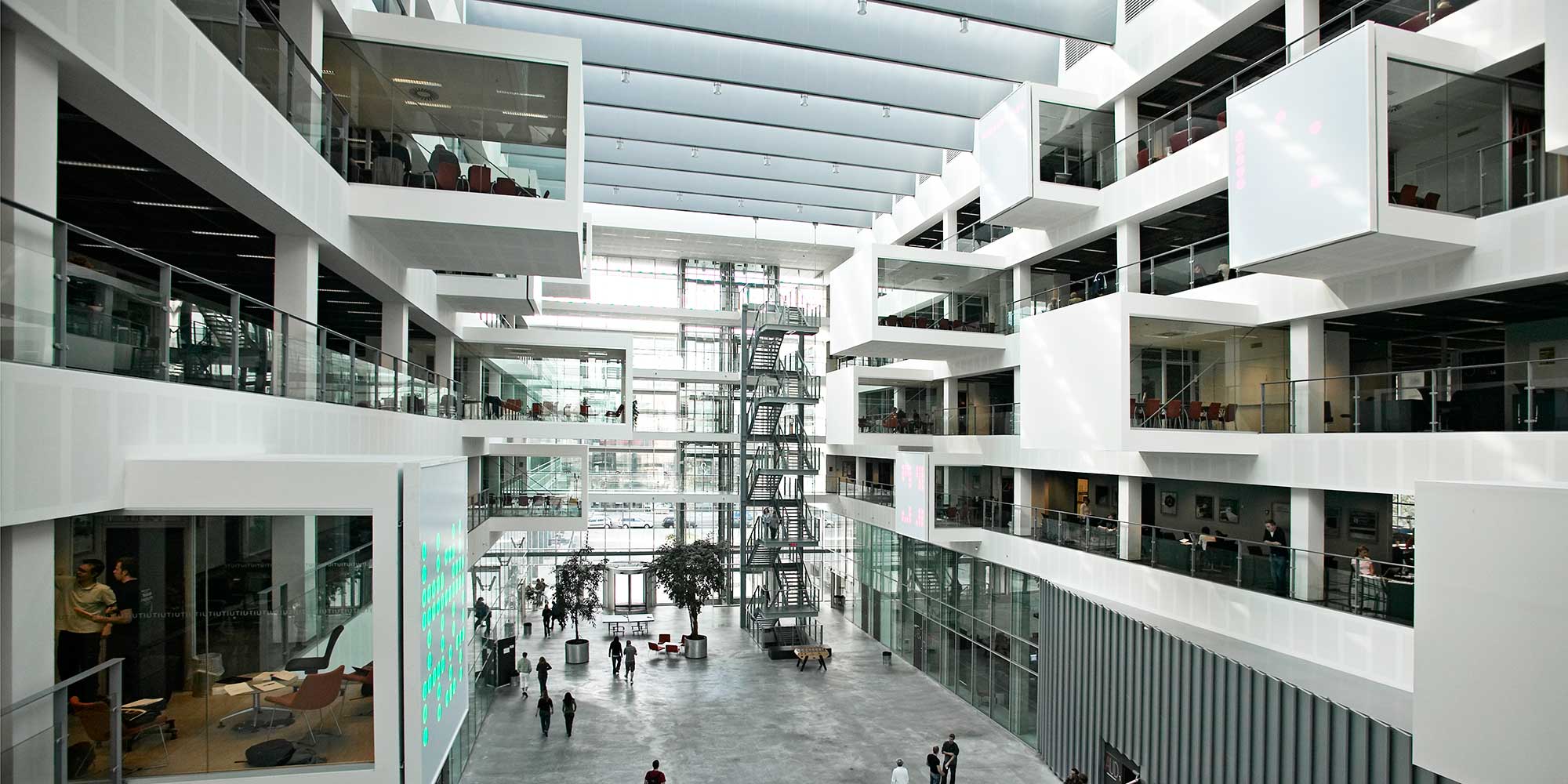
IT University of Copenhagen (ITU) is a Danish public university specialized exclusively in information technology, founded in 1999. It is a young but highly focused institution: unlike classic universities that cover every field, ITU is entirely dedicated to the digital domain, with the motto "Dedicated to the digital world". The campus is in Ørestad, a modern district on the island of Amager in Copenhagen, directly connected to the metro and to the airport.
ITU is a small and concentrated university: roughly 3,100 students in total (bachelor, master, doctorate) and around 100 academic staff. This means smaller groups, direct access to professors and an environment intensely oriented toward practice and collaboration with the Copenhagen tech industry. The strong fields are computer science and software engineering, data science, digital design and interactive technologies, business IT, plus research in computational social science, games, information security and computing education.
About rankings, be realistic: ITU is a small and specialized university, so it does not appear high in general rankings (which favor large, multidisciplinary universities). In the QS World University Rankings by Subject 2026 for Computer Science, ITU is in the 651-700 range worldwide. ITU's value lies not in its overall ranking position, but in its pure focus on IT, its close ties to the Danish tech scene and the fact that you are in an ecosystem where everything you learn is digital.
For Romanian students, important to know honestly: although ITU offers 4 bachelors (BSc), the only one open to international students and taught in English is BSc Data Science. Global Business Informatics is in English, but it is not open to international applicants; Software Development and Digital Design are in Danish (advanced level required). As an EU citizen, studying at ITU is FREE (Denmark does not charge tuition to students from the EU/EEA), and the bachelor lasts 3 years (180 ECTS). In addition, if you work part-time in Denmark, you can become eligible for the Danish state grant SU.
How to apply to ITU
Choose the program and check the language
ITU has 4 bachelors. In English, open to international students: only Data Science (Global Business Informatics is in English, but it does not accept international applicants). In Danish: Software Development and Digital Design. Check the subject requirements (mathematics, especially for Data Science). Be honest with yourself about language: for the Danish-taught programs you need an advanced level.
Apply on Optagelse.dk (the KOT system)
All Danish bachelors are applied for through the national portal Optagelse.dk, part of the centralized KOT system (Den Koordinerede Tilmelding). For applicants with a foreign diploma (Romanian Baccalaureate), the deadline is 15 March, 12:00 noon CET. For Danes the deadline is later (July), but you use the March deadline.
Quota 1 and Quota 2 (how selection works)
Denmark uses two paths: Quota 1 (you qualify on your Baccalaureate grade average alone, converted to the Danish 7-trin scale) and Quota 2 (the average plus additional criteria, such as a motivation letter, tests, experience). If your Baccalaureate average is not enough for Quota 1, Quota 2 gives you a second chance.
Prove your English (IELTS 6.5+) or Danish
For the English-taught programs, you need IELTS 6.5+ or an equivalent TOEFL (the Danish "English B" requirement). Exception: if your high school was taught in a recognized English language. For the Danish programs, you must prove advanced Danish (Studieprøven / Dansk niveau).
Registration as an EU citizen and CPR
As a Romanian (EU) citizen you do not need a study visa. After admission and arriving in Denmark, you register for the EU registration certificate (EU residence document) and obtain the CPR number (the Danish personal card), required for banking, health insurance and to apply for the SU grant.
Enrollment, SU and start of studies
After your place is confirmed (July-August), you complete enrollment online at ITU and start in September. Studies are FREE for you as an EU citizen. If you also want the SU grant (~5,000 DKK/month), you can apply once you have a part-time job of at least 10-12 hours/week that gives you EU worker status.
Costs for Romanians
Tuition 2026 (EU/EEA citizens)
Cost of living in Copenhagen (estimate)
Free tuition
As a Romanian (EU/EEA) citizen, you pay no tuition at ITU. You only need to prove EU citizenship via passport or ID card. That means a saving of almost €49,500 over 3 years compared with a non-European student, who pays ~€8,250 per semester.
SU for Romanians
SU (Statens Uddannelsesstøtte) is the Danish state's monthly grant (~5,000 DKK/month). As an EU citizen, you can become eligible if you have a part-time job of at least 10-12 hours/week and EU worker status. Many Romanian students in Denmark combine SU with a part-time job to cover their living costs.
Income from work
As an EU citizen you can work freely, without a work permit. Copenhagen has a strong tech market, so ITU students often find student jobs in IT. In addition, you can combine this with Erasmus+ for mobility and with possible grants from your town hall/region in Romania for students abroad.
Want to apply to ITU Copenhagen?
We help you aim for BSc Data Science (the only bachelor open to international students, in English), apply correctly on Optagelse.dk by the 15 March deadline, prepare your Quota 2 and take advantage of free studies plus the SU grant. Our mentors have been through the process. The first mentoring session is 100% free.
Talk to a mentorFrequently asked questions
How much does ITU Copenhagen cost for a Romanian student?
For you, as an EU citizen, tuition is zero. Denmark does not charge tuition fees to students from the EU/EEA/Switzerland. A non-European student would pay ~€8,250 per semester (almost €49,500 for a 3-year bachelor), but you pay nothing.
The only real cost is living in Copenhagen, an expensive city: roughly €12,000-€16,000 per year (accommodation €650-€1,000/month, food €300-€400/month, transport €50-€70/month). Part of this can be covered through the SU grant and through a part-time job.
Are ITU's bachelor programs in English or in Danish?
ITU has 4 bachelors (BSc), but for international students only BSc Data Science is open, in English. Global Business Informatics is in English, but it does not accept international applicants; Software Development and Digital Design are in Danish.
For Data Science you need IELTS 6.5+ (or equivalent). The Danish-taught programs require advanced Danish, which for a Romanian without Danish is a real barrier. Our recommendation for Romanian students is BSc Data Science.
How do you apply to ITU through Optagelse.dk and what is the KOT system?
All Danish bachelors are applied for through the national portal Optagelse.dk, part of KOT (Den Koordinerede Tilmelding, Denmark's coordinated admission system). For applicants with a foreign diploma, such as the Romanian Baccalaureate, the deadline is 15 March, 12:00 noon CET, earlier than for Danes (July).
You apply online, upload your Baccalaureate diploma and transcript, your language proof (IELTS) and, for Quota 2, a motivation letter. You can choose several programs in order of preference.
What are Quota 1 and Quota 2 and which is the path for Romanians?
Denmark selects through two paths. Quota 1: you qualify exclusively on your Baccalaureate grade average, converted to the Danish scale (7-trin, from -3 to 12). If your average is high enough, you get in directly.
Quota 2: in addition to the average, additional criteria are assessed, such as a motivation letter, relevant experience, possibly tests. Quota 2 is a second chance if your average is not enough for Quota 1. For Romanians we recommend preparing the Quota 2 component thoroughly as well, especially for competitive programs like Data Science.
What level of English do I need at ITU?
For the English-taught program open to international students (Data Science), ITU requires IELTS 6.5+ or an equivalent TOEFL, in line with the Danish "English B" requirement. You must demonstrate that you can follow the courses entirely in English.
Exception: if your high school was taught in an officially recognized English language, you may be exempted from the English test. For Romanian students, the safest approach is to take IELTS early, at least a year before the 15 March deadline.
Can I receive the Danish SU grant as a Romanian student?
Yes, it is possible. SU (Statens Uddannelsesstøtte) is the Danish state's monthly grant, roughly 5,000 DKK per month. As an EU citizen, you do not receive SU automatically just because you study, but you become eligible if you obtain EU worker status: that is, you have a part-time job of at least 10-12 hours per week, sustained over a period (generally 10 consecutive weeks before applying).
In practice, many Romanian students in Denmark take a student job and then apply for SU, combining the grant with income from work to cover their living costs in Copenhagen.
How long is the bachelor and how does ITU stand in the rankings?
The bachelor at ITU lasts 3 years (180 ECTS), according to the European Bologna system, one year less than in many other European countries where bachelors last 4 years.
About rankings, be realistic: ITU is a small university specialized exclusively in IT, so it does not appear high in general rankings, which favor large multidisciplinary universities. In the QS World University Rankings by Subject 2026 for Computer Science, ITU is in the 651-700 range worldwide. Its real value lies in its pure focus on digital and its ties to the Danish tech scene, not in an overall ranking position.
Can I stay and work in Denmark after graduation?
Yes, as an EU citizen. Unlike the USA or the United Kingdom where you need a work visa, as a Romanian (EU) citizen you can work freely in Denmark, without a work permit, both during your studies and after graduation.
Copenhagen is a strong tech hub (companies like Maersk and Novo Nordisk on the digital side, plus numerous startups and software and gaming companies). ITU graduates are highly sought after in software, data science and digital design. With a Danish degree recognized across the EU, you can then work anywhere in the European Union without a visa.
Our mentors from Europe
They studied at Bocconi, Sciences Po, TU Delft, ETH Zurich and other EU universities. Now they guide you.

