
Carnegie Mellon University
Its School of Computer Science is ranked #1 in the world for CS (tied with MIT, Stanford, Berkeley). Roughly 20% of undergraduate students are international, among the most diverse in the US top tier. 6 undergraduate schools with separate admissions. Note: CMU does NOT offer undergraduate financial aid to international students, the family must cover roughly $87k/year.
About Carnegie Mellon
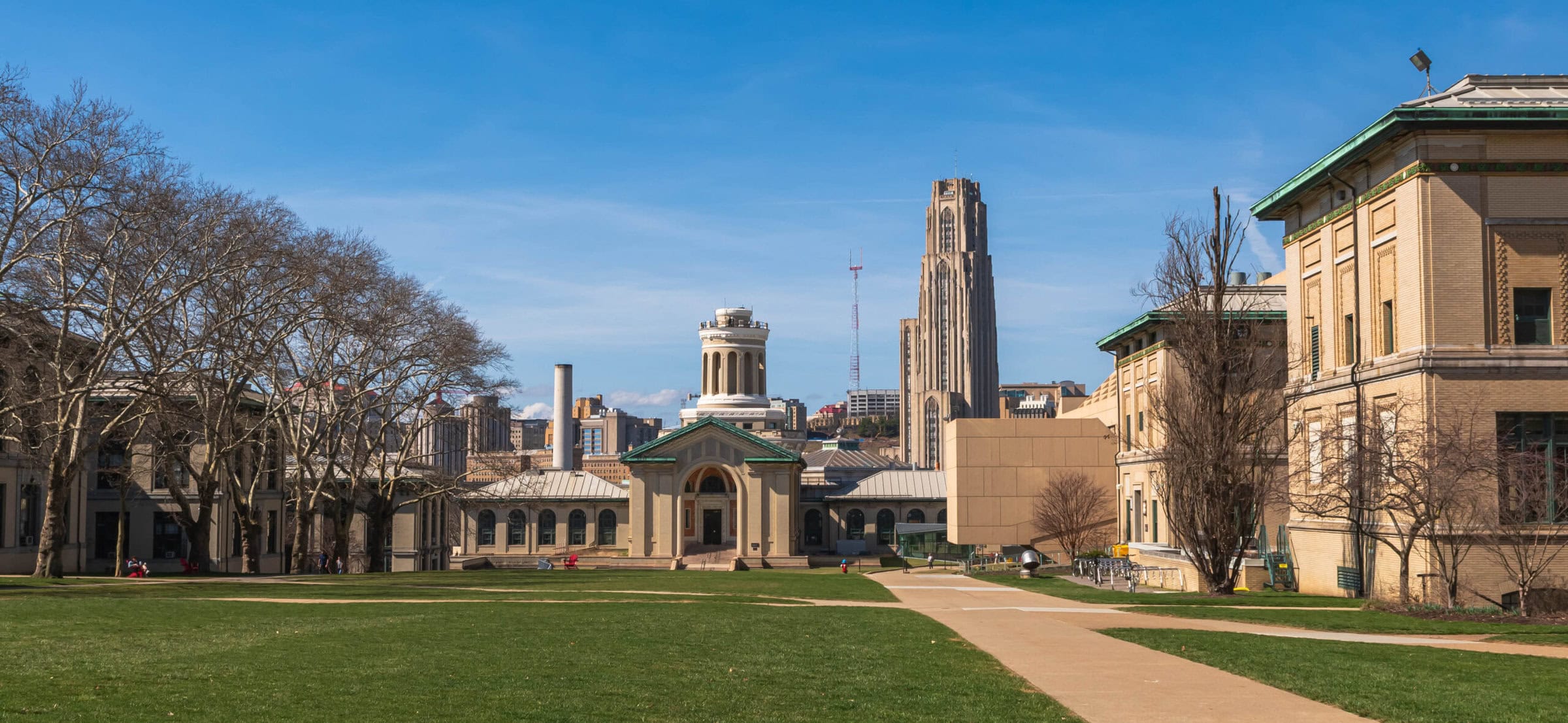
Carnegie Mellon University is located in Pittsburgh, Pennsylvania, the second-largest city in Pennsylvania, formerly the capital of the steel industry and now a major tech hub (Google, Uber Autonomous, Duolingo HQ, Meta AI Research). The 60-hectare campus is 5 km from downtown Pittsburgh, next to the University of Pittsburgh. Founded in 1900 by Andrew Carnegie (Carnegie Technical Schools) and merged in 1967 with the Mellon Institute (donated by the Mellon family), CMU grew from a technical school into one of the best-known research universities in the world, especially for Computer Science, AI and Robotics.
CMU has 6 undergraduate schools, each with separate admissions and very different acceptance rates: the School of Computer Science (SCS), ranked #1 in the world for CS, with an acceptance rate of roughly 5-7% (similar to the Ivies); the College of Engineering (CIT) with Mechanical, ECE, Biomedical, ChemE, Materials Science, Civil; the Tepper School of Business with a strong emphasis on analytics and quantitative finance; the College of Fine Arts (CFA) with 5 sub-schools (Architecture, Art, Design, Drama ranked among the top 5 in the US, Music); the Mellon College of Science (MCS) with Biology, Chemistry, Physics, Math; the Dietrich College of Humanities and Social Sciences with Economics, Psychology, English, History, Statistics. Critical: you apply to a single school, and switching between schools afterwards is difficult, especially toward SCS or CFA.
CMU's unique feature for Romanians: roughly 20% of undergraduate students are international (Class 2029: 43 countries represented), among the most diverse international communities in the US top 25. Asia dominates (roughly 89% of incoming internationals, especially China, India, South Korea), Europe is roughly 3%. The Robotics Institute (graduate) is ranked #1 in the world. A "nerd-friendly", collaborative atmosphere, with an emphasis on interdisciplinarity (BXA programs: a bachelor in arts plus science, dual CS plus Drama programs). Mascot: Scotty the Scottie Dog. Colors: Carnegie Red and Tartan plaid. Notable alumni: Andy Warhol (art), John Nash Jr. (Nobel Prize in Economics, undergraduate in Math), Andy Hertzfeld (Apple), Vinod Khosla (Sun Microsystems), Holly Hunter, Joe Manganiello. Historically: 13 Nobel laureates, 12 ACM Turing Awards (the top prize in CS).
How to apply to Carnegie Mellon
Common App, choice of school (final)
CMU accepts only the Common Application. On submission you choose one of the 6 schools. Important: switching schools after admission is very difficult, especially toward SCS or CFA. For SCS: applicants who are not accepted are NOT automatically redirected to another school, they are rejected. Think through your complete profile before choosing.
Deadline: ED Nov 1, RD Jan 5
Binding ED with a deadline of November 1, decision mid-December. ED rate Class 2029: 20.6% (553 of 2,680 applicants). RD rate Class 2029: 10.3% (3,306 of 32,187). General RD deadline: January 5 (not January 1 like other universities). Exception Drama and Music: RD deadline December 1, no ED. Note: if you are rejected outright in ED, you canNOT reapply in RD.
SAT/ACT test-optional for most programs
CMU is test-optional for most undergraduate programs, but SCS and Tepper recommend/require scores. Admitted profiles: SAT 1510-1560 (median 1540), ACT 33-35 (median 34). For SCS and Engineering: SAT Math 780 plus is almost mandatory. For internationals from Romania the SAT is practically mandatory, the competition is too high to rely on the transcript alone. CMU College Board code: 2074.
CMU Writing Supplement (3 essays x 300 words)
Besides the Common App Personal Statement (650 words), CMU requires 3 short essays, each max 300 words: (1) What passion or inspiration led you to this field of study? (2) How will you define a successful college experience? (3) What do you want to highlight about your profile that you did not get the chance to say elsewhere in the application? Critical tip: write numbers 1 and 2 first, then 3, so you do not repeat yourself.
Portfolio or audition (for CFA)
For Architecture: a portfolio is mandatory (design work, sketches). For Art and Design: a portfolio via SlideRoom. For Drama: a video pre-screening plus an in-person or virtual audition for those selected. For Music: pre-screening plus audition. BXA programs (bachelor of computer science plus arts, humanities plus arts, science plus arts): you apply to a primary school plus indicate BXA interest.
Recommendations plus TOEFL/IELTS
A counselor recommendation plus 2 teachers from core academic subjects (ideally from grades 11-12). For SCS and Engineering: at least one from math or science. English proficiency is mandatory if English is not the main language of instruction in high school: TOEFL 102 plus (subscore 25 plus) or IELTS 7.5 plus or Duolingo 135 plus or Cambridge 191 plus. CMU accepts self-reporting of grades initially, with official documents only after admission.
Costs, no financial aid for internationals
List cost (academic year 2025-26)
Total cost for 4 years
$0 aid
CMU states explicitly on its official site: "Carnegie Mellon doesn't offer financial aid to international students". The family pays in full. Source: cmu.edu/admission.
Limited
Only a small list of specific countries has CMU institutional scholarships (e.g. Brazil via Behring for SCS/ECE). Romania is NOT among the eligible countries.
External
The only path: external scholarships (Fulbright graduate, RBE Foundation, Open Society) or full family funding. CMU does NOT make up the difference.
Want to apply to Carnegie Mellon?
The critical decision at CMU is the choice of school: SCS has roughly 5% admission, Dietrich roughly 25%. The second critical decision: can you financially support $348k over 4 years without aid? We help you make these 2 assessments correctly, plus build the 3 short 300-word essays. The mentoring session is 100% free.
Talk to a mentorFrequently asked questions
What is the difference between CMU and other top non-Ivy schools for a Romanian?
Carnegie Mellon is the most distinctive university in the top non-Ivy tier from 2 perspectives. Academic perspective: CMU is ranked #1 in the world for Computer Science (tied with MIT, Stanford, Berkeley). No Ivy beats it at CS, AI or Robotics. For CS, ECE, AI/ML, Robotics, Game Design, Computational Biology programs: CMU is the top global choice. Plus, Drama (ranked among the top 5), Architecture (top 10), Design (among the top 5). Financial perspective: unlike Northwestern, JHU, Vanderbilt, Rice (all with generous aid packages for internationals admitted with aid), CMU does NOT offer undergraduate financial aid to internationals. This means: if your family cannot pay the full roughly $87k/year over 4 years, CMU is not a realistic option. For Romanians with financial resources: CMU is top tier for tech. For Romanians who depend on aid: CMU is less accessible than the Ivies or other top non-Ivy schools.
CMU does NOT offer financial aid to internationals, what does that mean in practice?
It means exactly what it sounds like. CMU states on its official site (cmu.edu/admission/admission/international-applicants): "Carnegie Mellon doesn't offer financial aid to international students. If you're an international student who plans to enroll at Carnegie Mellon, you and your family must plan to pay the total cost of attendance." Concretely: roughly $87,000/year x 4 years equals roughly $348,000 total, with absolutely no package from CMU (no grants, no merit scholarships, no subsidized loans). It is not need-aware (like other universities where aid lowers your chances). It is zero aid available to you as an international. The real solutions: (1) the family pays in full, (2) external scholarships: Fulbright (graduate), Open Society, Lift the Lid, etc., (3) private loans with an American cosigner (Sallie Mae, College Ave), (4) savings plus selling assets. Do NOT apply to CMU if you do not have the financial plan ready.
How do I choose among CMU's 6 undergraduate schools?
The most important decision when applying to CMU. Acceptance rates differ enormously between schools: SCS ~5-7% (more competitive than most Ivies), CIT (Engineering) ~12-15%, Tepper Business ~15%, CFA (Architecture/Drama/Music/Art/Design) ~10-25% depending on the program, MCS ~15-18%, Dietrich (Humanities/Social Sciences) ~20-25%. The strategy for Romanians: if you are very strong in math and have a genuine passion for CS, apply to SCS (but be prepared for rejection, Dietrich has the same subjects but is more accessible). For Engineering (CIT): a good choice if you are not sure you are in the top 5%. For CFA: a portfolio or audition is decisive. Do NOT apply to a school with easy admission just to get in, switching later is difficult.
What is CMU's School of Computer Science like, is it worth applying directly?
SCS at CMU is considered ranked #1 in the world for CS by most rankings (US News, CSRankings, QS), tied with MIT, Stanford and Berkeley. SCS undergraduate programs: Computer Science (classic), Computational Biology, AI (the first undergraduate AI program in the US, launched in 2018), Human-Computer Interaction. Unique features: courses such as 15-213 (Systems) and 15-251 (Math Foundations) are legendary for their rigor. SCS has the strongest emphasis on systems programming, algorithms and theory in the US. SCS acceptance rate for internationals: roughly 3-5% (vs roughly 7% overall SCS). For Romanians: if you have national or international computer science olympiads (OJI, ONI, IOI etc.), serious open-source projects, tech internships: it is a realistic target. Without that: apply to CIT (Engineering) or Dietrich (Information Systems via Dietrich is an alternative).
ED at CMU, what is the strategy for Romanians?
CMU offers a single binding ED round, deadline November 1, decision mid-December. ED rate Class 2029: 20.6% (553 of 2,680 applicants) vs RD 10.3%. ED nearly doubles your chances. Special note: if you are rejected outright in ED, you canNOT reapply in RD (you are either deferred into the RD pool, or denied equals out on the spot). For Romanians: apply ED only if (1) CMU is clearly your first choice, (2) you have the financial plan ready (CMU does not offer aid, so "I'll see what they offer" does not work), (3) your profile is clearly at the required level. ED is not available for Drama, BXA Design and Music, for these programs only RD. For CFA (other programs such as Architecture, Art): ED exists but the supplementary materials (portfolio) must be ready by November 1.
Is there any external scholarship Romanians can use for CMU?
Yes, but the options are limited and very competitive. Main sources for Romanians: (1) Fulbright, for graduate, NOT undergraduate. (2) Open Society Foundations, scholarships for international studies, but focused on graduate and on social fields. (3) RBE, Romanian-British Educational Foundation, a few scholarships, but priority for the UK. (4) Private corporate scholarships, some Romanian companies fund studies in the US for employees' children. (5) US private loans with an American cosigner, Sallie Mae, College Ave, Earnest offer loans to internationals if they have a US citizen co-signer. There is NO large scholarship "for Romanians" that would cover $348k. The real solution for CMU: full family funding or a combination of small sources. Important: apply for external scholarships before applying to CMU, many have deadlines in November or December.
Pittsburgh, what is it like as a city for a Romanian student?
Pittsburgh is one of the most affordable university cities in the US. Advantages: cost of living much lower than NYC, Boston or SF (off-campus rent roughly $800-1,200/month vs $2,000 plus on the expensive coasts), a safe city (the university in the Oakland neighborhood, student-friendly), a major tech hub (Google Pittsburgh, Uber Autonomous Vehicles, Duolingo HQ, Meta AI Research Lab, all 10-15 min from campus), an international airport with direct flights to most European hubs. A strong international community: roughly 20% international equals one of the most diverse tech environments in the US. Winter is cold (roughly minus 5 degrees C), summer is pleasant. Disadvantages: it is not a "cool" city like NYC or SF, public transport is ok but not excellent (a car helps in year 2 plus), Pittsburgh airport is smaller than the big hubs. For Romanians: Pittsburgh is very well integrated for internationals, far more welcoming than the stereotypes suggest.
How many Romanian students are at Carnegie Mellon?
CMU has roughly 20% international undergraduate students (the highest percentage among top non-Ivy schools), but the Romanian community is small in that context, because most internationals are from Asia (roughly 89% of newcomers). Realistic estimates for Romanians: 1-2 Romanian students per year at the undergraduate level, the total undergraduate community ranges between 5-15 people. At the graduate level (Master's and PhD in CS, Engineering, MBA Tepper), the number is higher: 10-20 per year, the total community 60-100 people. The Romanian Student Association at CMU is active, organizing regular events, professional connections after graduation. CMU is very popular among Romanians oriented toward SCS (CS, AI), CIT (ECE, Mechanical), Tepper MBA. Many internships and job offers at big tech companies through CMU's networking.
Our mentors for the USA
They studied in the USA, at universities such as Harvard, MIT and Stanford. They went through the process. Now they guide you.


