
University of Pennsylvania
Founded by Benjamin Franklin in 1740. The only Ivy designed secular and multidisciplinary from the start. Home of Wharton (the world's first business school), of 4 undergraduate schools and of the best-known Coordinated Dual Degree Programs in the USA.
About UPenn
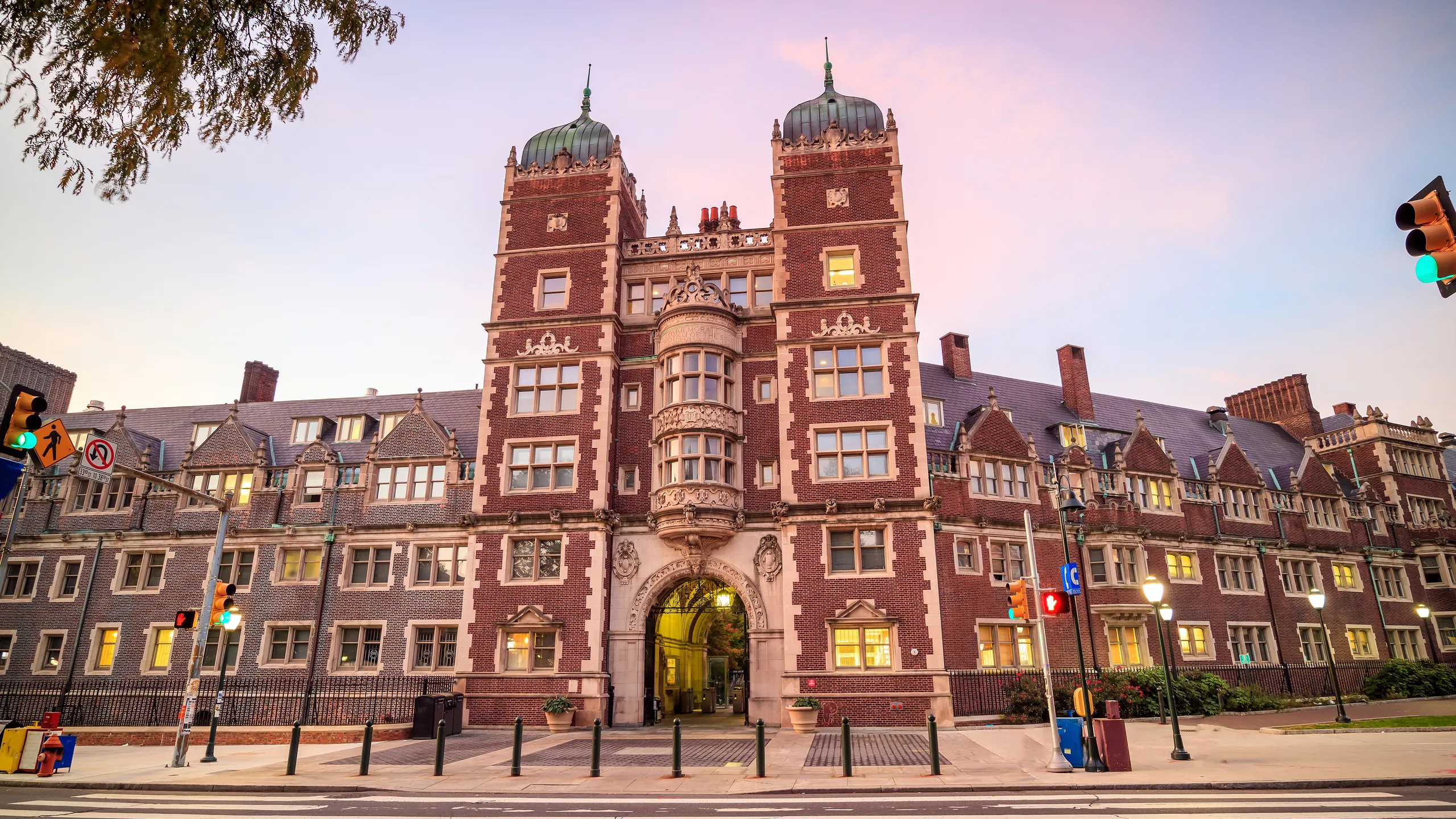
University of Pennsylvania (Penn, UPenn) was founded in 1740 by Benjamin Franklin, the only Ivy designed from the start as a secular and multidisciplinary university (all the others began as theological schools). The 119-hectare campus sits in University City, in West Philadelphia, 90 minutes by Amtrak from Manhattan and 1h45 from Washington DC. Locust Walk is the central pedestrian artery, and the architecture blends classic Collegiate Gothic (College Hall) with modern (Perelman Quadrangle).
Penn has 4 distinct undergraduate schools, a unique structure among the Ivies. You apply to one specific school at admission, you cannot apply to several at once. College of Arts and Sciences (CAS, ~6,000 students, liberal arts with 50+ majors). Wharton School (~2,700 students, founded 1881, the world's first business school and consistently #1 globally, a BS in Economics with concentrations). Penn Engineering (SEAS, ~1,800 students, a strong focus on Computer Science, Bioengineering, Robotics). Penn Nursing (~600 students, a top-ranked nursing school in the USA).
Penn's signature feature: Coordinated Dual Degree Programs (CDDs). Four-year programs that lead to 2 integrated degrees (not 2 majors within a single degree). M&T (Wharton + Engineering, for tech entrepreneurs). Huntsman (Wharton + International Studies + an advanced foreign language). Vagelos LSM (Wharton + Life Sciences, for pre-med and biotech). NHCM (Nursing + Wharton, healthcare management). DMD (Digital Media Design, Engineering + Design). Vagelos Integrated Program in Energy Research (VIPER). CDD admit rates are 1-3 percent, among the most competitive programs in the USA.
Plus the One University policy: any Penn student (regardless of their undergraduate school) can take courses from any school, with no bureaucratic restrictions. CAS students can minor at Wharton, Engineering students can take Nursing courses, and so on. Penn is also known as "the Social Ivy": roughly 30 percent of students are in Greek life (frats/sororities, vs 5-10 percent at Yale/Princeton), with lively traditions (Spring Fling, Hey Day, Toast Throwing at football games) and a vibrant atmosphere on Locust Walk.
For Romanian students: Penn admits on average 3-5 Romanians per year at undergrad level (across the 4 schools combined). The active Romanian community (undergrad plus grad plus Wharton MBA plus recent alumni) numbers 80-120 people, among the largest in the Ivy League thanks to Wharton. The Romanian Business Society at Penn (RBSP) organizes networking events. Note: Penn is need-aware for internationals (see the Costs section). Notable alumni: Elon Musk (Wharton + Physics), Warren Buffett (transferred after 2 years), Donald Trump (Wharton), John Legend, Mira Nair, Noam Chomsky (faculty), Anil Ambani.
How to apply to UPenn
Common App, Coalition or QuestBridge
Penn accepts all three. When you submit you choose one of the 4 schools (CAS, Wharton, SEAS, Nursing) or apply to a Coordinated Dual Degree Program (M&T, Huntsman, Vagelos LSM, NHCM, DMD, VIPER). You apply to a single school or CDD, not several. Application fee $75, waiver available.
Early Decision BINDING (Nov 1)
Penn uses binding Early Decision, not Early Action. If it admits you in ED, you are REQUIRED to accept. The only exception: if the financial aid is insufficient. ED decision on December 15. ED rate Class of 2029: 13.6 percent (9,500 applicants, ~1,300 admitted). Wharton ED: 8-10 percent. Apply ED only if Penn is clearly #1.
Regular Decision (Jan 5)
For RD: deadline January 5, decision in late March. RD rate for Class of 2029 was roughly 3.7 percent. Internationals have significantly lower rates: 2.5 percent for Class of 2029 (441 admitted out of 17,882 international applicants).
SAT/ACT REINSTATED AS REQUIRED (Class 2030+)
CRITICAL: Penn announced the reinstatement of required SAT/ACT starting with the Class of 2030 (admission for Fall 2026 and after). It is no longer test-optional. Median of admitted students: SAT 1510-1560, ACT 34-35. For Wharton and CDDs, a score of 1530+ is practically standard. Penn code for the College Board: 2926. ACT: 3732.
Penn Supplement: 3 essays + school-specific
In addition to the Common App essay, Penn asks for: 3 short essays (~150 words) about community, your contribution to Penn, and the "aha" moment. Plus 1 essay specific to your chosen school (~350-650 words): "Why Wharton" for Wharton, "Why Engineering" for SEAS, "Why Nursing" for Nursing, "Why CAS" for the College. For CDDs: an additional program-specific essay.
Recommendations, TOEFL and interview
2 teachers (preferably both core academic subjects) plus counselor. For Wharton/M&T: a math teacher recommendation is critical. For SEAS: Math/Physics/CS. For Romanian students: TOEFL iBT minimum 100 (105+ preferred), IELTS 7.0+, Duolingo 125+. Penn offers an optional alumni interview (Penn Alumni Interview Program), not for every applicant.
Costs and financial aid
Total cost of study 2025-26
Upfront costs for Romanians
You pay $0
Families under $75,000 with typical assets receive a full ride: tuition, fees, housing, meals fully covered. Plus resources for equipment and transport.
No tuition
NEW 2025-26 (Quaker Commitment). Families between $75,000 and $200,000 with typical assets receive full tuition guaranteed. They pay only for housing/meals, partly subsidized.
Individual aid
Families above $200,000 can still receive considerable aid depending on assets (excluding the primary home) and multiple children in college. Calculated individually.
Want to apply to Penn or Wharton?
Decisions: CAS vs Wharton vs SEAS, binding ED, CDDs below 3% admit rate. Strategy matters enormously at Penn. We help you with the right school, the essays, the SAT/ACT and the full application. Your first mentoring session is 100% free.
Talk to a mentorFrequently asked questions
What is the difference between UPenn and the rest of the Ivy League for a Romanian?
Penn: the most pre-professional Ivy. The only place where you can do undergraduate business at Wharton, the most prestigious business school in the world. 4 undergraduate schools and unique CDDs. "The Social Ivy" with strong Greek life.
Harvard, Yale, Princeton: a focus on intense liberal arts, a more academic and intellectual atmosphere.
Columbia: Manhattan, need-aware like Penn, binding ED in the same way.
For business, finance, a dual major in business plus something else, or a vibrant social atmosphere: Penn is the first choice. For pure liberal arts intensive: Yale or Princeton. For the most generous FA: Princeton (need-blind, $150k zero).
What is Wharton and how do you apply to Wharton vs CAS?
Wharton School is the oldest business school in the world (founded 1881 as the first business school in the world) and consistently #1 globally in the rankings (Bloomberg Businessweek, US News, Financial Times). At undergrad level it offers a Bachelor of Science in Economics with concentrations in Finance, Marketing, Accounting, Real Estate, Statistics, Operations Management, Management, Entrepreneurship, Legal Studies, Healthcare Management and more.
When you apply, you explicitly mark Wharton or CAS (College of Arts and Sciences) or SEAS or Nursing. You cannot apply to several at once. Wharton is more selective: roughly 5 percent vs CAS roughly 7 percent. Wharton requires a separate "Why Wharton" essay in the supplement.
Switching from CAS to Wharton after admission is almost impossible (internal transfer rate roughly 1 percent). If you want Wharton, you apply to Wharton.
How do the Coordinated Dual Degree Programs (M&T, Huntsman, Vagelos) work?
Penn's CDDs are four-year programs that lead to 2 integrated degrees, not 2 majors within a single degree. You apply separately to the CDD at submission, with an additional essay. Admit rates are 1-3 percent, among the most competitive in the USA.
M&T (Management and Technology): Wharton plus Engineering. For tech entrepreneurs. Elon Musk was a CDD student here.
Huntsman: Wharton plus International Studies. Requires an advanced foreign language plus a mandatory study abroad semester.
Vagelos LSM (Life Sciences and Management): Wharton plus Life Sciences. For pre-med, biotech, pharma.
NHCM (Nursing and Health Care Management): Nursing plus Wharton. For healthcare management.
DMD (Digital Media Design): Engineering plus Design. VIPER (Vagelos Integrated Program in Energy Research): Engineering plus Natural Sciences.
For Romanian olympiad students with dual interests (math + business or science + business), the CDDs are excellent options, but the competition is brutal.
What does Early Decision BINDING mean at Penn?
Penn uses binding Early Decision, similar to Columbia, Brown and Dartmouth, but different from Harvard/Yale/Princeton/MIT which use non-binding Early Action. Binding means: if it admits you in ED, you are REQUIRED to accept the offer and withdraw all your other applications.
The only exception: if the financial aid offered is insufficient to afford Penn. For need-aware Romanians applying with aid, this is a real escape option, but it has to be clearly documented.
ED rate Class of 2029: 13.6 percent, double the RD rate (3.7 percent). For Wharton ED: 8-10 percent. ED deadline: November 1. Decision: December 15. Apply ED only if Penn is absolutely #1 on your list and you are financially prepared.
What is Quaker Commitment and how does FA work for Romanians?
Quaker Commitment, announced in November 2024 and effective from the 2025-26 academic year, is the largest expansion of Penn Financial Aid in the past decade. Four guarantees:
1) Penn covers 100 percent of demonstrated need for all admitted students who apply for aid.
2) No loans in the aid packages (the all-grant policy introduced in 2008, with Penn being the second university in the USA to eliminate loans, after Princeton in 2001).
3) The value of the family's primary home is NOT counted in the aid calculation (NEW from 2025-26). Penn is one of the few universities that fully exclude home equity.
4) Families with income up to $200,000 and typical assets receive full tuition guaranteed (extended from $140,000, NEW 2025-26).
Families under $75,000 with typical assets: a full ride (tuition plus housing plus meals). 45.4 percent of students receive aid. Average package 2025-26: $70,552.
For Romanians: Penn is need-aware (need-blind only US/Canada/Mexico). You must apply for aid AT SUBMISSION. If you are admitted without having requested aid, you can no longer request it in years 2-4.
Is SAT/ACT required at Penn now?
YES. Penn announced in 2025 the reinstatement of required SAT/ACT starting with the Class of 2030 (applicants for Fall 2026 and after). This is a major change from the test-optional policy of the COVID period. For those applying now (Class of 2030 or later), the SAT or ACT is a required component for all first-year applicants, both ED and RD.
Median of admitted students Class of 2029: SAT 1510-1560, ACT 34-35. For Wharton and CDDs (M&T, Huntsman, Vagelos), a competitive score of 1530+ is practically standard. Penn offers a testing waiver only for demonstrated hardship (financial, geographic, other documented barriers), it is not a general test-optional policy.
Penn code for the College Board: 2926. ACT: 3732. Start your SAT prep in 11th grade if you want to apply to Penn.
What is the social atmosphere like at Penn vs Princeton or Yale?
Penn is known as "the Social Ivy". Strong Greek life: roughly 30 percent of students are in frats or sororities (vs 5-10 percent at Yale/Princeton). Intense tailgating at football games, a lively Locust Walk, traditions such as Spring Fling (a week-long festival in April), Hey Day (the celebration of juniors becoming seniors), Toast Throwing at halftime of football games.
Unlike the intense and intimate academic atmosphere at Princeton (with Eating Clubs as the social focus) or Gothic-introvert Yale, Penn balances academic rigor with a vibrant social life. For students who want a "full American college" experience with sports, parties, multiple clubs, Penn is a good fit. For those who prefer academic calm and a quieter intellectual community, Princeton or Yale are a better fit.
Penn is also relatively larger at undergrad level (~11,000 vs ~5,500 at Princeton or ~6,500 at Yale), which contributes to the social diversity.
How many Romanian students are at Penn?
Penn admits on average 3-5 Romanian students per year at undergrad level, across all 4 schools combined (CAS, Wharton, SEAS, Nursing). The exact number varies, but Penn has one of the largest Romanian communities in the Ivy League thanks to Wharton and the Wharton MBA.
The active Romanian community at Penn (undergrad plus graduate plus Wharton MBA plus recent alumni) numbers 80-120 people. The Romanian Business Society at Penn (RBSP) is the main organization, running networking events and conferences for Romanian students interested in business and finance.
The typical profile of admitted Romanians: olympiad students in math or physics, a strong business-finance profile (internships at Romanian companies, entrepreneurial projects), or an applied science profile for SEAS/Vagelos LSM.
What grades do I need for Penn with the Romanian Baccalaureate?
There is no official cut-off. Admitted profiles generally have: a Baccalaureate average of 9.85+, with a 10 or close to 10 in the subjects relevant to the chosen school. IB 42+ (HL 776+) or A-Levels A*A*A.
For Wharton: perfect math, a demonstrated business-finance profile, SAT 1530+. For SEAS: very strong math plus physics plus computer science, olympiads in the field, SAT Math 760+. For CAS: a well-rounded profile, excellence in the specific field of interest. For CDDs: the profile must demonstrate fitness for BOTH components (Wharton plus Engineering for M&T, and so on).
Penn places very heavy emphasis on demonstrating passion for the chosen school. The "Why Wharton" or "Why Engineering" essay is critical. Extracurricular activities must be aligned with the school (Wharton: business clubs, finance internships; SEAS: science research, robotics).
Our mentors for the USA
They studied in the USA, at universities like Harvard, MIT and Stanford. They went through the process. Now they guide you.
