
Cornell University
The youngest and largest Ivy. Founded in 1865 as the only land-grant Ivy. 7 undergraduate colleges with separate admission: Hotel Administration (#1 in the world), ILR (unique in the USA), Engineering, CALS, AAP with a 5-year B.Arch, plus CAS and SC Johnson. Roughly 16,000 undergraduate students.
About Cornell
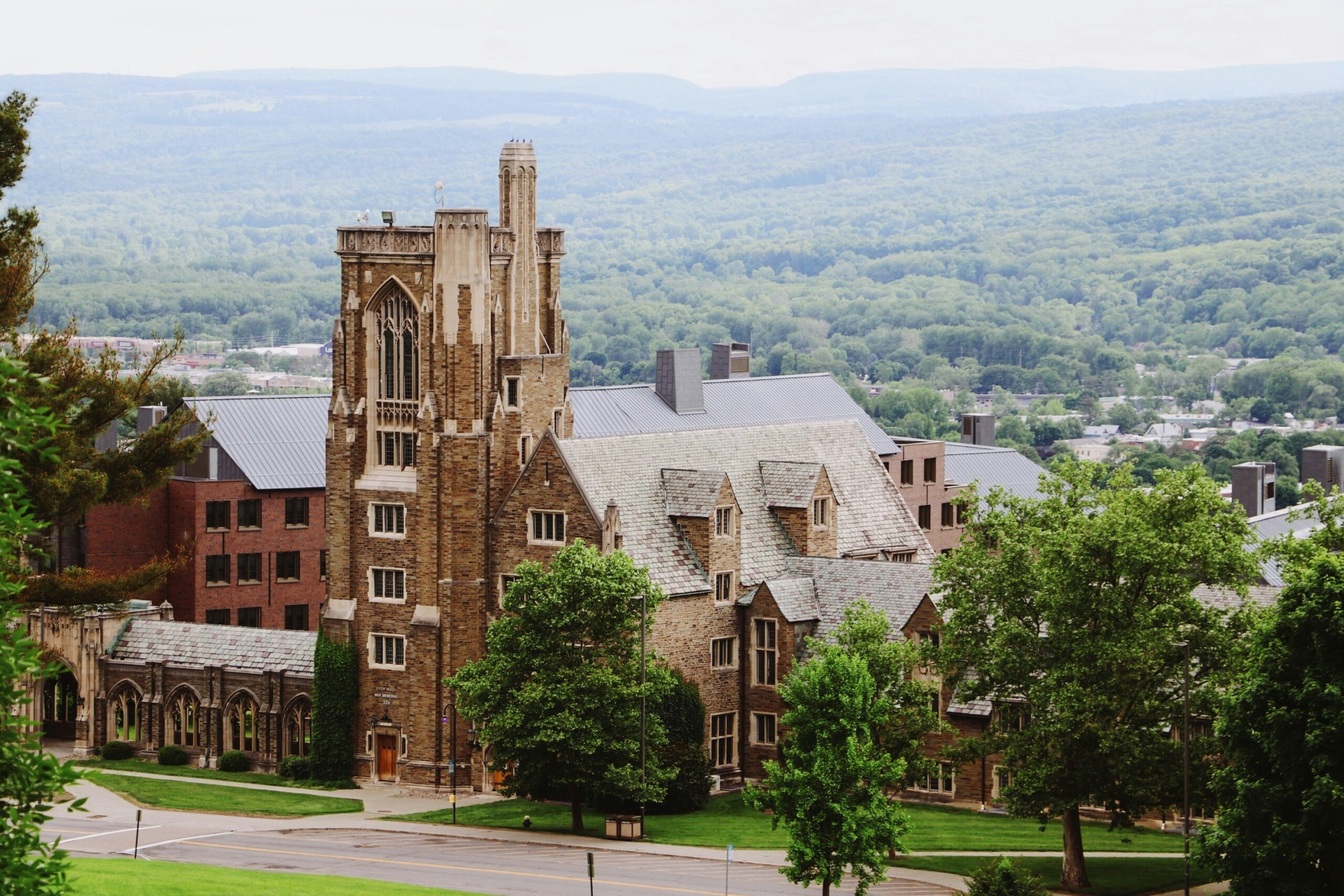
Cornell University was founded in 1865 by Ezra Cornell and Andrew Dickson White in Ithaca, New York, making it the youngest university in the Ivy League and the first American university designed from the outset as non-sectarian and open to everyone: women, minorities, international students, with no religious tests. Ezra Cornell's motto still holds today: "I would found an institution where any person can find instruction in any study." The 2,300-hectare campus sits on College Hill above Cayuga Lake (one of the Finger Lakes), with spectacular gorges (canyons with waterfalls), eclectic Collegiate Gothic plus modern architecture, and a tough climate (a long winter from November to April). It is 4 hours by car from Manhattan and 4 hours from Boston.
Cornell is the only land-grant Ivy (Morrill Act of 1862), a unique relationship with the state of New York that gives it an unmatched structure. 7 undergraduate colleges, of which 4 are "endowed" (private, funded by Cornell directly) and 3 are "contract" (a partnership with New York State). You apply to ONE SINGLE college from the moment you submit, with a specific essay. Switching after admission is difficult, especially toward Engineering, Hotel or Dyson Business.
Cornell's 7 undergraduate colleges
Three Cornell programs are unique in the USA: the School of Hotel Administration (founded in 1922 as the world's first hospitality school, consistently #1 globally). The School of Industrial and Labor Relations (ILR) (the country's only undergraduate ILR school, a favorite for pre-law). The 5-year Bachelor of Architecture (B.Arch) at AAP (top 3 in the USA). On top of that, Cornell has the best Vet School in the USA (graduate). Important for international students: non-NY tuition is THE SAME ($71,266) at both endowed and contract colleges, the difference existing only for NY State residents.
For Romanian students: Cornell admits 4-7 Romanians per year (across all 7 colleges combined), more than most Ivies due to its size. An active Romanian community of 50-80 people, with a Cornell Romanian Society spanning undergraduate and graduate students. Note: Cornell is need-aware for international students (see the Costs section). Notable alumni: Ruth Bader Ginsburg, Bill Nye, Toni Morrison (MA), Mae Jemison, Andy Bernard (from The Office, fictional), Janet Reno, Christopher Reeve.
How to apply to Cornell
Common App or QuestBridge
Cornell accepts both. When you submit, you choose ONE college out of the 7. The choice is critical: each college has its own director of admission, its own criteria, its own rates (Hotel ~25 percent, CAS ~7 percent, Engineering ~7 percent, Dyson ~3 percent). Application fee $80, waiver available.
Early Decision BINDING (Nov 1)
Cornell uses binding Early Decision, similar to Columbia, UPenn and Brown. If you are admitted in ED, you are obligated to accept. Exception: insufficient aid. ED decision on December 15. ED rate Class of 2029: 18.78 percent, significantly higher than most Ivies (due to Cornell's size).
Regular Decision (Jan 2)
For RD: deadline January 2, decision at the end of March. RD rate Class of 2029: 6.70 percent (4,187 admitted out of 62,466 applicants). Class of 2029 total: 6,077 admitted out of 72,523 applicants (overall rate 8.38 percent), the largest class admitted in Cornell's history.
SAT/ACT REINSTATED for Class of 2030+
CRITICAL: Cornell has announced it is reinstating required SAT or ACT starting with Fall 2026 (Class of 2030 and after). Class of 2029 was the last test-optional cycle. Median of admitted students Class of 2029: SAT 1500-1560, ACT 34-35. Cornell's College Board code: 2098. ACT: 2726.
Cornell Supplement: college-specific essay
In addition to the Common App essay, Cornell asks for 1 essay specific to the chosen college (350-650 words): why you want to study AT THIS COLLEGE, what specialization attracts you, what you will do with this education. The Hotel School also asks for a list of hospitality experiences. AAP requires an art portfolio for the B.Arch.
Recommendations, TOEFL and interview
2 teachers plus a counselor. For Engineering, a Math/Physics recommendation is critical. For CALS/pre-vet, Biology/Chemistry. For Romanian students: TOEFL iBT minimum 100, IELTS 7.0+, Duolingo 120+. The Hotel School and AAP offer evaluative interviews (even for international students). The other colleges: optional alumni interview.
Costs and financial aid
Total cost of study 2025-26
Initial costs for Romanians
Cornell is need-aware for international students (need-blind only for US citizens). This means that the family's financial situation is taken into account in the admission decision. The more aid you request, the stronger your academic and personal profile needs to be. Critical: you must apply for aid AT THE TIME OF SUBMISSION. If you are admitted without having requested aid, you can NO LONGER request it in years 2, 3 or 4. Cornell thus joins Columbia and UPenn in the category of need-aware Ivies for international students.
You pay $0
Cornell Tradition policy: families under $75,000 with modest assets receive zero parent contribution PLUS zero loans. Full coverage of tuition, housing, meals, books.
Substantial aid
Families between $75,000 and $160,000 receive considerable aid. The contribution is calculated based on income, assets and multiple children in college.
Calculated individually
Families over $160,000 can receive considerable aid depending on circumstances. Average package for a student who receives aid: $63,849.
Want to apply to Cornell?
7 colleges with admission rates between 3 and 25 percent. The choice of college matters enormously. The ED-Cornell strategy is strong (~22%) if you are convinced. We help you with strategy, college-specific essays, SAT/ACT and the complete application. The first mentoring session is 100% free.
Talk to a mentorFrequently asked questions
What is the difference between Cornell and the rest of the Ivy League for a Romanian?
Cornell: the largest Ivy (~16,000 undergrad, double most of them), the most academically diverse (7 colleges with completely different characters). The only place where you can study at the undergraduate level:
Hospitality (Hotel School #1 in the world), Industrial and Labor Relations (ILR, unique in the USA), applied Agriculture and Life Sciences (CALS), professional Architecture in 5 years (AAP B.Arch), Veterinary (graduate but strongly visible from CALS undergrad).
For niche pre-professional programs: Cornell is clearly the first choice. For CS, classic business, liberal arts: comparable to Penn/Columbia. Trade-off: Ithaca is isolated (4 hours from Manhattan), long winter. Atmosphere: "beautiful nature, tough winter, strong community".
What is the Cornell Hotel School and why is it famous?
The School of Hotel Administration (officially part of the SC Johnson College of Business since 2017) is the world's first hospitality management school, founded in 1922 in response to the American hotel industry's needs after WW1. Consistently #1 globally.
The program combines a business core (finance, marketing, accounting, real estate, statistics) with hospitality-specific subjects (hotel operations, food and beverage management, revenue management, asset management, restaurant management). The Statio Restaurant on campus is run by students. A mandatory industry internship is required.
Marriott, Hilton, IHG, Four Seasons, Hyatt, Accor and most major brands recruit from Cornell Hotel. Many alumni are CEOs or in the C-suite of global hospitality.
The admission rate is ~25 percent, significantly higher than CAS ~7 percent. But you must demonstrate authentic passion for hospitality: restaurant/hotel experience, reading about the industry, organized events, a profile that shows you are not applying just for "easy Ivy entry". The Hotel committee immediately detects applicants without an authentic fit.
How do I choose among the 7 colleges at admission?
Choosing the college is the most important Cornell-specific decision. Guidelines:
Liberal arts, pre-med, humanities, math, theoretical science: College of Arts and Sciences (CAS).
Engineering, Computer Science, ORIE, BME: Cornell Engineering.
Business / Finance: SC Johnson College of Business → Dyson (applied economics + management) or Hotel School (hospitality).
Pre-vet, applied biology, agronomy, food science: CALS (College of Agriculture and Life Sciences).
Nutrition, fashion design, Human Development, policy: Human Ecology.
Pre-law, HR, labor studies, conflict resolution: ILR.
Architecture (5-year B.Arch), Fine Arts, City and Regional Planning: AAP.
Switching after admission is difficult, especially toward Engineering, Hotel or Dyson. CAS to Engineering is almost impossible. CALS to Engineering similar. Choose carefully based on real fit, not on the "higher admission rate".
Cornell ED binding: how does it work and is it a good strategy for Romanians?
Cornell uses binding Early Decision, similar to Columbia, UPenn and Brown. "Binding" means: if you are admitted in ED, you are OBLIGATED to accept the offer and withdraw all other applications. The only exception: insufficient financial aid.
ED deadline: November 1. Decision: December 15. Cornell ED rate Class of 2029: 18.78 percent, significantly higher than most Ivies (due to Cornell's size and large ED pool). RD rate: 6.70 percent. ED admission gives a boost of approximately 2.8x over RD.
For Romanians, ED Cornell can be a good strategy IF: (1) Cornell is absolutely #1 on your list, (2) you are convinced of the choice of college among the 7, (3) your family can support the cost or you are prepared to withdraw if the aid is insufficient. ED Cornell is more accessible than ED Harvard/Princeton/Yale (which are non-binding EA).
How does Cornell Financial Aid work for Romanians?
Important: Cornell is need-aware for international students, alongside Columbia and UPenn. This means that the financial situation is taken into account in the admission decision. The more aid you request, the stronger your academic and personal profile needs to be.
But for international students admitted with aid, Cornell covers 100 percent of demonstrated need with pure grants (no loans for families under $75,000, the Cornell Tradition policy). Total international aid at Cornell: approximately $30 million per year. 50 percent of students receive aid. Average grant: approximately $63,849.
Tiers:
Families with income under $75,000 and modest assets: zero parent contribution, no loans. Cornell Tradition.
Families between $75,000 and $160,000: substantial aid, calculated individually.
Families over $160,000: considerable aid depending on assets, multiple children in college, circumstances.
CRITICAL: you must apply for aid AT THE TIME OF SUBMISSION, in year 1. If you are admitted without having requested aid, you can no longer request it in years 2-4.
Is SAT/ACT required at Cornell now?
For CURRENT applicants (Class of 2030 = Fall 2026 entry and after): YES, SAT or ACT is REQUIRED.
Cornell has announced the reinstatement of required SAT/ACT starting with the Class of 2030. The Class of 2029 (Fall 2025) was the last test-optional cycle. For those applying now for Fall 2026 entry, standardized testing is a mandatory component.
Median of admitted students Class of 2029: SAT 1500-1560 (median 1530), ACT 34-35 (median 35). For Engineering and SC Johnson Business (Dyson), the math score is analyzed with special attention. For the Hotel School, a competitive score is recommended but passion for hospitality matters more.
Cornell's College Board code: 2098. ACT: 2726.
Note: Cornell is different from Columbia, the only Ivy that remains permanently test-optional.
What does endowed college vs contract college mean at Cornell?
Cornell is the only Ivy with this distinction, due to its land-grant status (Morrill Act of 1862).
Endowed colleges (CAS, Engineering, SC Johnson, AAP): private, funded by Cornell directly. Standard tuition.
Contract colleges (CALS, Human Ecology, ILR, plus the Brooks School of Public Policy for the BS): a partnership with New York State. They are operated by Cornell but receive funding from the state of NY.
For New York State residents, tuition at contract colleges is much lower ($48,010 vs $71,266 endowed). For almost half of American students at CALS, Human Ecology, ILR, Brooks BS who are from NY, this means significant annual savings.
Important for Romanians (and all non-NY residents): tuition is THE SAME ($71,266) at both endowed and contract colleges. The contract vs endowed difference applies ONLY to NY residents. For Romanians, the choice between an endowed or contract college is made based on academic fit, not on cost.
How many Romanian students are at Cornell and what is the Ithaca atmosphere like?
Cornell admits on average 4-7 Romanian students per year at undergrad (across all 7 colleges combined), more than most Ivies due to its size. Active Romanian community: 50-80 people (undergrad plus graduate plus recent alumni).
Ithaca, NY: a rural town in the Finger Lakes Region, approximately 30,000 inhabitants, economically and demographically dominated by Cornell. The atmosphere: isolated, "nature first, then education", a long and tough winter (snow from November to April). Summer is gorgeous (lakes, waterfalls, hiking, local wineries).
Cornell has a reputation of "happy students, miserable winter". For those who love the outdoors (hiking, kayaking on Cayuga Lake, skiing at Greek Peak), Cornell is paradise. For those who want quick access to a big city, Cornell is an adjustment (4 hours by car to NYC, 5 hours to Boston, 2 hours to Syracuse).
"Ithaca is gorges" is the local joke (a play on words between "gorgeous" and "gorges", the canyons that run through campus). For Romanians from Cluj or Brasov, the Ithaca climate may feel familiar. For those from Bucharest or Constanta, the winter adjustment is real.
What grades do I need for Cornell with the Romanian Baccalaureate?
There is no official cut-off. Admitted profiles generally have a Baccalaureate average of 9.80+, with 10 or close to 10 in the subjects relevant to the chosen college. IB 41+ or A-Levels A*AA. SAT 1500+ required for Class of 2030+.
By college:
CAS: a well-rounded profile, excellence in the specific field, strong recommendations, excellent essays.
Engineering: very strong math plus physics plus computer science, olympiads in the field (IMO, IPhO, IOI), SAT Math 760+.
Dyson: perfect math, a demonstrated business profile, internships or entrepreneurial experience (rate ~3 percent, very selective).
Hotel School: demonstrable hospitality experience (worked in a restaurant, hotel, events), authentic passion for the industry. SAT less critical.
CALS/Human Ecology: a profile aligned with the specialization, demonstration of interest in the field.
ILR: an interdisciplinary profile, interest in legal/policy/HR demonstrated through activities.
AAP: art portfolio required (10-15 diverse pieces), an essay on design thinking.
Our mentors for the USA
They studied in the USA, at universities like Harvard, MIT and Stanford. They went through the process. Now they guide you.
