
Brown University
The 7th oldest university in the USA, founded in 1764. The only Ivy with an Open Curriculum: no required courses, no distribution requirements. Need-blind for internationals from Fall 2025 after raising $120 million from donors. Known as "the happiest Ivy".
About Brown
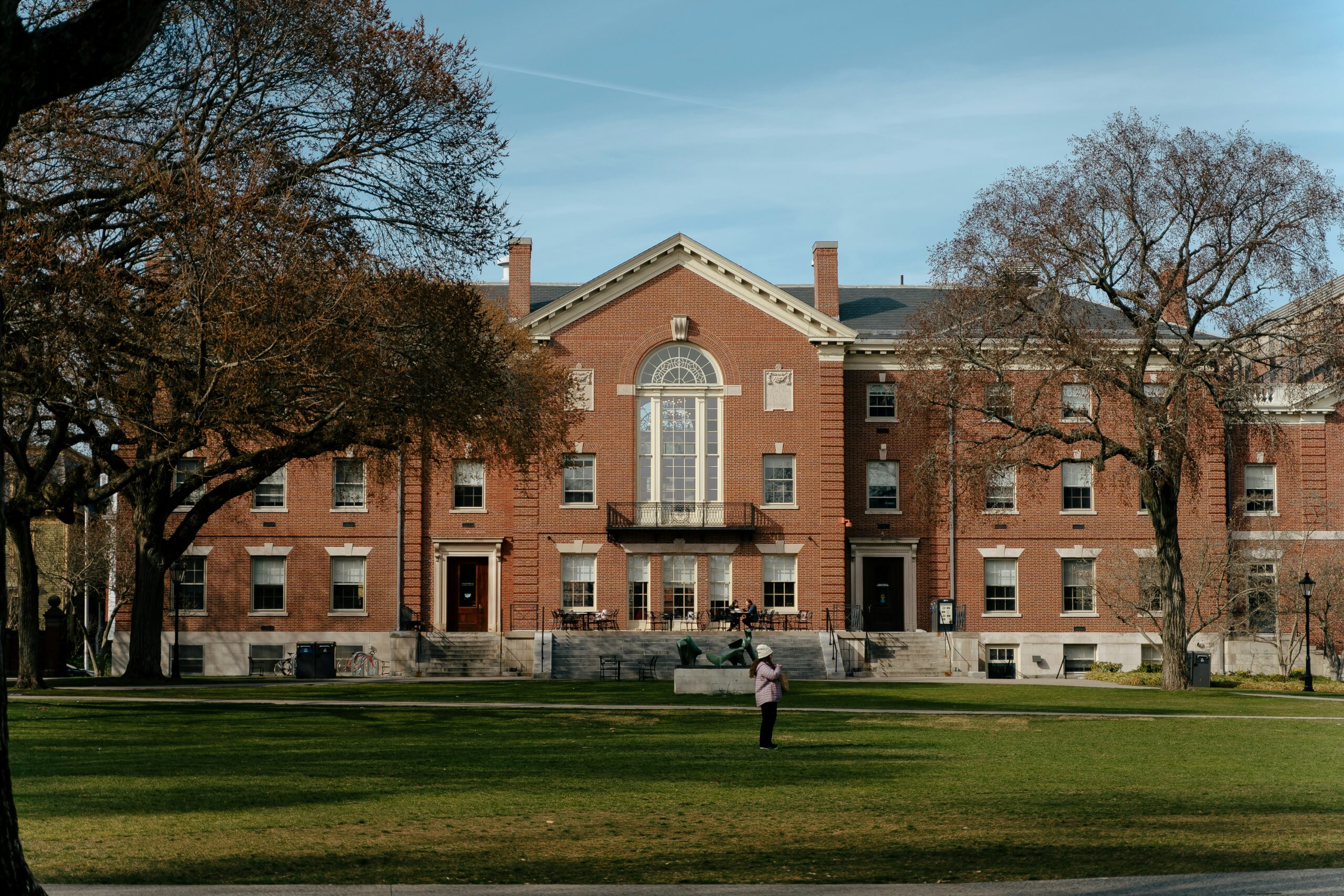
Brown University was founded in 1764 under the name College of Rhode Island and is the 7th oldest university in the USA, the 3rd oldest in the Ivy League. The College Hill campus in Providence (Rhode Island) is small and walkable, with well-preserved colonial and Victorian architecture. Location: 90 minutes by train from Boston and 3 hours from Manhattan. More famous than the Brown campus is the Van Wickle Gates, which students pass through only twice in their lives: when they arrive in year 1 and at graduation.
The defining feature is the Open Curriculum, adopted in 1969 after student protests demanding academic freedom. Brown is the only Ivy with no required courses and no distribution requirements. The only requirements for the degree: 30 courses total (8 per semester x 8 semesters minus 2 spare courses), choosing a concentration from roughly 80 options, and demonstrating writing competence (Writing Requirement). Plus a unique innovation: any class can be taken Satisfactory/No Credit (S/NC, the equivalent of Pass/Fail), including concentration courses. This lets you take risks, take advanced courses outside your comfort zone without fear for your overall GPA.
Two programs unique in the USA: PLME (Program in Liberal Medical Education): an 8-year combined BS plus MD program. You apply at 18; if admitted, you are guaranteed acceptance to the Warren Alpert Medical School of Brown after your bachelor's, with no mandatory MCAT. PLME acceptance rate: roughly 3 percent, one of the most competitive BS/MD programs in the USA. Brown-RISD Dual Degree: 5 years, two degrees (from Brown and the Rhode Island School of Design, the design school across the street, considered world-class). For artist-academics it is the only way to do Ivy plus RISD at the same time. Plus engineering integrated within Brown College (not a separate school, as at Penn or Columbia).
For Romanian students: Brown became need-blind for internationals from the Class of 2029 (Fall 2025), completely changing the equation for Romanian applicants (see the Costs section). Brown's atmosphere is described by students as "the happiest Ivy": collaborative, not competitive, small seminar classes, accessible professors. The Romanian community is 20-30 people, smaller than Penn or Harvard, but cohesive. Notable alumni: John F. Kennedy Jr., Emma Watson, Bobby Jindal, Janet Yellen, Ted Turner, Andrei Codrescu (Romanian-American poet and graduate).
How to apply to Brown
Common App, Coalition or QuestBridge
Brown accepts all three. When applying you can indicate interest in PLME (the 8-year medical program) or the Brown-RISD Dual Degree, each requiring specific supplemental essays. Application fee $75, waiver available with demonstrated financial need.
Early Decision BINDING (Nov 1)
Brown uses binding Early Decision, similar to Columbia/UPenn/Dartmouth. If admitted in ED, you are obligated to accept. The only exception: insufficient aid. ED decision on December 15. Brown's ED rate: ~13-14 percent (double the RD rate of ~5 percent). Apply ED only if Brown is clearly #1.
Regular Decision (Jan 5)
For RD: deadline January 5, decision end of March. RD rate Class 2029: ~5 percent. Total Class 2029 admitted: 2,418 out of ~42,800 applicants (overall rate ~5.65 percent). 95 percent of those admitted were in the top 10 percent of their high school class.
SAT/ACT required (Class 2029+)
Brown announced in March 2024 the reinstatement of mandatory SAT or ACT starting with the Class of 2029. Brown super-scores both tests. Competitive score: SAT 1500+ (median 1540), ACT 34+ (median 35). For PLME, a score of 1550+ is practically standard. Brown's College Board code: 3094. ACT: 003800.
Brown Supplement: 3 short essays
In addition to the Common App essay, Brown requires 3 short essays (200-250 words): 1) what you want to explore through the Open Curriculum and why; 2) about a community that shaped you; 3) what makes you happy and how you see your impact. For PLME and Brown-RISD: additional program-specific essays. Brown values intellectual authenticity, not over-achievement.
Recommendations, TOEFL and interview
2 teachers (preferably one in sciences, one in humanities) plus a counselor. For PLME, an additional Biology or Chemistry recommendation. For Romanian students: TOEFL iBT minimum 100, IELTS 7.0+, Duolingo 130+. Brown offers an optional alumni interview through the Brown Alumni Schools Committee (BASC).
Costs and financial aid
Total cost of attendance 2025-26
Initial costs for Romanians
You pay $0
Families under $60,000 with modest assets (under $100,000) have a $0 parent contribution. Brown fully covers tuition, housing, meals, books, personal costs.
Substantial aid
Families between $60,000 and $125,000 receive considerable aid. Contribution calculated based on income and assets. Many students receive close to a full ride.
Calculated individually
Families over $125,000 may receive aid depending on assets, multiple children in college, specific circumstances. Average contribution: $32,160/year.
Want to apply to Brown?
Open Curriculum, PLME, Brown-RISD, binding ED. Brown is different; your strategy needs to be different too. We help you with strategy, essays, SAT/ACT and the complete application. The first mentoring session is 100% free.
Talk to a mentorFrequently asked questions
What is the difference between Brown and the rest of the Ivy League for a Romanian?
Brown: the most academically flexible Ivy. Open Curriculum (no required courses). Relaxed, cooperative atmosphere, "the happiest Ivy". Less pre-professional than Penn, less academically intense than Princeton. Ideal for interdisciplinary exploration.
Harvard, Yale, Princeton: more rigid structure, strong generalist prestige, distribution requirements or Core Curriculum.
Columbia, Penn: pre-professional, Core Curriculum (Columbia) or Wharton (Penn). Both need-aware for internationals.
For students who want to explore (CS plus philosophy plus dance, for example), to change direction without penalty, or to take Pass/Fail classes outside their comfort zone: Brown is clearly the first choice. PLME is among the best BS/MD programs in the USA.
What is the Open Curriculum at Brown?
The Open Curriculum, adopted in 1969 after student protests, is radically different from any other Ivy. There are NO required courses. There are NO Math, Science, Humanities or foreign language requirements.
The only requirements for the degree: 30 courses total over 4 years, choosing a concentration from roughly 80 options (Brown does not use the term "major"), and demonstrating writing competence (Writing Requirement).
Plus a unique innovation: any class can be taken Satisfactory/No Credit (S/NC, equivalent to Pass/Fail), including concentration courses. This lets you take risky advanced courses outside your comfort zone without fear for your overall GPA. Students can take up to 25 percent of their courses as S/NC.
For Romanian olympiad students: the Open Curriculum is ideal if you want to explore new fields after 4 years of intense specialization in high school.
What is PLME (Program in Liberal Medical Education)?
PLME is Brown's combined 8-year BS plus MD program, one of the most prestigious BS/MD programs in the USA. You apply at 18 and, if admitted, you are guaranteed acceptance to the Warren Alpert Medical School of Brown after your bachelor's, with no mandatory MCAT for internal admission.
Advantages:
1) Guaranteed medical admission without the MCAT (saving you 6 months of prep in year 3 or 4).
2) Complete freedom in choosing your undergraduate concentration. You can do philosophy plus medicine, history plus medicine, computer science plus medicine. The Open Curriculum applies fully to PLME.
3) No re-applying to medical school in year 4. Directly admitted as long as you maintain the GPA and Brown PLME standards.
Acceptance rate: roughly 3 percent, more competitive than regular admission to Brown. You apply as a separate applicant within the Brown supplement, with PLME-specific essays and a recommendation from a science teacher.
How does Brown Financial Aid work for Romanians (after 2025)?
Historic change: from the Class of 2029 (Fall 2025), Brown is need-blind for all internationals, including Romanians. Announced January 25, 2024 after raising $120 million from donors across 6 continents. Brown is the 8th university in the USA to be need-blind for internationals, alongside Harvard, Yale, Princeton, Dartmouth, MIT, Amherst and Bowdoin.
This means that a family's financial situation does NOT influence the admission decision. Unlike Columbia, UPenn and Cornell (need-aware for internationals), Brown admits you based on academic and personal merit, regardless of how much aid you request.
Brown Promise (since 2018): zero loans in aid packages. Brown covers 100 percent of demonstrated need with pure grants plus optional work-study.
Tiers:
Families with income under $60,000 with modest assets: $0 parent contribution. Brown covers tuition, housing, meals, books, personal costs.
Families between $60,000 and $125,000: substantial aid, calculated individually.
Families over $125,000: aid depending on assets and multiple children. Average family responsibility: $32,160/year.
49 percent of the Class of 2029 receive aid. Average grant: $59,655.
Is the SAT/ACT required at Brown now?
YES. Brown announced in March 2024 the reinstatement of mandatory SAT or ACT starting with the Class of 2029 (applicants for Fall 2025 and after). Brown super-scores both tests, which means it can use the best scores across multiple sittings.
Median of admitted students Class 2029: SAT 1500-1580 (median 1540), ACT 34-36 (median 35). For PLME (the 8-year medical program), a score of 1550+ is practically standard. 95 percent of those admitted were in the top 10 percent of their high school class.
Brown's College Board code: 3094. ACT: 003800. For Romanians, the score must be sent directly by College Board or ACT, not by you.
What does Brown ED BINDING mean?
Brown uses binding Early Decision, similar to Columbia, UPenn and Dartmouth, different from Harvard/Yale/Princeton/MIT which use non-binding Early Action. Binding means: if admitted in ED, you are OBLIGATED to accept the offer and withdraw all other applications.
The only exception: if the financial aid offered is insufficient to allow Brown. For Romanians applying now under need-blind, this is an unlikely situation, given 100 percent of need is met.
Brown ED rate Class 2029: roughly 13-14 percent, double the RD rate (roughly 5 percent). ED deadline: November 1. Decision: December 15. Apply ED only if Brown is absolutely #1 on your list.
What is the academic atmosphere like at Brown vs Princeton or Yale?
Brown is consistently described by students as "the happiest Ivy". More relaxed, more cooperative, less competitive than most Ivies. The combination of the Open Curriculum (no required courses) plus the S/NC option (Pass/Fail for any class) reduces academic stress. You study what you want, not what you have to.
Small seminar classes, accessible professors, a tight-knit community on College Hill (small, walkable campus). There are no fraternities at Brown as a dominant cultural tradition (some exist, but they do not define social life).
Comparison: at Princeton the atmosphere is more academically intense (mandatory Senior Thesis, Eating Clubs). At Yale more gothic and introverted (residential colleges, intense seminar-style classes). At Brown you are encouraged to explore freely, without pressure.
Trade-off: the lack of structure can be disorienting. Students who want clear guidance from professors and a structured study plan struggle more. Those who are self-directed and have intrinsic curiosity thrive.
How many Romanian students are at Brown?
Brown admits on average 1-2 Romanian students per year at undergraduate level. The number has grown gradually in recent years along with the expansion of Brown's international policy.
The active Romanian community (undergrad plus graduate plus recent alumni) numbers 20-30 people, smaller than at Harvard or Penn (where Wharton attracts more). With the new need-blind policy from the Class of 2029, it is very likely that the number of admitted Romanians will grow significantly, given that a family's financial situation is no longer an eliminating factor in admission.
The typical profile of Romanians admitted to Brown: interdisciplinary olympiad students, an intellectual profile with multiple passions (math plus literature, science plus philosophy), students who value academic freedom over rigid structure.
What is the Brown-RISD Dual Degree?
The Brown-RISD Dual Degree is the joint 5-year program between Brown and the Rhode Island School of Design (RISD), the design school across the street (literally, they are separated by a single street in Providence). RISD is consistently considered the top design and visual arts school in the USA, alongside Parsons and SAIC.
Graduates of the program receive two degrees: a Bachelor of Arts (BA) or Bachelor of Science (BS) from Brown, plus a Bachelor of Fine Arts (BFA) from RISD. You take courses simultaneously at both institutions.
For artist-academics it is the only way to obtain an Ivy plus RISD at the same time. Acceptance rate: roughly 1-2 percent, more competitive than either program separately. You apply to both institutions simultaneously, with a mandatory art portfolio (12-20 pieces of art) plus all the Brown documents.
For Romanians interested in design, architecture, industrial design, illustration, animation: the Brown-RISD program is unique in the world.
Our mentors for the USA
They studied in the USA, at universities like Harvard, MIT and Stanford. They went through the process. Now they guide you.
