
Sciences Po Paris
A selective grande école founded in 1872, specialising in political science, international relations, economics and law. Ranked number 3 worldwide for Politics in QS 2026 and number 1 in the European Union 11 years running. Around 15,000 students, over 50 percent international. Tuition fees depend on family income, not on nationality: for low-income EU families they can be €0.
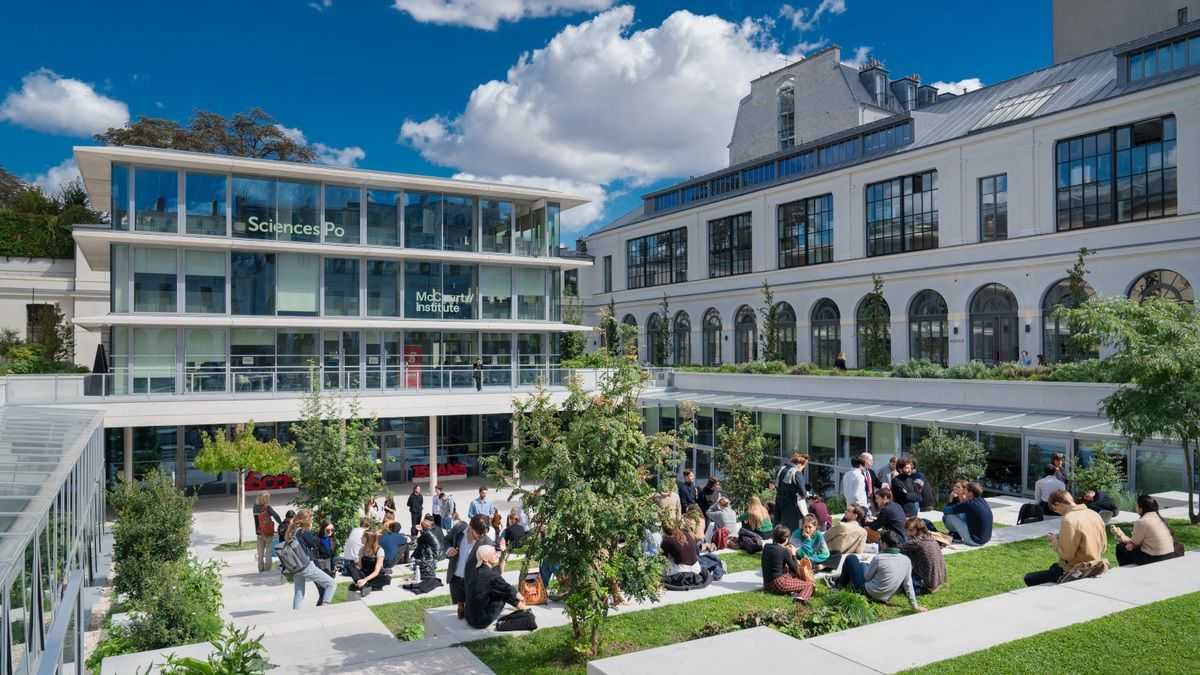
About Sciences Po Paris
Sciences Po (official name: Institut d'études politiques de Paris) is a selective grande école founded in 1872, after France's defeat in the Franco-Prussian War, with the aim of training a new elite capable of leading the state. Today it is the best-known institution in Europe for political science, international relations, economics, law, sociology and public policy. Its historic home is in the Saint-Germain-des-Prés district in central Paris, around Rue Saint-Guillaume (hence the informal nickname "Rue Saint-Guillaume").
In the QS by Subject 2026 ranking, Sciences Po is number 3 worldwide for Politics, right after Harvard and Oxford and ahead of Princeton, and number 1 in the European Union for the 11th year in a row. The grande école system means Sciences Po is not a classic mass university: admission is highly selective, based on an individually assessed application plus an oral interview, and the training emphasises critical thinking, debate, writing and a multidisciplinary approach.
The bachelor's degree (called the Collège universitaire) lasts 3 years and has a unique structure: you spend the first 2 years on one of the 7 campuses in France, each with a thematic regional specialisation. The Paris campus is generalist, while the regional campuses focus on geographical areas: Reims (Euro-American and Euro-African programmes, taught in English), Le Havre (Europe-Asia), Menton (the Middle East and the Mediterranean), Dijon (Central and Eastern Europe), Nancy (the Franco-German area) and Poitiers (the Ibero-American world). The third year is spent abroad on a compulsory basis, at one of more than 470 partner universities, as a study semester or an internship.
For Romanian students, the big advantage is the fee model based on family income, not on nationality. Sciences Po applies a progressive scale for students with tax residence in the EU or the European Economic Area (EEA): low-income families pay €0, while the maximum ceiling reaches around €14,900 per year for very high-income families. Because Romania has average incomes below the upper ceilings, many Romanian students fall into the lower brackets of the scale, paying zero or a reduced fee. There are many bachelor's programmes taught entirely in English (especially on the Reims, Le Havre, Menton and Dijon campuses), so you do not have to master French by the time you apply. Notable alumni: French presidents (Macron, Chirac, Mitterrand, Hollande, Pompidou), Boutros Boutros-Ghali, Christine Lagarde and numerous international leaders.
How to apply to Sciences Po
Apply directly on the Sciences Po portal
For international applicants, the application is made directly through Sciences Po's own procedure (the school's admissions portal), not via Parcoursup. There is also a Parcoursup route, used mainly by candidates studying at a high school in France, but for a Romanian student with a Romanian Baccalaureate the recommended path is the direct international procedure. You create an account, choose your campus and programme (generalist Paris or a thematic campus in English).
Essays and motivation letter
The application includes written essays and a motivation letter, plus a section on an activity or personal commitment that defines you. Sciences Po looks for critical thinking, intellectual curiosity, and civic and international awareness. This part carries as much weight as your grades and is where you set yourself apart.
Grades, Baccalaureate and language proof
You upload your high school transcripts and your Baccalaureate results (or predicted results, if you have not yet sat the BAC). For programmes in English you need proof of English: IELTS, TOEFL, Cambridge or Duolingo (C1 level recommended). For programmes in French, proof of French (DALF C1 / TCF). Sciences Po does not require the SAT for the European international route.
Oral interview
Candidates pre-selected on the basis of their application are invited to an oral interview (usually online), a key element of the grande école procedure. It is a conversation about your motivation, current international affairs and the way you think, not a test of memorised knowledge. The interview confirms your fit with the Sciences Po profile.
Admission decision
Sciences Po communicates its decision after reviewing the application and the interview. The international procedure has several sessions (an autumn wave and a winter/spring wave); the first major deadline is in the autumn (usually October), and decisions arrive over the winter and spring. Check the exact date of the session you are applying to on the portal.
Enrolment and income-based fee
After admission, you confirm your place and go through enrolment. This is where your tuition fee is calculated on the basis of family income (the EU/EEA scale): you submit your family's tax documents, and Sciences Po sets your bracket, from €0 up to the maximum. As a Romanian citizen (EU), you do not need a study visa.
Costs and income-based fees
Income-based tuition scale (EU/EEA), Bachelor
Total cost of living, Paris (estimate)
Income-based tuition
As an EU citizen with tax residence in the EU/EEA, you automatically benefit from the income-based scale (€0-€14,900/year), not the flat non-EU fee. You submit your family's tax documents at enrolment, and Sciences Po calculates your bracket. For low-income families, the fee can be €0. Non-EU students pay a higher flat amount, with no reference to income.
International scholarship
The Émile Boutmy scholarship is Sciences Po's flagship merit scholarship, dedicated to non-EEA students. It grants up to €9,500 per year or a full fee waiver at Bachelor level (up to €18,500/year at master's level). Over 250 students from 72-plus countries receive it each year. For Romanians (EU) it does not apply, because the equivalent advantage is already the income-based scale.
Erasmus+ year 3
The third year of the bachelor's is spent abroad on a compulsory basis. If you go to a partner university in the EU through Erasmus+, you receive a monthly grant (usually €350-€600/month, depending on the country). In addition, as a low-income student you can access French CROUS scholarships and various housing benefits (CAF).
Want to apply to Sciences Po?
We help you choose the right campus, build a strong application, write the essays and motivation letter, and prepare for the oral interview. Plus how to prove family income to obtain the lowest fee. Your first mentoring session is 100% free.
Talk to a mentorFrequently asked questions
How much does Sciences Po cost for a Romanian student?
At Sciences Po the tuition fee is calculated on family income, not on nationality. As a Romanian citizen (EU) with tax residence in the EU or EEA, you enter the progressive scale: from €0 per year for low-income families (under about €42,000) up to a maximum of around €14,900 per year for very high-income families (over about €285,000). The average Bachelor tuition was around €5,740 in 2024-25. For many Romanian families, the real fee is zero or reduced. On top of this comes the cost of living in Paris, around €13,000-€18,000 per year.
How exactly does the income-based fee scale work?
Sciences Po divides the household's annual income by the number of family units (1 unit for each adult contributor, 0.5 for each dependent child) and uses income from 2 years prior. The result places you in a bracket on the scale. Below the minimum ceiling (around €42,000 income) you pay €0; above the maximum ceiling (around €285,000) you pay the full fee of around €14,900 per year; between the two, the fee rises progressively. Nationality does not enter the calculation, only income and EU/EEA tax residence count. You submit your family's tax documents at enrolment.
How do I apply to Sciences Po as a Romanian student, via Parcoursup or directly?
For international applicants who attend high school outside France, the recommended path is Sciences Po's own international procedure, directly on the school's portal, not Parcoursup. There is also a Parcoursup route, but it is used mainly by candidates studying in the French high school system. The international application includes essays, a motivation letter, transcripts, language proof and an oral interview. The first major deadline is in the autumn (usually October), with multiple sessions. Check the exact date on the admissions portal in the year you apply.
Do I need to know French to study at Sciences Po?
Not necessarily. Sciences Po has many bachelor's programmes taught entirely in English, especially on the thematic campuses in Reims, Le Havre, Menton and Dijon. For these programmes you need proof of English (IELTS, TOEFL, Cambridge or Duolingo, C1 level recommended). The Paris campus and some programmes are in French, in which case you need proof of French (DALF C1 / TCF). Many international students start in English and learn French along the way, which is a real advantage for life in France.
How is the 3-year bachelor's structured and what are the thematic campuses?
The bachelor's (Collège universitaire) lasts 3 years. You spend the first 2 years on one of the 7 campuses in France: Paris (generalist), Reims (Euro-American and Euro-African, in English), Le Havre (Europe-Asia), Menton (the Middle East and the Mediterranean), Dijon (Central and Eastern Europe), Nancy (Franco-German) and Poitiers (the Ibero-American world). The third year is spent abroad on a compulsory basis, at one of more than 470 partner universities, as a study semester or an internship. The bachelor's degree is multidisciplinary, with a focus on political science, economics, law, history and sociology.
How selective is admission to Sciences Po?
Sciences Po is a selective grande école, so admission is competitive and based on an individually assessed application plus an oral interview, not on grades alone. A solid academic profile counts (good high school grades and predicted Baccalaureate results), but so do the essays, motivation, civic and international commitment and the interview. There is no public numeric cutoff; the panel looks for your fit with the school's profile. A well-built application, with authentic essays and an extracurricular activity that has impact, counts enormously. That is why preparing in good time makes the difference.
What scholarships can I receive on top of income-based tuition?
For Romanians (EU), the main advantage is already the income-based tuition scale (it can be €0). The Émile Boutmy scholarship, Sciences Po's flagship merit scholarship, is dedicated to non-EEA students, so it does not apply to Romanians. Instead, as a student in France you can access the CROUS scholarships (on social criteria), CAF housing benefits and, for the third year spent abroad, the Erasmus+ grant (usually €350-€600/month). Also check the scholarships of the Romanian Ministry of Education for studies abroad.
What can I do after Sciences Po and can I stay in France or the EU?
Yes, as an EU citizen you automatically have the right to work in France and anywhere in the EU without a visa. Many bachelor's graduates go on to a master's at Sciences Po (Affaires Internationales, Affaires Publiques, Management, Droit, Journalisme) or at other universities in Europe. The degree opens up careers in diplomacy, European and international institutions (EU, UN, OECD), consulting, finance, journalism, public policy and NGOs. The alumni network is powerful, with French presidents, leaders of international institutions and company directors among the graduates. For a Romanian, it is one of the best springboards to an international career in Europe.
Our mentors in Europe
They studied at Bocconi, Sciences Po, TU Delft, ETH Zurich and other EU universities. Now they guide you.


