
Roskilde University
A Danish public university founded in 1972, famous for interdisciplinary project-based learning. Half coursework, half group project work on real-world problems. Around 8,000 students, bachelor's programmes taught entirely in English and FREE for EU/EEA citizens.
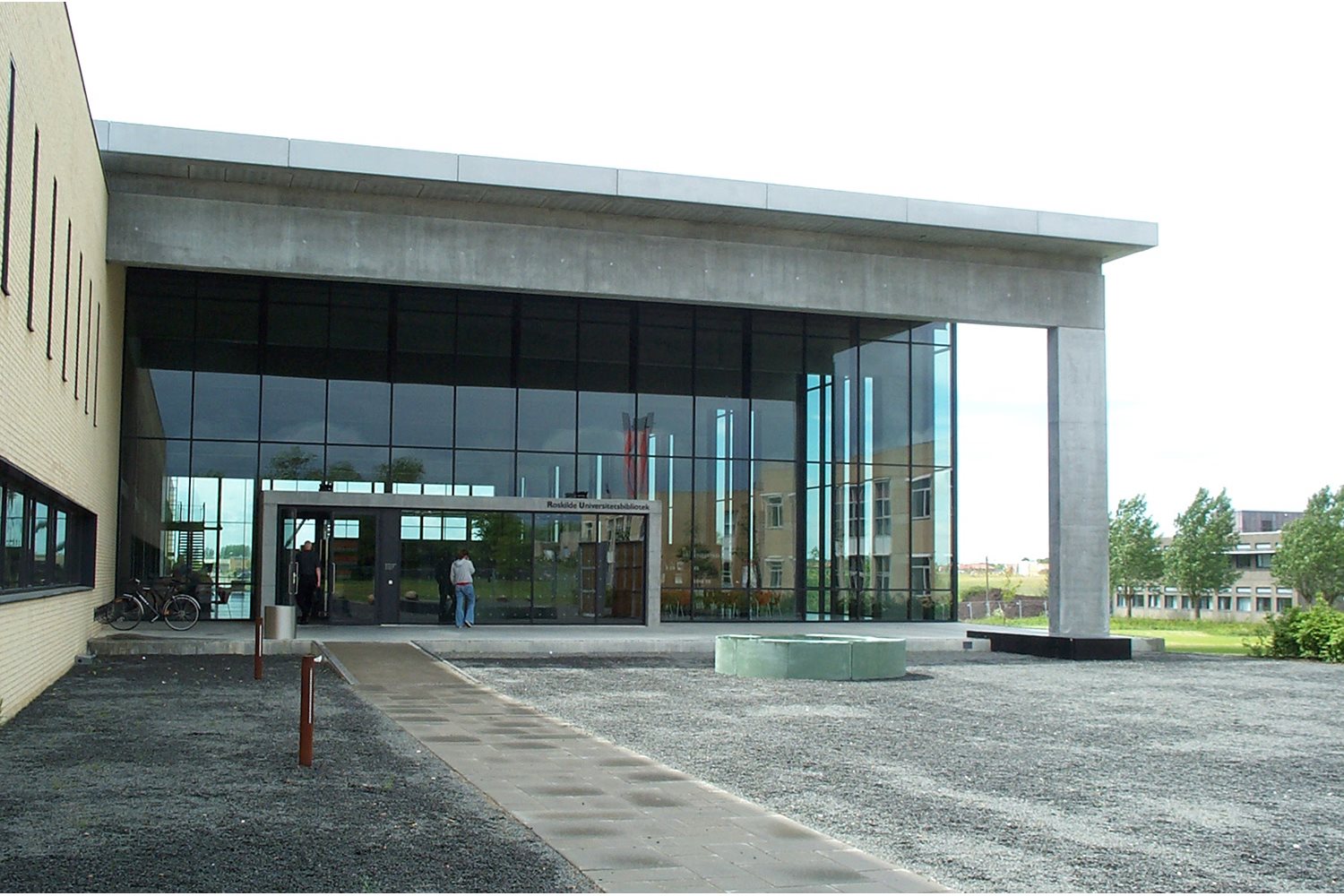
About Roskilde University
Roskilde University (RUC) is a Danish public university founded in 1972, with the stated aim of breaking with traditional university practice and putting student involvement and critical thinking at its core. The campus is in Trekroner, Roskilde, a town about 25 minutes by train from Copenhagen. RUC has around 8,000 students and a growing international academic environment, with students and researchers from all over the world.
What makes RUC different is its project-based / problem-oriented learning model. Studies are split roughly 50 percent specialised coursework and 50 percent group project work. Each semester you join a project group and research a real-world, societal or scientific problem in depth, which you explore over the entire semester. The model is designed to mirror real collaboration in academia and the workplace, building teamwork, critical analysis and your own initiative. It is an approach related to PBL (problem-based learning) also used by other Nordic universities.
RUC is organised into 4 interdisciplinary departments: Communication and Arts, People and Technology, Science and Environment, and Social Sciences and Business. The university's recognised strengths are social sciences, humanities and the sciences. RUC appears in international rankings in fields such as politics, communication and media studies, but be aware: it is a small and relatively young university, so do not look for it high in the overall QS ranking (RUC has not been included in recent editions of the QS World University Rankings overall). In the Times Higher Education World University Rankings 2026 it sits around position 401 worldwide. Its real value lies in its project-based pedagogy, not in ranking prestige.
For Romanian students, the structure is attractive and clear: a 3-year bachelor's (followed by a 2-year master's) in line with the European system. RUC offers bachelor's programmes taught entirely in English, in particular the International Bachelor in Humanities, International Bachelor in Social Science and International Bachelor in Natural Science (interdisciplinary programmes where you combine two subjects). Most important for a Romanian family: as an EU/EEA citizen you pay ZERO tuition at a Danish public university. In addition, EU students who work part-time in Denmark may become eligible for the Danish state grant SU, under certain conditions.
How to apply to RUC
Choose the programme and check the language
RUC offers bachelor's programmes in English, in particular the International Bachelor in Humanities, Social Science and Natural Science (interdisciplinary programmes where you combine two subjects). Check the page for each programme on ruc.dk: semester structure, subject combinations and specific admission requirements.
Apply through Optagelse.dk (KOT)
Bachelor's admission in Denmark is centralised through the national portal Optagelse.dk, managed by Den Koordinerede Tilmelding (KOT). You create an account, upload your Baccalaureate diploma and transcript (translated), choose your programmes and rank them by preference. For EU/EEA citizens there is no application fee.
Prove your English (IELTS 6.5+)
For the English-taught programmes you need a recognised certification. RUC requires IELTS Academic minimum 6.5 overall, with a minimum of 6.5 in the Writing and Speaking sections (or a TOEFL equivalent). For Romanians, the level of English demonstrated at the Baccalaureate is also taken into account, but the official test is the required standard.
Application deadline and Baccalaureate recognition
The main deadline for EU/EEA citizens is generally 15 March (with quota 2 until 5 July for remaining places). The Romanian Baccalaureate is assessed as an access qualification; RUC checks whether you meet the general requirements and the specific ones of the chosen programme.
CPR and registration as an EU citizen
As a Romanian (EU) citizen, you do not need a visa. After arrival, you apply for an EU residence document at SIRI and register at Borgerservice for your personal CPR number, which gives you access to the health system, a bank account and services. You need proof of admission to RUC and an address in Denmark.
Enrolment and start of studies
After the admission letter (usually at the end of July), you confirm your place and enrol online. The academic year begins in September. RUC has an introduction programme for international students. If you work part-time, you can check your eligibility for the SU state grant.
Costs for Romanians
Tuition (EU/EEA citizens)
Estimated cost of living (Roskilde)
€0 tuition
As a Romanian (EU/EEA) citizen, you study at RUC without paying tuition, identical to a Danish student. You do not have to do anything special, just prove your EU citizenship with a passport or ID card. That means savings of ~7,000-10,000 EUR per year compared with a non-European, across all 3 years of the bachelor's.
SU (conditional)
SU (Statens Uddannelsesstøtte) is the monthly state grant for students. EU citizens are not automatically eligible, but can become so if they work part-time in Denmark (usually a minimum of 10-12 hours per week) and obtain EU worker status. Many international students combine a student job with their studies. Check the current conditions on su.dk.
National grants
As a Romanian admitted to a public university in the EU you can also apply for grant programmes from Romania (the Ministry of Education, programmes run by city halls or private foundations for studies abroad). These can partly cover the cost of living. Check the deadlines; they are usually applied for in parallel, in spring.
Want to apply to Roskilde University?
We help you choose the right International Bachelor programme, apply correctly through Optagelse.dk (KOT), prepare for IELTS and take advantage of free studies for EU citizens. Our mentors have been through the process. The mentoring session is 100% free.
Talk to a mentorFrequently asked questions
How much does Roskilde University cost for Romanians?
As an EU/EEA citizen, you pay ZERO tuition at RUC, exactly like a Danish student. Your only real expense is the cost of living in Denmark, estimated at ~900-1,300 EUR per month (accommodation, food, transport, personal). A non-European pays between ~7,000 and 10,000 EUR per year for tuition alone, plus an application fee of ~165 EUR (1,230 DKK), which you, as a Romanian, do not pay. The bachelor's lasts 3 years, so the entire undergraduate degree is free in terms of tuition.
What is project-based learning at RUC?
RUC is built around project-based / problem-oriented learning. Studies are roughly 50 percent specialised coursework and 50 percent group project work. Each semester you join a project group and research a real-world, societal or scientific problem in depth, which you explore over the entire semester, completed with a project report and an oral defence.
The model is designed to mirror collaboration in academia and the workplace, building teamwork, critical analysis and initiative. It is related to PBL (problem-based learning) in the Nordic context. For students who prefer to learn in an applied way, through projects, not just through classic exams, RUC is a very good fit.
How do I apply to RUC through Optagelse.dk?
Bachelor's admission in Denmark is centralised through the national portal Optagelse.dk, managed by Den Koordinerede Tilmelding (KOT). The steps: you create an account, upload your Baccalaureate diploma and transcript (officially translated), choose RUC's programmes and rank them by preference, then add your proof of English (IELTS).
The main deadline for EU/EEA citizens is generally 15 March, with a second round (quota 2) until 5 July for remaining places. For EU/EEA citizens there is no application fee. Admission letters are usually sent at the end of July.
What level of English do I need for RUC?
For the English-taught bachelor's programmes, RUC requires IELTS Academic minimum 6.5 overall, with a minimum of 6.5 in the Writing and Speaking sections, or a TOEFL equivalent. The International Bachelor programmes (Humanities, Social Science, Natural Science) are taught entirely in English.
For Romanians, the level of English demonstrated at the Baccalaureate is also taken into account, but the official standardised test (IELTS or TOEFL) remains the basic requirement. Check the exact threshold for your programme on ruc.dk, as there may be small differences.
Which English-taught bachelor's programmes does RUC have?
RUC offers interdisciplinary programmes taught entirely in English, in particular: International Bachelor in Humanities, International Bachelor in Social Science and International Bachelor in Natural Science. What is specific about them is that you combine two subjects and learn through projects, not just through classic coursework.
RUC is organised into 4 departments: Communication and Arts, People and Technology, Science and Environment, and Social Sciences and Business. The recognised strengths are social sciences, humanities and the sciences. Check on ruc.dk the subject combinations available for the year you are applying.
Where does RUC stand in the rankings?
Be honest about expectations: RUC is a small and relatively young university (founded 1972, ~8,000 students), so it does not appear high in the overall QS ranking. In fact, RUC has not been included in recent editions of the QS World University Rankings overall. In the Times Higher Education World University Rankings 2026 it sits around position 401 worldwide.
By field, however, RUC is noted for politics, communication and media studies. Its real value lies not in ranking prestige, but in its project-based pedagogy and interdisciplinary profile, which make it suitable for students who want to learn in an applied way.
How long does the bachelor's last and how do I continue with a master's?
At RUC, the bachelor's lasts 3 years in line with the European system (180 ECTS), followed by a 2-year master's (120 ECTS). The programme starts from a more general base and gradually specialises, giving you flexibility to shape your path through subject combinations and chosen projects.
After the bachelor's you can continue with a master's at RUC or at another university in the EU, benefiting from ECTS credit recognition. As an EU citizen, a master's at a Danish public university is also free in terms of tuition.
Can I work and stay in Denmark as a Romanian student?
Yes. As a Romanian (EU) citizen you automatically have the right to work in Denmark without a visa. After arrival you apply for an EU residence document at SIRI and obtain your personal CPR number from Borgerservice, which gives you access to the health system, a bank account and services.
Many international students work part-time during their studies. If you obtain EU worker status (usually by working a minimum of 10-12 hours per week), you can become eligible for the Danish state grant SU. After graduation, as an EU citizen you can stay and work in Denmark or anywhere in the EU without a visa, and the Danish degree is recognised throughout the European area.
Our mentors from Europe
They studied at Bocconi, Sciences Po, TU Delft, ETH Zurich and other EU universities. Now they guide you.

