
Trinity College Dublin
Founded in 1592 by Queen Elizabeth I, the oldest university in Ireland. Number 1 in Ireland, QS World 2026 number 75, its best position in the last decade. Around 22,000 students, over 3,000 international from 120 plus countries. Taught entirely in English. As an EU citizen you pay only the student contribution through the Free Fees Initiative (around EUR 2,500 per year), not the full non-EU tuition. Home to the Book of Kells, Oscar Wilde, Samuel Beckett and Bram Stoker.
About Trinity College Dublin
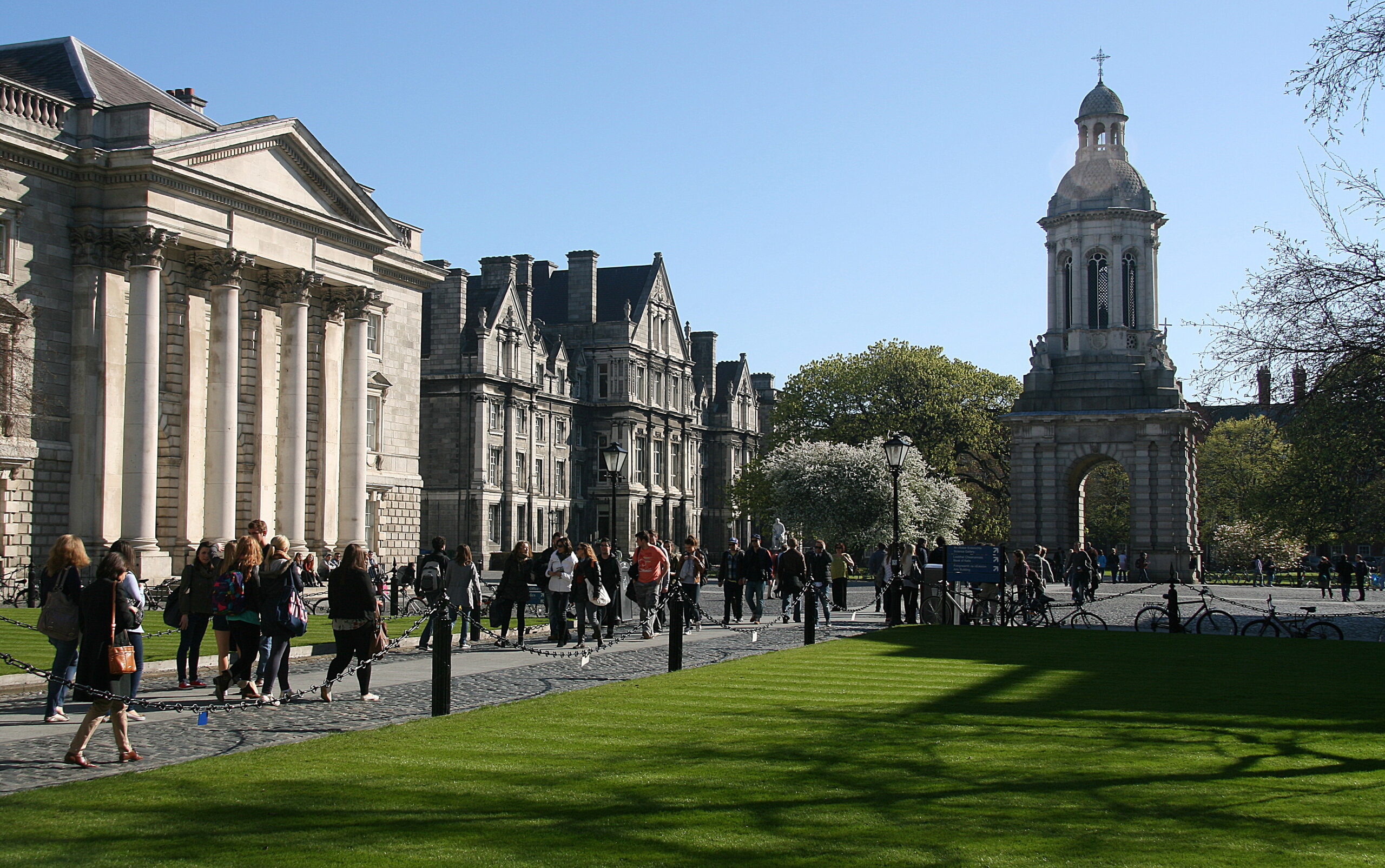
Trinity College Dublin (TCD), the sole college of the University of Dublin, is a public university founded in 1592 by Queen Elizabeth I of England and Ireland. It is the oldest university in Ireland in continuous operation and one of the oldest in the English-speaking world, alongside Oxford and Cambridge, with over 430 years of academic tradition. The historic 47-acre campus sits right in the centre of Dublin, a short walk from Grafton Street and Parliament.
Trinity is number 1 in Ireland with a clear lead over the other Irish universities and holds QS World 2026 number 75, its best result in the last decade (up from 87). The university has around 22,000 undergraduate and postgraduate students, of whom over 3,000 are international (roughly 10 to 13 percent) from 120 plus countries, placing it among the most international universities in the world. The Trinity Library, the largest in Ireland, holds the famous Book of Kells (an illuminated manuscript from around the year 800) and the celebrated Long Room.
Strong fields at Trinity: the university is renowned above all for the humanities (English Literature, History, Classics, Philosophy), Law (School of Law, one of the most prestigious in Europe), Business (Trinity Business School, triple-accredited), sciences (Genetics, Physics, Computer Science, Mathematics) and medicine (School of Medicine, one of the oldest in the world). All undergraduate programmes are taught entirely in English, so you do not face the language barrier you encounter in Spain, France or Germany. Trinity is a member of the Coimbra group of historic European universities and the LERU network (League of European Research Universities).
For Romanian students, Trinity is one of the most accessible elite options in Europe. As an EU citizen you pay only the student contribution through the Irish state's Free Fees Initiative (around EUR 2,500 per year, cut permanently by EUR 500 under Budget 2026 for the 2026-27 year), not the full tuition that non-EU students pay (around EUR 18,000 to EUR 30,000 plus per year, depending on the programme). As an EU citizen you do not need a visa, and teaching is natively in English. Applications go through the national CAO (Central Applications Office) system, with the Romanian Baccalaureate converted into CAO points. Notable alumni: the writers Oscar Wilde, Jonathan Swift, Samuel Beckett (Nobel laureate) and Bram Stoker, and the philosophers George Berkeley and Edmund Burke.
How to apply to Trinity
Apply through CAO (cao.ie)
Applications to all Irish universities, including Trinity, are made centrally through the CAO (Central Applications Office) at cao.ie, not directly to the university. You create an account, complete your details and pay the application fee (~EUR 30-EUR 60, depending on the period). Recommended deadline: the normal application round usually closes on 1 February for the academic year starting in September, so prepare your file from the previous autumn.
Convert the Baccalaureate into CAO points
CAO works on a system of points (maximum 625). The Romanian Baccalaureate is converted into CAO points through a grade equivalence grid (overall average plus the marks from the relevant exams). Trinity's competitive programmes (Law, Medicine, Business) require high scores, close to the ceiling. Tip: check on the Trinity international admissions page exactly how your Bac grade maps onto the CAO scale and what minimum each course requires.
Choose up to 10 level 8 programmes
On CAO you can select up to 10 level 8 honours bachelor programmes, ordered by preference, plus another 10 at a lower level (level 6/7). The system admits you to the highest-ranked option for which your score is sufficient. Strategy: put Trinity and your preferred programmes high on the list and add backup options lower down, to maximise your chances of admission.
Proof of English
Trinity teaches entirely in English, so you need proof of language proficiency: usually IELTS 6.5 (no band below 6.0) or an equivalent TOEFL iBT ~88-90. Being a natively English-speaking country, the requirement is standard and clear. Some candidate profiles (for example with strongly performing English at the Bac or prior studies in English) may qualify for a waiver, but check the official Trinity criteria first.
PPS number and registration as an EU citizen
As a Romanian (EU) citizen, you do not need a study visa for Ireland. After arriving in Dublin you obtain a PPS number (Personal Public Service Number), the Irish equivalent of the CNP, needed for a bank account, a rental contract, a part-time job and access to services. You register online and at an Intreo centre with a Romanian passport or ID and proof of address. With EU status, you also have access to the labour market without restrictions.
Registration and start of studies (September)
Once you receive your offer through CAO (offer rounds usually begin in August), you accept it online and complete registration on the Trinity portal. You confirm your Free Fees status, pay the student contribution (~EUR 2,500), choose your modules and receive your student card. Start of the year: mid-September. Tip: arrange accommodation early, Dublin has a very tight rental market; the Trinity campus and the Trinity Hall residences (Dartry) have limited places.
Costs for Romanians
EU citizen (Free Fees Initiative)
Non-EU student comparison
Free Fees as an EU citizen
As an EU citizen with residence in the EU for at least 3 of the last 5 years, you are eligible for the Free Fees Initiative: the Irish state covers your tuition and you pay only the student contribution (~EUR 2,500 per year, cut permanently by EUR 500 under Budget 2026). That means a saving of EUR 15,000 to EUR 27,000 plus per year compared with a non-EU student, simply by being an EU citizen.
SUSI and scholarships
SUSI (Student Universal Support Ireland) is the national grant system: it can cover the student contribution and provide a maintenance grant to EU students who meet the income and residence criteria. Trinity also has its own scholarships (Trinity Scholarships, merit and need-based awards, sport, leadership). Check susi.ie and the Trinity scholarships page for eligibility and deadlines.
Ireland scholarship (RO Min. of Education)
As a Romanian student, you may be eligible for scholarships from the Romanian Ministry of Education dedicated to studies abroad, if you gain admission to a recognised university in the EU. Many town halls and county councils in Romania also have scholarship programmes for their students studying abroad. Important: these scholarships can be combined with the Irish support, but must be applied for in parallel, with their own deadlines.
Want to apply to Trinity?
We help you navigate CAO, convert your Baccalaureate into CAO points, choose the 10 level 8 programmes and take advantage of the Free Fees Initiative (~EUR 2,500/year as an EU citizen). Our mentors have been through the process. Your first mentoring session is 100% free.
Talk to a mentorFrequently asked questions
How much does Trinity College Dublin cost for a Romanian?
As an EU citizen resident in the EU for at least 3 of the last 5 years, you are eligible for the Free Fees Initiative: the Irish state covers your tuition and you pay only the student contribution, around EUR 2,500 per year (cut permanently by EUR 500 under Budget 2026 for the 2026-27 year). That compares with the full non-EU tuition of EUR 18,000 to EUR 30,000 plus per year (non-EU Medicine can exceed EUR 50,000). Adding Dublin accommodation (EUR 700-EUR 1,200 per month) plus food and transport, the total cost of a year for a Romanian is around EUR 13,000 to EUR 18,000, drastically below the UK or the USA.
How do I apply to Trinity through CAO and how is the Baccalaureate converted?
Applications are made centrally through the CAO (Central Applications Office) at cao.ie, not directly to the university. CAO works on a system of points (maximum 625), and the Romanian Baccalaureate is converted into CAO points through an equivalence grid (overall average plus the marks from the relevant exams). You can choose up to 10 level 8 bachelor programmes, ordered by preference, and you are admitted to the highest-ranked option for which your score is sufficient. The normal application deadline usually closes on 1 February.
Are Trinity's programmes in English? Do I need IELTS?
Yes, Ireland is a natively English-speaking country and all of Trinity's undergraduate programmes are taught entirely in English. You do not face the language barrier you encounter in Spain, France or Germany. For proof of language proficiency, the standard requirement is usually IELTS 6.5 (no individual band below 6.0) or an equivalent TOEFL iBT ~88-90. Some candidate profiles (strongly performing English at the Bac or prior studies in English) may qualify for a waiver; check the official Trinity criteria.
What is the Free Fees Initiative and why does it matter for Romanians?
The Free Fees Initiative is a scheme of the Irish state under which the government covers tuition for eligible undergraduate students, and the student pays only the student contribution (around EUR 2,500 per year, cut permanently by EUR 500 under Budget 2026). Eligible are citizens of the EU, EEA, Switzerland or the United Kingdom who have been resident in these areas for at least 3 of the last 5 years before the start of the course. For a Romanian who meets the residence criterion, this means a saving of EUR 15,000 to EUR 27,000 plus per year compared with the non-EU rate, simply through EU citizen status.
What scholarships are there at Trinity for Romanians?
First of all, the Free Fees Initiative is itself the biggest advantage (tuition covered, you pay only ~EUR 2,500 student contribution). In addition: SUSI (Student Universal Support Ireland) is the national grant that can cover the student contribution and provide a maintenance grant to EU students who meet income and residence criteria (susi.ie). Trinity has its own scholarships (Trinity Scholarships, merit, need-based, sport, leadership awards). As a Romanian, you can also apply for scholarships from the Romanian Ministry of Education for studies abroad, plus possible scholarships from your town hall or county council. These sources can be combined, but have separate deadlines.
What are the strongest programmes at Trinity?
Trinity is renowned above all for the humanities (English Literature, History, Classics, Philosophy, the home of Wilde, Beckett and Swift), Law (School of Law, one of the most prestigious in Europe), Business (Trinity Business School, triple-accredited), sciences (Genetics, Physics, Computer Science, Mathematics, Nanoscience) and medicine (School of Medicine, one of the oldest in the world). In the QS subject rankings, Trinity does very well in English Language and Literature, Classics, Nursing and Politics. The competitive programmes (Law, Medicine, Business) require high CAO scores, close to the ceiling of 625.
Do I need a visa as a Romanian to study in Ireland?
No. As a Romanian (EU) citizen you have the right of free movement and do not need a study visa for Ireland. You can move with a Romanian passport or identity card. After arriving in Dublin, you obtain a PPS number (Personal Public Service Number, the Irish equivalent of the CNP), needed for a bank account, a rental contract, a part-time job and access to services. Also as an EU citizen, you have access to the labour market without restrictions, so you can work part-time during your studies and full-time after graduation, without a work permit.
Can I stay in Ireland to work after graduation?
Yes, without restrictions, as an EU citizen. Unlike the United Kingdom or the USA where you need a work visa, as a Romanian (EU) citizen you have the automatic right to work in Ireland. Dublin is one of the largest tech hubs in Europe, with the European headquarters of Google, Meta, Microsoft, Apple, LinkedIn, Stripe, plus a strong financial sector (IFSC) and pharma industry (Pfizer, Johnson and Johnson). English is the official language, and Trinity graduates have an excellent reputation on the job market. With a degree recognised across the EU, you can subsequently work anywhere in the Union, without a visa.
Our mentors in Europe
They studied at Bocconi, Sciences Po, TU Delft, ETH Zurich and other EU universities. Now they guide you.

