
Maastricht University
The most international university in the Netherlands, founded in 1976. Famous for the Problem-Based Learning (PBL) method, taught in small groups of 10 to 15 students. Almost 60 percent of its students are international, most bachelor's programmes are in English, and as an EU citizen you pay the statutory EU fee of roughly €2,694 per year.
About Maastricht University
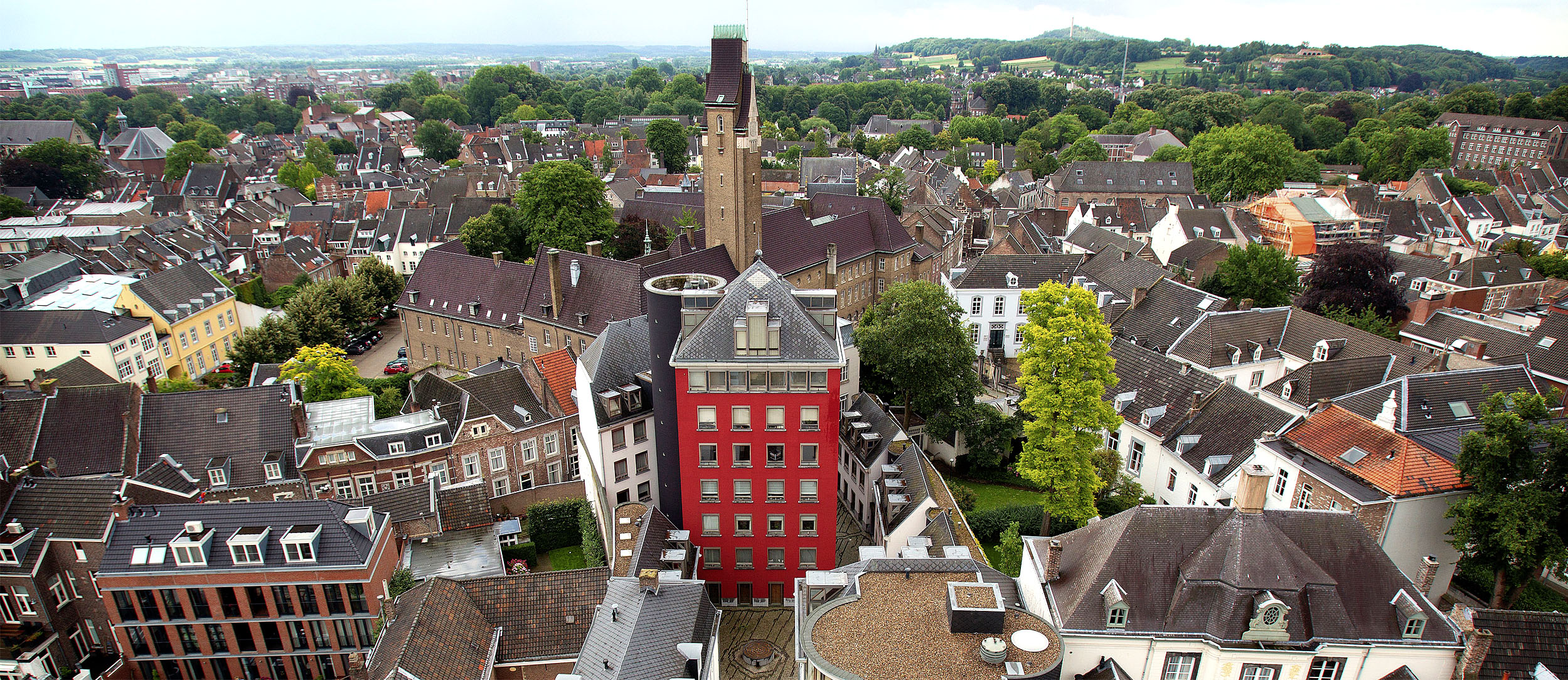
Maastricht University (UM) is a Dutch public university founded in 1976, one of the youngest large universities in the Netherlands, but also the most international in the country. Almost 60 percent of its students are international, from more than 100 countries, which makes the campus a genuinely European environment where the everyday language is English. The city of Maastricht, in the far south of the Netherlands, is just a few minutes from the borders with Belgium and Germany, in the heart of the Euregio region.
What truly sets it apart is its teaching method: Problem-Based Learning (PBL). Instead of classic lectures with hundreds of students in an auditorium, you learn in small groups of 10 to 15 students (tutorial groups), where you work on real problems, debate and build solutions together. The teacher is a facilitator, not just a lecturer. UM has applied PBL since its founding in 1976, and it is the globally recognised model for this approach. For a Romanian student used to the classic system, PBL means more responsibility, but also far more genuine involvement.
UM has 6 faculties and is especially strong in Business and Economics (School of Business and Economics, SBE, with triple crown accreditation), Law (Faculty of Law, with a European and international focus), health, medicine and life sciences (FHML), and Arts and Social Sciences (FASoS). Most bachelor's programmes are taught entirely in English, including distinctive programmes such as European Studies, International Business, European Law School, Psychology and University College Maastricht (liberal arts).
For Romanian students, Maastricht is one of the most accessible English-taught opportunities in Europe. As an EU citizen you pay the statutory EU fee, roughly €2,694 per year (set annually by the Dutch government), compared with EUR 15,000 or more paid by a non-European student. The Romanian Baccalaureate is accepted as an access diploma, and you apply centrally through Studielink, the national platform of the Netherlands. Note: some highly sought-after programmes have Numerus Fixus (limited places, with selection and an earlier deadline). Bachelor's degrees last 3 years, as in the United Kingdom, but with a much lower EU fee.
How to apply to Maastricht
Choose your programme and check Numerus Fixus
UM has English-taught bachelor's programmes such as European Studies, International Business, European Law School, Psychology, Econometrics or University College Maastricht. First thing: check whether the programme has Numerus Fixus (limited places with selection). For these, the deadline is earlier, usually 15 January, and involves an additional selection procedure.
Apply through Studielink
You apply to any public university in the Netherlands centrally through Studielink, the national platform. You create an account, choose the programme and the university, then UM opens its own application portal (My UM) where you upload your documents. Standard deadline (programmes without Numerus Fixus): generally up to 1 May for EU citizens.
Prepare your academic file
For EU citizens, the Romanian Baccalaureate is accepted as an access diploma. You upload your Baccalaureate diploma and transcript (translated into English), and for certain programmes specific subjects at an adequate level are required, for example mathematics for Econometrics, International Business or science programmes.
Prove your English (IELTS or TOEFL)
English-taught bachelor's programmes require proof of language level: typically IELTS 6.0-6.5 or TOEFL iBT 80-90, depending on the programme. Cambridge C1 Advanced or equivalent are also accepted. Check the exact threshold on your programme page, since some require 6.5 with a minimum on each component.
Register as an EU citizen and get a BSN
As a Romanian (EU) citizen you do not need a study visa. After arriving in Maastricht, you register with the municipality (gemeente) and obtain a BSN (the Dutch identification number), needed for a bank account, insurance and a part-time job. You need confirmed accommodation and a valid Romanian ID.
Pay tuition and enrol
After admission, you complete enrolment by paying the statutory EU tuition (roughly €2,694 per year), usually via a digital authorisation (debit) or full payment. The academic year starts in September. UM has an introduction week (INKOM) for international freshers, with orientation, tours and socialising.
Costs for Romanians
Statutory EU tuition (EU citizens)
Total cost per year (all in)
Statutory EU fee
As an EU citizen you automatically pay the statutory EU fee, identical to that of a Dutch student, roughly €2,694 per year. You do not have to do anything special, just prove your Romanian citizenship with an ID. Compared with the non-EU fee from EUR 15,000 per year, that means over EUR 12,000 saved annually simply through your status as an EU citizen.
DUO and student job
As an EU citizen who works part-time in the Netherlands (usually a minimum of 56 hours per month), you may become eligible for Dutch government support through DUO, including the basic grant and the low-interest loan. Maastricht has many part-time jobs in English, and EU students have full work rights without a permit.
Romania scholarship
As a Romanian student you are eligible for the scholarship from the Romanian Ministry of Education if you gain admission to a public university abroad, including in the Netherlands. Many municipalities in Romania also have scholarship programmes for their students abroad (check with your local town hall). These scholarships can be combined with Dutch support, but must be applied for separately.
Want to apply to Maastricht?
We help you choose the right English-taught programme, check whether it has Numerus Fixus, apply correctly through Studielink and benefit from the EU fee of roughly €2,694 per year. Our mentors in Europe have been through the process. The first mentoring session is 100% free.
Talk to a mentorFrequently asked questions
How hard is it to get into Maastricht University?
For most bachelor's programmes, Maastricht has relatively open admission if you meet the academic requirements: an accepted Baccalaureate, specific subjects (for example mathematics for business or science programmes) and the required English level. Unlike the United States, it is not a matter of a low, competitive admission rate for every programme.
The exception is Numerus Fixus programmes (limited places), such as certain medical and health specialisations, or very popular programmes. These have an additional selection and an earlier deadline (usually 15 January). For Romanians, a solid Baccalaureate plus IELTS 6.0-6.5 puts you in a good position for most English-taught programmes.
How much does Maastricht cost for Romanians exactly?
As an EU citizen, you pay the statutory EU fee set by the Dutch government, roughly €2,694 per year (the amount is updated annually). Compared with a non-European student, who pays from EUR 15,000 per year, that means over EUR 12,000 saved annually simply through your status as an EU citizen.
Total tuition over 3 years of bachelor's: roughly €8,082. Accommodation in Maastricht: EUR 450-EUR 750 per month. Food: EUR 250-EUR 350 per month. Transport, books and miscellaneous: EUR 100-EUR 150 per month. Total cost per year all-in: roughly EUR 12,000-EUR 15,000, drastically below the United Kingdom or the United States. Bachelor's degrees last 3 years, not 4 as in Spain.
What is Problem-Based Learning (PBL) and how does it work?
Problem-Based Learning (PBL) is Maastricht's defining teaching method, applied since its founding in 1976. Instead of classic lectures in an auditorium, you learn in small groups of 10 to 15 students (tutorial groups), led by a tutor who facilitates rather than just teaches.
The typical process: you receive a real problem, analyse it as a group, identify what you need to find out, study individually between meetings, then come back and build the solution together. This develops critical thinking, teamwork and the ability to learn independently, exactly the skills demanded by the job market. For a Romanian student used to the classic system, PBL requires more proactive involvement, but many find it far more motivating.
Are Maastricht's bachelor's programmes in English?
Yes. Most of Maastricht's bachelor's programmes are taught entirely in English, which makes the university ideal for Romanian students who do not speak Dutch. English-taught programmes include European Studies, International Business, European Law School, Psychology, Econometrics, Business Analytics, University College Maastricht (liberal arts) and health and life sciences programmes.
For these programmes you need proof of English, typically IELTS 6.0-6.5 or TOEFL iBT 80-90. You do not need to know Dutch in order to study, although learning the basics helps in everyday life and for a part-time job. WIB note: the Dutch Wet internationalisering in balans law, currently being phased in, aims to rebalance internationalisation and may gradually reduce some English-taught programmes; check the exact language of your programme when you apply.
What is Numerus Fixus and how does it affect my application?
Numerus Fixus means that a programme has a limited number of places and uses a selection procedure to choose candidates. In the Netherlands, Numerus Fixus programmes have a fixed and earlier deadline, usually 15 January, with no exceptions.
Selection may include criteria such as grades, motivation letters, tests or interviews, depending on the programme. Programmes without Numerus Fixus have a more relaxed deadline (generally up to 1 May for EU citizens) and admission based on meeting the requirements. Tip for Romanians: check early whether your programme has Numerus Fixus, because the 15 January deadline is not extended.
How do I apply through Studielink as a Romanian student?
Studielink is the national platform of the Netherlands through which you apply to all public universities. The steps for a Romanian student: 1) You create an account on Studielink. 2) You choose the programme and Maastricht University. 3) UM opens its own application portal (My UM), where you upload your documents (translated Baccalaureate and transcript, proof of English, possibly a motivation letter).
Deadlines: Numerus Fixus programmes have a 15 January deadline; standard programmes generally have a deadline up to 1 May for EU citizens. You do not need a visa, being an EU citizen. Our recommendation: start the process in the autumn of your final year of high school, so you have time for translations and the English test.
Can I stay and work in the Netherlands after graduating?
Yes, as an EU citizen you have the automatic right to work in the Netherlands without a work permit, both during your studies (part-time) and after graduation. The Netherlands has a strong economy, with major hubs in Amsterdam, Rotterdam, Eindhoven and the Maastricht region, plus many international companies that work in English.
Maastricht graduates are sought after especially in business, finance, consulting, European law, public health and data science. With English being the working language at many international firms, not speaking Dutch is not an obstacle to starting a career. With a degree recognised across the EU, you can later work anywhere in the Union without a visa.
How long is the bachelor's at Maastricht and what is student life like?
The bachelor's at Maastricht lasts 3 years (180 ECTS), as in the United Kingdom, but with a much lower EU fee. After the bachelor's you can continue with a master's (usually 1-2 years), also with the statutory EU fee.
Maastricht is a compact and safe student city in the south of the Netherlands, on the border with Belgium and Germany. With almost 60 percent international students, the community is very cosmopolitan, and English is spoken everywhere. Many students get around by bike, the cost of living is lower than in Amsterdam, and student events, associations and the INKOM introduction week help freshers integrate quickly. Brussels, Cologne and Aachen are an hour away.
Our mentors in Europe
They studied at Bocconi, Sciences Po, TU Delft, ETH Zurich and other EU universities. Now they guide you.

