
University of Groningen
Founded in 1614, the second oldest university in the Netherlands. QS World 2026 number 147, Times Higher Education number 82 worldwide. About 37,000 students, of whom more than 9,900 are international from 120 plus nationalities. Over 37 bachelor's programmes taught entirely in English. As an EU citizen you pay the statutory EU fee, around 2,694 euros per year.
About University of Groningen
University of Groningen (in Dutch Rijksuniversiteit Groningen, abbreviated RUG or UG) is a comprehensive public university founded in 1614, which makes it the second oldest university in the Netherlands, after Leiden. With over 400 years of academic tradition, it is one of the most respected research institutions in Europe and a member of the Coimbra Group and the U4 Society networks.
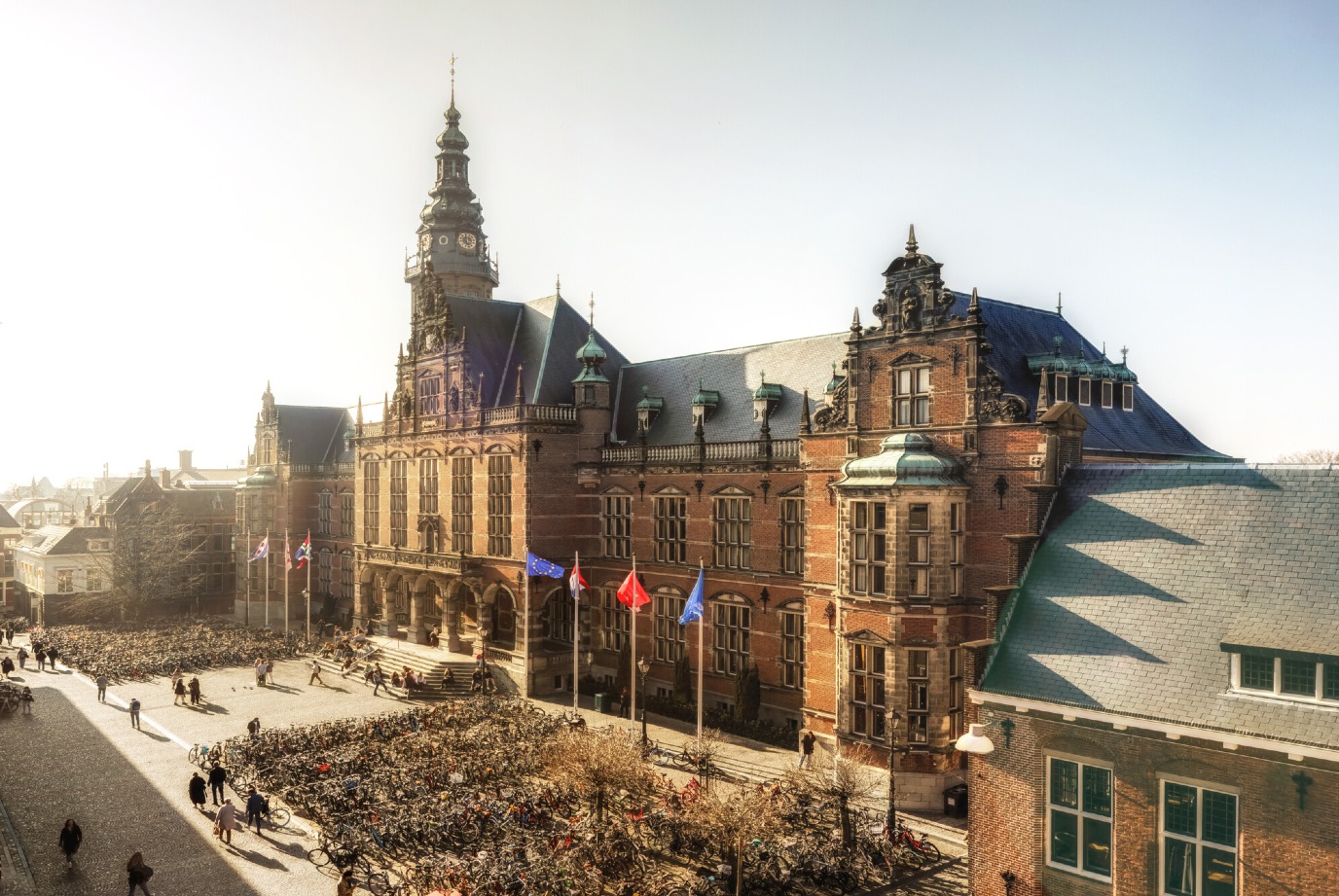
The university is QS World 2026 number 147 and Times Higher Education number 82 worldwide, consistently in the global top 100. It is located in Groningen, in the north of the Netherlands, a classic university city where roughly one in four residents is a student. The city is compact, safe, cyclist-friendly and considered among the happiest cities in Europe for students. RUG has 11 faculties and the historic Academiegebouw building in the city centre, alongside the modern Zernike campus for sciences and engineering.
RUG has roughly 37,000 students, of whom more than 9,900 are international (around 27 percent) from over 120 nationalities, which makes it one of the most international universities in the Netherlands. The university offers over 45 bachelor's programmes, of which more than 37 are taught entirely in English, from Psychology, International Business, International Relations and Economics, to Computing Science, Artificial Intelligence, Life Sciences or Liberal Arts and Sciences (at University College Groningen). For an international student, this means you can complete a full bachelor's degree in English, without learning Dutch for your studies.
For international students, RUG is one of the most accessible major opportunities in Europe. As an EU citizen you pay the statutory EU fee, around 2,694 euros per year for a government-funded bachelor's degree, compared with 10,000 to 17,000 euros paid by students from outside the EU. Standard bachelor's degrees last 3 years (180 ECTS), in the European Bologna system. Applications are made centrally through Studielink, the Dutch national portal, plus an application in the RUG portal. Many programmes have open admission, but some popular ones have a Numerus Fixus (limited places, selection).
How to apply to Groningen
Choose your programme and check Numerus Fixus
RUG has over 45 bachelor's programmes, of which more than 37 are in English. Check on rug.nl whether your programme has open admission (most of them) or a Numerus Fixus (limited places, selection on criteria). Numerus Fixus programmes, such as Psychology or International Business, have an earlier deadline, usually 15 January.
Apply through Studielink
All applications to Dutch universities go through Studielink, the national portal. You create an account (with DigiD once you have a BSN, or as an international applicant without DigiD), choose the programme and RUG, then continue in the university's own portal. General deadline for EU citizens: usually 1 May, but Numerus Fixus is 15 January.
Prove your English (IELTS, TOEFL)
For English-taught programmes you need IELTS Academic minimum 6.5 (usually with a minimum of 6.0 per component) or TOEFL iBT 90 plus, or Cambridge C1 Advanced. The certificate cannot be older than 2 years. Some programmes also accept a high school diploma with English at a high level, but check the exact requirement of the programme.
Upload documents and your high school diploma
In the RUG portal you upload: your high school diploma (or a certificate that you are in your final year), translated transcript, passport or national ID, proof of English and, for some programmes, a motivation letter or a maths test. The Romanian Baccalaureate is recognised as a qualification for access to Dutch higher education.
Register as an EU citizen and get a BSN
As an EU citizen, you do not need a visa or study permit. After arriving in Groningen, you register at the municipality (Gemeente) as a resident and receive a BSN (Burgerservicenummer), the Dutch identification number required for a bank account, health insurance and a part-time job. Bring your birth certificate, apostilled and translated.
Enrolment and paying tuition
After acceptance, you finalise your enrolment in Studielink: you confirm the programme, sign the tuition payment authorisation (€2,694/year for EU citizens, payable in full or in monthly instalments by direct debit) and upload the final documents. The academic year starts in September, with an introduction week (KEI Week) for first-year students in Groningen.
Costs for international students
EU tuition 2026-27 (EU citizens)
Total cost per year (all included)
EU fees
As an EU citizen, you automatically pay the statutory EU fee, identical to that of a Dutch student (~€2,694/year), compared with €10,000-€17,000 paid by a non-European student. You do not have to do anything special, just prove your EU citizenship with a passport or national ID. The saving is over 7,000 euros per year simply because you are an EU citizen.
European scholarships
Studiefinanciering (DUO): as an EU student working part-time at least 56 hours per month in the Netherlands, you can become eligible for Dutch student funding, including the transport pass. Erasmus plus: for mobility. RUG scholarships: there are merit scholarships and profile funds for international students. Check the Scholarships section on rug.nl.
Home-country grants
As an international student, you may be eligible for scholarships from your home country's education authorities for studies abroad, as well as for local programmes run by municipalities or foundations. These grants can be combined with Dutch funding. Important: apply in parallel, home-country deadlines are often in spring.
Want to apply to Groningen?
We help you choose the right English-taught programme, check whether it has a Numerus Fixus, apply through Studielink, prepare your IELTS and your file, and take advantage of the EU fee (~€2,694/year). Our mentors have been through the process. The mentoring session is 100% free.
Talk to a mentorFrequently asked questions
How hard is it to get into the University of Groningen?
It depends a lot on the programme. Most RUG bachelor's programmes have open admission, which means you are admitted if you meet the basic requirements (a recognised high school diploma, English IELTS 6.5, possibly maths for technical or economics programmes). For these programmes there is no strict competitive selection.
However, popular programmes have a Numerus Fixus (limited places), such as Psychology, International Business or certain medical and life sciences programmes. There, selection is based on criteria (grades, motivation letter, sometimes a test). For applicants, the recommendation is solid final grades (a strong average, ideally near the top for Numerus Fixus) and an IELTS above the 6.5 minimum.
Exactly how much does the University of Groningen cost?
As an EU citizen, you pay the statutory EU fee: around 2,694 euros per year for the 2026-2027 academic year, for a government-funded bachelor's degree. A student from outside the EU pays between 10,000 and 17,000 euros per year for the same bachelor's degree.
Total cost of living in Groningen: accommodation €400-€650/month, food €250-€350/month, insurance, transport and other expenses €150-€250/month. Total per year (tuition plus living): around 11,000-14,000 euros. Over 3 years of a bachelor's degree, tuition alone is around 8,082 euros. Note: the halving of the fee for the first year was abolished as of 1 September 2024.
What does the statutory EU fee mean and why does it matter for EU students?
The statutory EU fee (statutory tuition fee) is the reduced fee paid by students with EU, EEA, Swiss or Surinamese citizenship, for one bachelor's and one master's programme funded by the Dutch government. For 2026-2027 it is around 2,694 euros per year at RUG.
As an EU citizen you are automatically in this category, so you pay exactly what a Dutch student pays. Students from outside the EU pay the institutional fee, several times higher (10,000 to 17,000 euros per year). This makes a major Dutch university such as Groningen financially accessible for a family, especially compared with the United Kingdom or the USA.
Are the programmes at Groningen in English?
Yes, to a large extent. RUG offers over 45 bachelor's programmes, of which more than 37 are taught entirely in English. This covers most of the fields students look for: Psychology, International Business, International Relations and International Organization, Economics and Business Economics, Computing Science, Artificial Intelligence, Life Sciences, International Law, Liberal Arts and Sciences (University College Groningen) and many others.
For these programmes you need proof of English (IELTS Academic 6.5 or equivalent), but you do not need to know Dutch for your studies. There are also programmes taught in Dutch (for example Dutch Law or Medicine), which require a level of Dutch. The recommendation is to choose an English-taught programme and learn Dutch optionally, for daily life and jobs. WIB note: the Dutch Wet internationalisering in balans law, currently being phased in, aims to rebalance internationalisation and may gradually reduce some English-taught programmes; check the exact language of your programme when you apply.
How do I apply through Studielink and what is Numerus Fixus?
Studielink is the Dutch national portal through which all university applications pass. You create an account, choose the programme and RUG, then continue your application in the university's own portal, where you upload the documents.
The deadlines depend on the type of programme. Programmes with open admission usually have a 1 May deadline for EU citizens. Programmes with a Numerus Fixus (limited places, selection), such as Psychology or International Business, have an earlier deadline, usually 15 January, with no exceptions. Always check the exact deadline of your programme on rug.nl, because Numerus Fixus does not allow late applications.
Is the Romanian Baccalaureate accepted at Groningen?
Yes. The Romanian Baccalaureate is recognised as a qualification for access to Dutch higher education. You upload it in the RUG portal, alongside your transcript translated into English. For some programmes, RUG may require minimum grades in certain subjects (for example maths for Economics, Computing Science or technical programmes).
Recommended profile: a strong Baccalaureate average (ideally near the top for Numerus Fixus programmes), good grades in subjects relevant to the programme and IELTS Academic above the 6.5 minimum. If you are still in your final year when you apply, you upload a certificate and present the final diploma after the exam.
What is a BSN and what do I need to do when arriving in the Netherlands as an EU citizen?
As an EU citizen you do not need a visa or study permit to study in the Netherlands. You move freely and automatically have the right to live and work.
After arriving in Groningen, you register at the municipality (Gemeente) as a resident and receive a BSN (Burgerservicenummer), the Dutch identification number. The BSN is required to open a Dutch bank account, for health insurance and for a part-time job. Bring your birth certificate, apostilled and translated. If you work part-time at least 56 hours per month, you can become eligible for Dutch student funding (Studiefinanciering) through DUO.
Can I stay in the Netherlands after graduation?
Yes, as an EU citizen! Unlike the United Kingdom or the USA, as an EU citizen you automatically have the right to work in the Netherlands without a visa or work permit. The Netherlands has a strong labour market, with high demand for graduates, especially in tech, engineering, life sciences, business and logistics.
The Netherlands has one of the highest levels of English proficiency in Europe, so you can work in many roles without Dutch, although knowing the language helps. Major economic hubs: Amsterdam, Eindhoven (tech and hardware), Rotterdam (logistics, port), plus the northern region around Groningen (energy, health, agritech). With a Dutch degree recognised across the EU, you can later work anywhere in the Union without a visa.
Our mentors in Europe
They studied at Bocconi, Sciences Po, TU Delft, ETH Zurich and other EU universities. Now they guide you.

