
Università di Padova
Founded in 1222, the fifth oldest continuously operating university in the world. Galileo Galilei taught here between 1592 and 1610, the years he called the best of his life. A public university, ranked 233rd in the QS World 2026 and 4th in Italy, with more than 70,000 students. As an EU citizen you pay EU fees calculated through ISEE, from 0 up to roughly 2,700 euros per year.
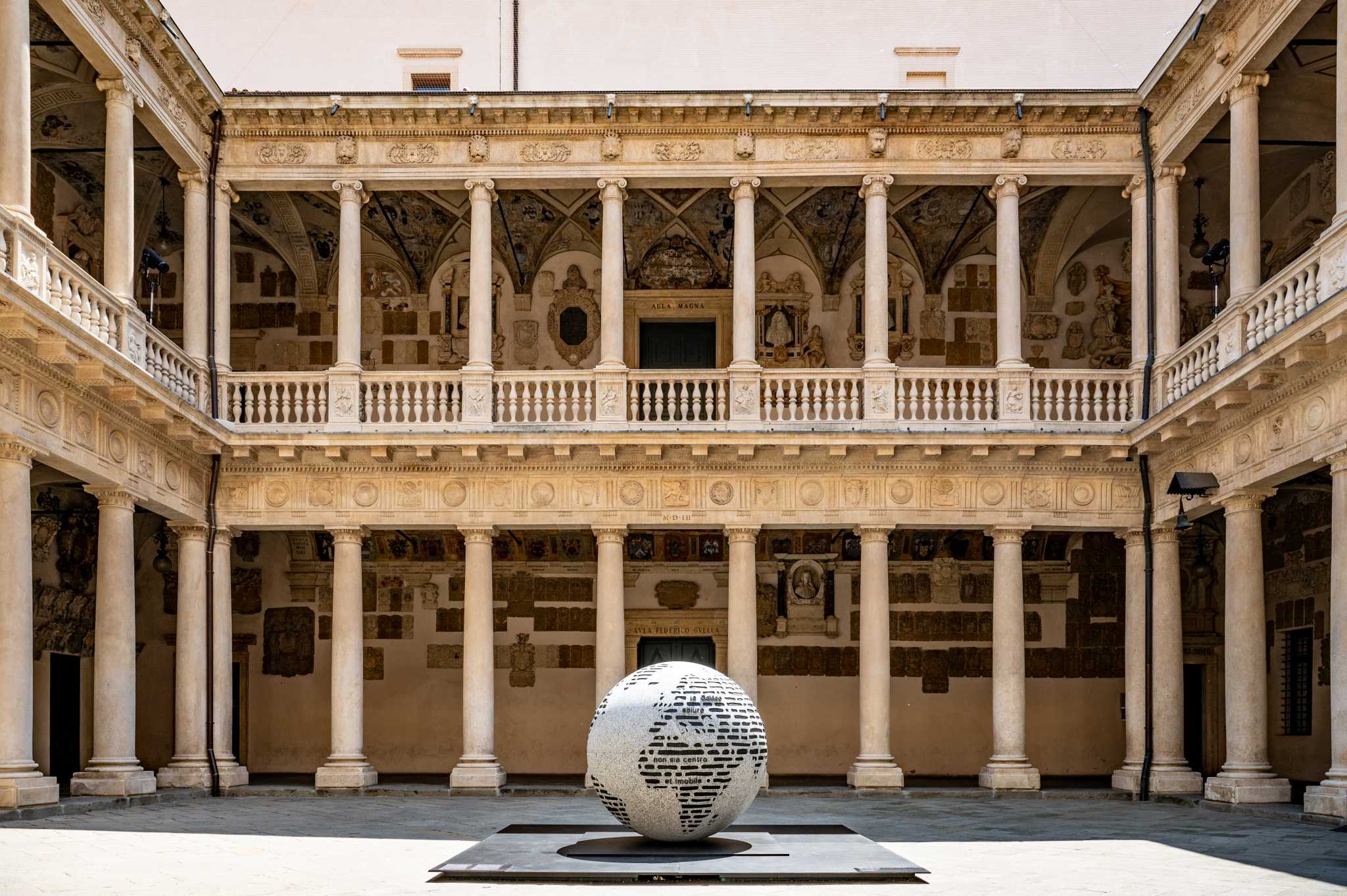
About Università di Padova
Università di Padova (UNIPD) is a public university founded in 1222, when around a thousand students and professors left the University of Bologna in search of academic freedom. With more than 800 years of history, it is the second oldest university in Italy and the fifth oldest continuously operating university in the world. Its motto, "Universa Universis Patavina Libertas" (The whole freedom of Padua for everyone), sums up its spirit from 1222 to today.
Padua's most famous connection is with Galileo Galilei, who taught mathematics and physics here between 1592 and 1610. Galileo called these years "the best eighteen years of my life" and it was in Padua that he made some of his astronomical observations. At Palazzo Bo, the historic seat, his lectern is preserved along with the first permanent anatomical theatre in the world (1594). It was also here, in 1678, that Elena Lucrezia Cornaro Piscopia became the first woman in the world to earn a university doctorate.
Today, UNIPD has more than 70,000 students and over 2,200 academic staff, with thousands of international students from around the world. The university has 8 schools and 32 departments, spread across the city of Padua and campuses in the Veneto region. In the QS World University Rankings 2026 it sits at 233rd worldwide (up three positions) and 4th in Italy, consistently in the top one percent of universities in the world.
For Romanian students, Padua is one of the best opportunities in Europe. Its strengths: sciences (Physics, Chemistry, Biology, Mathematics), Medicine and Surgery (with centuries of tradition), Psychology (among the best in the world in this subject), Engineering, Law, Economics and Political Science. As an EU citizen you pay EU fees, and the contribution is calculated according to ISEE (the indicator of the family's economic situation): with an ISEE up to roughly 27,000 euros you enter the no-fee bracket and pay 0 euros tuition, while the maximum contribution for higher incomes reaches roughly 2,500 to 2,700 euros per year. UNIPD also has an increasingly broad set of programmes in English, especially at master's level and for certain bachelor's degrees.
How to apply to Padua
Pre-enrolment on Universitaly
The first official step for students from outside Italy: pre-enrolment on the Universitaly portal, the platform of Italy's Ministry of Education. Here you choose the university (Padua) and the programme you are targeting. Even if you are an EU citizen and do not need a visa, pre-enrolment helps with the recognition of your high school diploma (Baccalaureate) and with the equivalence of your studies. Recommended timing: apply from spring for the academic year that starts in September or October.
Take the admission test or TOLC
Most bachelor's degrees in Italy have an admission test. For many programmes (engineering, economics, sciences) the TOLC (Test OnLine CISIA) is used, which can also be taken from home (TOLC@home). Programmes with numerus clausus (Medicine, Psychology) have separate national or local tests, with limited places. Check on the UNIPD website what type of test your programme requires and register early on the CISIA platform.
Calculate ISEE (mandatory for EU fees)
To pay correct EU fees and enter the no-fee bracket, you need ISEE (Indicatore della Situazione Economica Equivalente), the indicator that summarises the family's income and assets. As an EU citizen you use ISEE parificato, calculated through a CAF (Centro di Assistenza Fiscale) based on income documents from Romania. Without ISEE you pay the maximum contribution. With an ISEE up to ~27,000 euros you enter the no-fee bracket and pay 0 euros tuition.
Prove your language (Italian CILS B2 or English IELTS)
For programmes in Italian you need level B2, proven through certificates such as CILS, CELI or PLIDA (or through an Italian test organised by UNIPD). For programmes in English you need IELTS 6.0-6.5 or an equivalent TOEFL iBT, or a Cambridge B2/C1 certificate. UNIPD offers Italian courses for international students, useful especially in the first year.
Obtain codice fiscale and register as an EU citizen
For any formality in Italy (enrolment, rental contract, bank account) you need a codice fiscale, the Italian tax code, free of charge from the Agenzia delle Entrate or from the Italian consulate. As a Romanian (EU) citizen you do not need a study visa. After moving to Padua, if you stay more than 3 months, you register at the town hall (anagrafe) for residency, with your passport or ID card, proof of admission and health insurance (European Health Insurance Card or private).
Enrolment (immatricolazione) and start of studies
Once you pass the test and are admitted, you complete the immatricolazione online on the UNIPD portal. You upload your equivalated high school diploma (Baccalaureate), ISEE, codice fiscale and pay the first instalment of the contribution. Start of the academic year: generally late September or October. UNIPD has an orientation programme for international students. Tip: arrange accommodation (ESU Padova, halls or private apartments) at least 2 months in advance, because Padua is a student city with high demand.
Costs for Romanians
EU tuition 2026-27 (via ISEE)
Total cost 3-year bachelor's (all in)
EU fees
As an EU citizen you pay EU fees identical to those of an Italian student. You must submit ISEE parificato (calculated through a CAF based on income from Romania). With an ISEE up to ~27,000 euros you pay 0 euros tuition. Note: if you do not submit ISEE, the university automatically applies the maximum contribution, so it is a mandatory step for Romanians.
ESU Padova grant
The Veneto region, through ESU Padova (the body for the right to study), offers grants for students with a low ISEE, including EU citizens. The DSU grant can cover tuition, a sum of money and meals or accommodation in halls. You apply in parallel with enrolment, generally in autumn. There are also additional fee exemptions for students with good results.
Romania grant
As a Romanian student you are eligible for grants from Romania's Ministry of Education for studies abroad if you gain admission to a public university in the EU. Many town halls and county councils in Romania also have grant programmes for their students who go abroad to study. These grants can be combined with the Italian ones, but they must be applied for in parallel.
Want to apply to Padua?
We help you with pre-enrolment on Universitaly, choosing the programme, preparing for the test or TOLC, calculating ISEE for EU fees and obtaining the codice fiscale. Our mentors have been through the process. The mentoring session is 100% free.
Talk to a mentorFrequently asked questions
How hard is it to get into Università di Padova as a Romanian?
It depends a lot on the programme. Many bachelor's degrees have open access or an orientation test, while for others (engineering, economics, sciences) you take the TOLC (Test OnLine CISIA), which assesses mathematics, logic and reading comprehension. Programmes with numerus clausus such as Medicine and Surgery or Psychology have competitive national or local tests, with limited places, so they are the hardest. For Romanians, the high school diploma (Baccalaureate) is recognised through pre-enrolment on Universitaly. A good Baccalaureate average and serious TOLC test preparation are the key. Our mentors help you choose the programme that suits your profile.
How much does Padua cost for Romanians exactly?
As an EU citizen you pay EU fees, and the contribution is calculated through ISEE. With an ISEE up to roughly 27,000 euros you enter the no-fee bracket and pay 0 euros tuition, only the fixed regional and stamp taxes (~160 euros per year). For higher incomes, the contribution rises progressively up to roughly 2,500-2,700 euros per year. Accommodation Padua: 300-550 euros per month. Food: 200-350 euros per month. Total cost of living: ~600-1,000 euros per month. Total 3 years of a bachelor's all-in: roughly 25,000-38,000 euros, drastically lower than the UK or the US. Note: bachelor's degrees in Italy usually last 3 years (180 ECTS).
What is ISEE and why is it mandatory for Romanians?
ISEE (Indicatore della Situazione Economica Equivalente) is the official Italian indicator that summarises your family's economic situation, taking into account income, assets and the number of members. At Padua, the annual contribution depends directly on ISEE: the lower it is, the less you pay, and up to roughly 27,000 euros you pay 0 euros tuition. As an EU citizen you use ISEE parificato, calculated through a CAF (Centro di Assistenza Fiscale) based on income documents from Romania. Important: if you do not submit ISEE, the university automatically applies the maximum contribution, regardless of actual income. That is why ISEE is a mandatory step for any Romanian who wants correct EU fees.
What grants are available at Padua for Romanians?
The DSU grant through ESU Padova: the Veneto region offers grants for students with a low ISEE, including EU citizens, which can cover tuition, a sum of money and meals or accommodation in halls. Merit-based fee exemptions: students with good academic results can receive additional reductions. Erasmus+: if you come initially on an academic exchange, you receive a monthly grant. Grants from Romania's Ministry of Education for studies abroad, plus local programmes run by town halls and county councils in Romania, which can be combined with the Italian ones. Important: EU fees through ISEE (from 0 euros) are already a major advantage over non-EU students.
Are the programmes at Padua in English or do you need Italian?
Most bachelor's degrees at Padua are taught in Italian, so you need level B2, proven through CILS, CELI or PLIDA certificates, or through an Italian test by the university. However, UNIPD has an increasingly broad set of programmes in English, especially at master's level and for certain bachelor's degrees (engineering, sciences, international economics). For programmes in English you need IELTS 6.0-6.5 or an equivalent TOEFL iBT. Tip for Romanians: if you do not know Italian, look for bachelor's degrees in English; if you want the full offering, learn Italian to B2, for which UNIPD offers courses for international students.
What are the strongest programmes at Padua for Romanians?
Padua is renowned for sciences (Physics, Chemistry, Biology, Mathematics, Astronomy, with the historic Galileo connection), Medicine and Surgery (with centuries of tradition and the first anatomical theatre in the world), Psychology (among the best in the world in this subject), Engineering (computer science, mechanical, electronics), Law, Economics and Political Science. The university is also a strong research centre, in the top one percent of universities in the world. Note: Medicine and Psychology have numerus clausus, so the most competitive admission tests.
Can I stay in Italy after graduation?
Yes, as an EU citizen! Unlike the United Kingdom or the US where you need a work visa, as a Romanian (EU) citizen you have the automatic right to work in Italy without a visa. Italy is the third largest economy in the eurozone, and the Veneto region (where Padua is) is one of the most industrialised and prosperous areas, with engineering, pharma, fashion and technology companies. Padua has a technology park and many university spin-offs. Main industries: engineering and manufacturing, pharma and biotechnology, IT, fashion and design, agri-food. With an EU degree you can work anywhere in the European Union without a visa, which makes Padua a solid base for a European career.
What is Galileo Galilei's connection with Padua?
Galileo Galilei was a professor of mathematics at Università di Padova between 1592 and 1610, the 18 years he called "the best of my life". In Padua he carried out some of his research, including early astronomical observations, and taught in the Aula Magna at Palazzo Bo, where his lectern is preserved to this day as a relic. Padua is also home to the first permanent anatomical theatre in the world (1594), and in 1678 it was the university where Elena Lucrezia Cornaro Piscopia became the first woman in the world with a university doctorate. This scientific heritage explains why Padua remains a benchmark for sciences, medicine and research.
Our mentors from Europe
They studied at Bocconi, Sciences Po, TU Delft, ETH Zurich and other EU universities. Now they guide you.


