
University of Southern Denmark
A Danish public university, with its first students in Odense in 1966. QS World 2026 number 303, ranked 4th in Denmark after Copenhagen, Aarhus and DTU. Over 27,000 students, almost 20 percent international, plus 5 faculties and more than 70 programs taught in English. As an EU citizen you pay zero tuition fees.
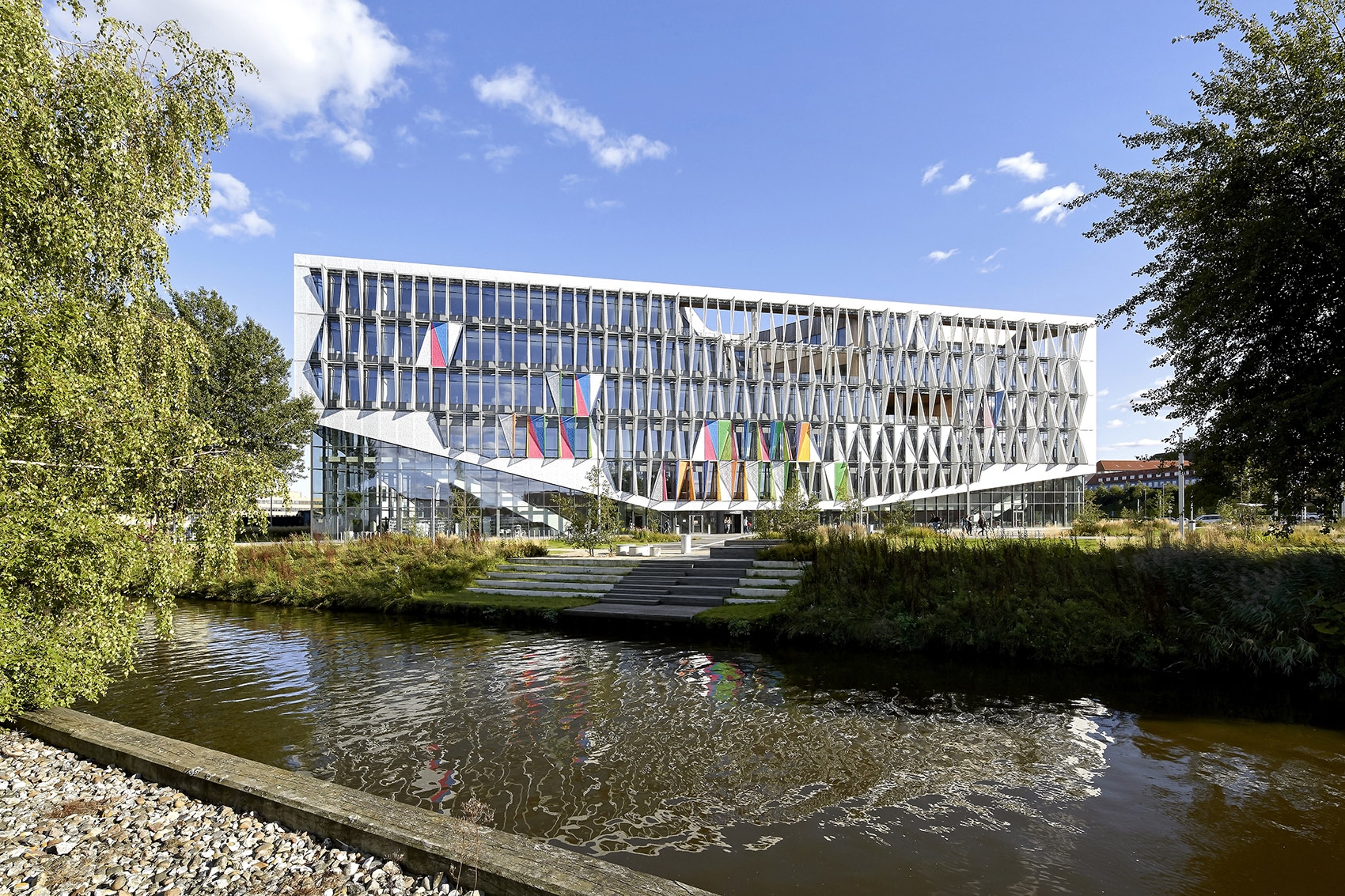
About University of Southern Denmark
University of Southern Denmark (SDU, Syddansk Universitet) is a public research university, with its first students welcomed in Odense in 1966. The institution in its current form was consolidated through a merger in 1998, but the main campus in Odense, on the island of Funen, remains the heart of the university. SDU has 5 faculties (Engineering, Science, Health Sciences, Social Sciences, Humanities) and campuses in Odense, Kolding, Esbjerg, Sønderborg and Vejle. Today it has over 27,000 students, of whom almost 20 percent are international.
In the QS World University Rankings 2026, SDU is ranked 303rd in the world, which places it 4th in Denmark after the University of Copenhagen, Aarhus University and DTU. SDU has solid results on indicators such as international faculty, citations per faculty member and international research collaboration. Its recognized strengths include engineering, the sciences, business and health, plus research hubs in robotics, biotechnology and information technologies.
SDU offers over 70 programs taught entirely in English, at bachelor and master level, which makes it accessible for Romanian students who do not speak Danish. The Danish teaching model emphasizes project-based learning, teamwork and a close relationship between students and professors, very different from the lecture-based style that students from Romania are used to. Many programs have practical components, internships and collaborations with industry in the Syddanmark region.
For Romanian students, SDU is one of the best opportunities in Europe. As an EU citizen, bachelor studies are FREE (zero tuition fees), unlike students from outside the EU/EEA who pay between 15,000 and 17,300 EUR per year. Danish bachelor degrees usually last 3 years (180 ECTS), in line with the Bologna system. In addition, as an EU student who works part-time in Denmark you can become eligible for SU, the Danish state student grant. You apply through the national system Optagelse.dk (the KOT coordinated admission system).
How to apply to SDU
Choose your program and language of instruction
SDU has over 70 programs taught in English in Odense and across its other campuses. Check on sdu.dk whether the program you want (engineering, business, science, health) is in English or in Danish. For Danish-taught ones you need Studieprøven (the Danish language test). For Romanians, English-taught programs are the natural path.
Apply through Optagelse.dk (the KOT system)
Bachelor applications in Denmark are centralized through Optagelse.dk, the national admission system (KOT). The portal opens on 1 February, and the final deadline is 15 March, 12:00 CET (Quota 1). Late applications are not accepted. You can choose up to 8 ranked program preferences.
Prove your English (English B, IELTS 6.5+)
Bachelor programs require English at Danish level B, usually demonstrated through your Baccalaureate. For applicants with foreign diplomas, SDU also accepts Cambridge C1 Advanced or IELTS Academic 7.0 (with no section below 6.5). Language documents must be submitted by 5 July, 12:00 CET.
EU citizen registration and CPR
As a Romanian (EU) citizen you do not need a study visa. After admission and arrival in Denmark you obtain an EU residence document from SIRI and register at Borgerservice for your CPR number (the Danish personal number), needed for banking, healthcare and SU. The CPR opens up access to Danish public services for you.
Check your eligibility for SU
As an EU student, you can become eligible for SU (Statens Uddannelsesstøtte), the Danish monthly state grant, if you work part-time in Denmark (usually around 10-12 hours per week, with EU worker status). SU is applied for separately on su.dk after you have a CPR and an employment contract. It is not automatic, but it is real support.
Enrollment and starting your studies
KOT admission responses are communicated on 28 July. After acceptance you confirm your place, enroll on the SDU portal and choose your courses for the first semester. The academic year starts in late August / early September. SDU organizes an introduction week for international students, with orientation, campus tours and accommodation support.
Costs for Romanians
Tuition fees (EU citizens)
Cost of living in Odense (estimated)
Free tuition
As an EU citizen, bachelor studies at SDU are completely free. You do not have to do anything special, just prove your Romanian citizenship through a passport or ID card. That means savings of 15,000-17,300 EUR per year compared to a student from outside the EU, that is over 45,000 EUR over the course of a 3-year bachelor degree.
Monthly state grant
SU (Statens Uddannelsesstøtte) is the Danish monthly state grant for students. As an EU student you become eligible if you work part-time in Denmark (EU worker status, usually around 10-12 hours per week). It is applied for separately on su.dk after you have a CPR. Combined with a part-time job, SU can cover a good part of your monthly expenses.
Sources for Romanians
As a Romanian student you are eligible for scholarship programs from the Romanian Ministry of Education for studies in the EU, plus scholarships offered by some town halls in Romania. Added to these are the part-time student job market in Odense and Erasmus+ grants if you arrive initially on mobility. Check all sources in parallel.
Want to apply to SDU?
We help you choose the right program in English, apply correctly through Optagelse.dk, prepare your proof of English and take advantage of free studies for EU citizens and of SU. Our mentors have been through the process. The first mentoring session is 100% free.
Talk to a mentorFrequently asked questions
How much does SDU cost for a Romanian student?
As an EU citizen, bachelor studies at SDU are FREE (zero tuition fees). Students from outside the EU/EEA pay between 15,000 and 17,300 EUR per year, but this cost does not affect you. The only real cost is everyday life in Odense: accommodation 450-750 EUR per month, food 250-350 EUR, transport 40-60 EUR, miscellaneous 100-150 EUR, that is approximately 850-1,300 EUR per month. Odense is significantly more affordable than Copenhagen.
Is SDU really free for EU citizens?
Yes. Danish public universities, including SDU, do not charge tuition fees for students from the EU, EEA and Switzerland. For you, as a Romanian, that means a free bachelor degree. You do not have to do anything special, just prove your Romanian citizenship through a passport or ID card at enrollment. The saving compared to a non-EU student is over 45,000 EUR over the course of a 3-year bachelor degree.
What is SU and can I receive it as a Romanian?
SU (Statens Uddannelsesstøtte) is the Danish monthly state grant for students. Danish students receive it relatively easily; as an EU student, you become eligible if you work part-time in Denmark and obtain EU worker status (usually around 10-12 hours per week). SU is applied for separately on su.dk after you have your CPR number and an employment contract. It is not automatic, but combined with a part-time job it can cover a good part of your monthly expenses.
How do I apply to SDU through Optagelse.dk?
Bachelor applications in Denmark are centralized through Optagelse.dk, the coordinated national admission system (KOT). The portal opens on 1 February, and the final deadline for Quota 1 is 15 March, 12:00 CET. Late applications are not accepted. You choose up to 8 ranked program preferences, upload your documents (diploma, transcript, proof of English) and wait for the response. Admission results are communicated on 28 July.
What level of English do I need at SDU?
Bachelor programs require English at Danish level B, usually demonstrated through your Baccalaureate (the English studied in high school). For applicants with foreign diplomas, SDU also accepts Cambridge C1 Advanced or IELTS Academic 7.0 with no section below 6.5 (test taken in the last 2 years). Note: for the bachelor, IELTS and TOEFL do not replace the English B requirement if you have not studied English in high school, so your high school documentation is the main one. Language documents must be submitted by 5 July, 12:00 CET.
Are SDU programs in English or in Danish?
SDU has over 70 programs taught entirely in English, at bachelor and master level, so you can study without knowing Danish. The strong fields with English-taught programs include engineering, the sciences, business and health. There are also many programs in Danish, for which you need the Studieprøven test. For Romanian students, the natural path is the English-taught programs. We still recommend learning basic Danish, useful for a part-time job, for SU and for integration.
What is CPR and why do I need it?
CPR (the Danish personal number) is your identification number in Denmark, the equivalent of a local national ID number. You obtain it at Borgerservice after arrival, together with the EU residence document from SIRI (as an EU citizen you do not need a visa). The CPR opens up access to the Danish public healthcare system, a bank account, an employment contract and the SU application. It is one of the first administrative steps you take as a new student at SDU.
How long is the bachelor at SDU and where does it rank?
Bachelor degrees at SDU usually last 3 years (180 ECTS), in line with the European Bologna system, one year less than in Spain (4 years) or the USA. In the QS World University Rankings 2026, SDU is ranked 303rd in the world, which places it 4th in Denmark after the University of Copenhagen, Aarhus University and DTU. It has good results on international faculty, citations per faculty member and international collaboration, with strengths in engineering, science, business and health.
Our mentors from Europe
They studied at Bocconi, Sciences Po, TU Delft, ETH Zurich and other EU universities. Now they guide you.

