
Stanford University
The university that generated Silicon Valley. Google, Yahoo, HP, Cisco, Netflix, Snapchat, Instagram, NVIDIA, all founded by Stanford graduates. Top global research plus direct access to the biggest investors and entrepreneurs in the world. Quarter system, 3 intense terms per year. 2026 CHANGE: Stanford has reinstated the SAT/ACT requirement and is the only top-10 school that is need-aware for international students.
About Stanford
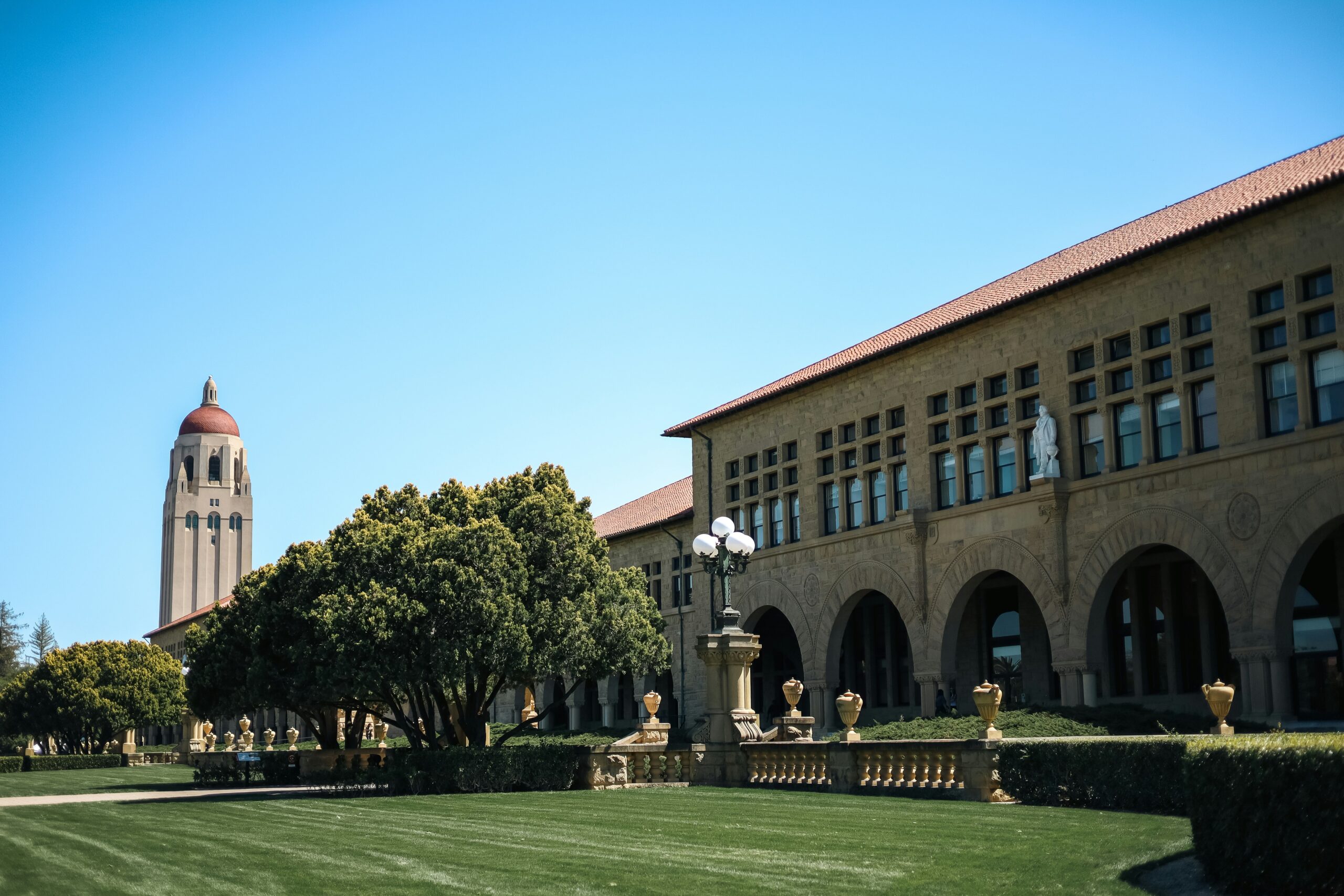
Stanford University is located in Stanford, California, near Palo Alto, in the heart of Silicon Valley. The 8,180-acre campus is the largest in the USA (80x larger than Yale!), with palm trees, the iconic Hoover Tower, and Memorial Church. The atmosphere is relaxed-Californian yet academically intense. The location is Stanford's key asset, 15 minutes from Palo Alto (home of Tesla, many VC firms), 45 minutes from San Francisco, in the middle of the ecosystem with the most startups in the world.
Stanford has 7 schools but only 3 offer undergraduate degrees: School of Humanities and Sciences (H&S, the largest, includes Math, Physics, Biology, CS pre-2023, Economics, etc.), School of Engineering (since 2023 includes CS, EE, MechE, BioE, Aero, Materials, MS&E), School of Earth, Energy and Environmental Sciences. Stanford's strongest programs: Computer Science (number 1 in the world, ~640 students per cohort, the largest concentration at an elite university), Management Science and Engineering (MS&E) (an alternative to the lack of an undergraduate business degree), Bioengineering, Symbolic Systems (CS + linguistics + philosophy), Human Biology, Mechanical Engineering, Economics.
Stanford's unique features: (1) Silicon Valley adjacency, direct access to Google, Apple, Meta, Stanford Research Park (with Tesla, VMware, HP, Lockheed Martin right on campus), tens of thousands of internships and job opportunities; (2) Quarter system, 3 terms of 10 weeks each (Autumn, Winter, Spring) plus an optional Summer Quarter. Fast pace, more intense than a semester (fewer weeks means a more accelerated tempo); (3) does NOT offer an undergraduate business degree, popular alternatives: Economics, MS&E, or a dual track of CS plus a minor in Management. Stanford Graduate School of Business (GSB) is for graduate students only; (4) Stanford d.school (Hasso Plattner Institute of Design), the global pioneer of design thinking, accessible to all students; (5) Hoover Institution, an influential conservative think tank, plus 30+ other affiliated Nobel researchers. Mascot: The Tree (not official, a humorous unofficial mascot; the official one is Cardinal Red, the color). Conference: ACC (since 2024). Alumni: Larry Page, Sergey Brin, Elon Musk (dropped out after 2 days into a PhD), Reed Hastings, Peter Thiel, Tiger Woods, John Steinbeck.
How to apply to Stanford
Common App or Coalition
Stanford accepts the Common Application or the Coalition Application with Scoir. Application fee: $90 (the most expensive in the top non-Ivy! a waiver is available). On both platforms, Stanford requires the Stanford-specific section: 3 short essays (50 words each) plus 3 short response questions (250 words each). Total: 9 prompts in addition to the main Common App essay.
2 rounds: non-binding REA or RD
Stanford offers 2 rounds: REA (Restrictive Early Action), non-binding, deadline November 1, decision mid-December. REA means you cannot apply simultaneously ED or REA to another private school (you can to state schools or international ones). RD: deadline January 5, decision April 1. Stanford stopped publishing its official rate starting with Class 2029, in order to reduce stress. The last published figure: Class 2028 3.61% (2,067 / 57,326). For Romanians: REA does not significantly increase your chances at Stanford (1.3-1.5x vs RD, far less than ED elsewhere), apply REA only if Stanford is clearly your first choice.
SAT/ACT now REQUIRED (reinstated Class 2030)
MAJOR change for 2026: Stanford has reinstated the SAT/ACT requirement for the 2025-26 cycle (Class 2030 onward). It was test-optional during the pandemic, but Stanford confirmed that the data showed scores are predictive of academic success. Stanford admitted median: SAT 1500-1570 (median 1540), ACT 33-35 (median 34). For Romanians: SAT 1500+ or ACT 34+ realistically required. Stanford superscores (combines best math plus best EBRW from different tests) and accepts score choice. For international students: TOEFL 100+, IELTS 7.5+, Duolingo 130+.
A distinctive profile plus Stanford-specific essays
Stanford looks for "intellectual vitality" and authenticity, not just a high GPA. Stanford essays are famous for their distinctive character: "Letter to your future roommate" (250 words), "What 5 things matter to you, and why" (50 words each), "How did you spend your last 2 summers", "What historical event do you find most intriguing". For Romanians: authenticity is the key, Stanford immediately detects essays that try to impress. Extracurricular activities that show real passion plus initiative (your own projects, research, volunteering) count more than long lists.
3 recommendations (counselor plus 2 teachers)
A counselor recommendation plus 2 teachers from core academic subjects in grades 11-12. Stanford prefers recommendations from teachers who know you well, not from the most prestigious ones. For STEM: at least one from math, science, CS. For Humanities/Social Sciences: at least one from English, History, Foreign Language. Stanford values authenticity over superlatives; recommendations that show genuine potential for research, innovation, leadership count more than standard praise.
Alumni interview (optional, through SAV)
Stanford Alumni Volunteers (SAV) offer optional interviews where local alumni are available. For Romanians, there is a limited network in Bucharest (a few alumni). Stanford officially states that the lack of an interview does NOT disadvantage the applicant. The interview is conversational, not evaluative, lasts 30-60 minutes, virtual or in person. Strategy: if you have the opportunity, do it, it is an extra chance to articulate your authentic interest in Stanford.
Costs for Romanians
List cost (academic year 2025-26)
Total cost for 4 years (international)
High impact
Stanford is the ONLY top-10 still need-aware for international students (source admission.stanford.edu): "For international citizens who indicate on their application that they will be applying for financial aid, that request will be a factor in our admission evaluation, making the process more selective".
100% need met
For intl admitted with aid: 100% of demonstrated need covered, regardless of citizenship. Average scholarship Fall 2025: ~$69,000/year. Zero loans in the package, only grants.
First-year only
Official source: if you are admitted without having requested aid or your citizenship does not change, you can NO longer request aid in years 2-4. The decision must be made in year 1 for the entire cycle.
Do you want to apply to Stanford?
Stanford is the hardest top-10 acceptance for international students (the only need-aware one), but also the biggest upside (Silicon Valley access). We help you build an authentic profile, write the 9 Stanford-specific essays, decide REA vs RD, and navigate the financial aid strategy (need-aware, decision crucial in year 1). The mentoring session is 100% free.
Talk to a mentorFrequently asked questions
Stanford vs Harvard for a Romanian, when does each make sense?
The key differences. Location: Stanford in Silicon Valley (warm climate, suburban, tech ecosystem), Harvard in Cambridge MA (urban, near Boston, 4 real seasons). Culture: Stanford more relaxed-Californian, more oriented toward risk-taking and entrepreneurship; Harvard more traditional, more oriented toward finance, government, law. Programs: Stanford is number 1 for CS, AI, Engineering, Entrepreneurship. Harvard is number 1 for Government, Law, History, Economics, Biology. Financial aid CRITICAL: Harvard is need-blind globally (the aid request does NOT lower your chances), Stanford is need-aware for international students (the aid request lowers your chances). For Romanians who need aid, Harvard is clearly more accessible. For those who can pay full cost and want tech or startups, Stanford is the optimal choice.
Stanford vs MIT for CS or Engineering?
The differences are subtle but important. Culture: MIT is more academically pure, more theoretical, more geek-friendly, "mens et manus" engineering philosophy. Stanford is more applied, more entrepreneurial, more pop-culture-tech. Location: MIT near Harvard in Cambridge (intellectual ecosystem), Stanford in Silicon Valley (industry ecosystem). Size: MIT ~4,700 undergrad, Stanford ~7,800 undergrad, Stanford larger and more diversified. For CS: both top 1-2 in the world. Stanford is the best for CS entrepreneurship (many startups started by students), MIT the best for theoretical CS, ML research, robotics. For international students: MIT is need-blind globally plus meets 100% of need, Stanford is need-aware. A MAJOR difference for Romanians who need aid. Conclusion: if you want mainstream tech and entrepreneurship plus you can pay, Stanford. If you want pure research or you need aid, MIT.
Why does Stanford NOT offer an undergraduate business degree?
Stanford believes that you cannot learn business before having work experience. Stanford Graduate School of Business (GSB), one of the most prestigious in the world (top 3 alongside Harvard Business School and Wharton), is strictly for graduate students (MBA), with a requirement of 3-5 years of work experience. Alternatives for business-oriented undergraduates: (1) Economics, Stanford's department is top 5 in the USA, very quantitative. (2) Management Science and Engineering (MS&E), the most popular substitute, a combination of mathematics, statistics, optimization, organizational behavior, with an emphasis on analytics and consulting. (3) CS plus a business minor, a very common dual track. (4) Symbolic Systems, popular for product management in tech. Stanford undergrads go into business at: McKinsey, BCG, Bain (consulting), Goldman, Morgan Stanley (banking), Google, Meta, Apple (tech PM), their own startups (frequently).
How does financial aid work for Romanians at Stanford?
Stanford is the ONLY top-10 university that is need-aware for international students (Harvard, Yale, Princeton, MIT, Dartmouth are need-blind globally). Official source admission.stanford.edu: "For international citizens who indicate on their application that they will be applying for financial aid, that request will be a factor in our admission evaluation, making the process more selective". What it means for Romanians: if you request aid, your admission chances drop significantly. The Stanford Review (a Stanford student publication) reports that international students who requested aid had admission rates much lower than the average. For those admitted with aid: 100% of demonstrated need covered, average scholarship Fall 2025 ~$69,000/year, zero loans. Applying for intl aid: CSS Profile required. FAFSA does NOT apply to international students, ineligible for Federal Aid. CRITICAL for Romanians: you must decide in year 1 whether to request aid; if you do not request it or are refused in year 1, you can NO longer request it in years 2-4.
SAT/ACT at Stanford, required or optional?
MAJOR CHANGE for the 2025-26 cycle (Class 2030 onward): Stanford has reinstated the SAT/ACT requirement. It was test-optional during the pandemic, but Stanford confirmed (March 2026) that scores are predictive of academic success. For Romanians: SAT 1500+ or ACT 34+ realistically required for a real chance. Stanford admitted median: SAT 1500-1570 (median 1540), ACT 33-35 (median 34). Stanford superscores (combines best math plus best EBRW from different tests) and accepts score choice (you can choose what to send). Stanford code for the College Board: 4704. Strategy for Romanians: take the SAT at least twice, the ACT at least once as a backup, submit the best score.
What is the Stanford d.school and design thinking?
Stanford d.school (officially the Hasso Plattner Institute of Design) is the global pioneer of design thinking. Founded in 2005, it is famous for the problem-solving approach that has influenced all the major tech companies (Apple, Google, IBM, etc.). Design thinking is a methodology with 5 stages: Empathize, Define, Ideate, Prototype, Test. Stanford students can take d.school courses regardless of their major, it is accessible to everyone. The most popular courses: ME 101 "Visual Thinking", ME 218 "Smart Product Design", ME 310 "Design Engineering" (a real industrial project, 8 months, in global teams with students from Europe and Asia). For Romanians oriented toward tech, design, entrepreneurship: the d.school is one of Stanford's main draws, many graduates found startups directly with prototypes from d.school courses.
The quarter system at Stanford, what does it mean?
Stanford uses the Quarter system, 3 intense terms per year: Autumn Quarter (September-December), Winter Quarter (January-March), Spring Quarter (March-June), plus an optional Summer Quarter. Differences vs a semester: (1) The quarter system has 3 terms x 10 weeks vs a semester system's 2 semesters x 15 weeks. A faster pace. (2) More courses per year, an undergraduate takes 12-15 courses per year on quarters, vs 8-10 on semesters. (3) Less time per course, assignments come more often, exam season 3 times per year. For Romanians: it is a big transition from the Romanian system (2 semesters x 15 weeks). The advantages: you explore more subjects, missing one course does not kill you (you recover quickly the next quarter), summer is free for internships. The disadvantages: an intense pace, cumulative fatigue, less time to go deep.
How many Romanian students are at Stanford?
Stanford has ~14% international students at the undergraduate level (~1,000 students), Class 2029 represents 65 different countries. For Romanians: we estimate 10-15 Romanian students at the undergraduate level across all 4 years combined, very selective due to the need-aware policy. At the graduate level (PhD in CS, EE, MS&E, Engineering plus GSB MBA), the Romanian community is larger, 40-60 people. Stanford is popular among Romanians oriented toward: CS and AI (all Romanians with Informatics olympiads dream of Stanford), Engineering (Aerospace, Mech, Bio), Entrepreneurship (many Romanian students have founded startups at Stanford), PhD in CS. Stanford's advantage for Romanians: the Bay Area has an active Romanian community, ~5,000 Romanians in the San Francisco metro area, plus tens of thousands of Romanian tech professionals in Silicon Valley. Direct access to Google, Meta, Apple, Tesla, NVIDIA for internships and jobs. The only downside: a very high cost of living and a strict need-aware policy.
Our mentors for the USA
They studied in the USA, at universities like Harvard, MIT and Stanford. They went through the process. Now they guide you.


