
MIT
The most prestigious tech university in the world. Need-blind for everyone (including internationals), a non-restrictive Early Action (you can also apply to Harvard at the same time), MIT's own application, not the Common App.
About MIT
Founded in 1861 as a response to industrialization, MIT defined what a modern technical university means.
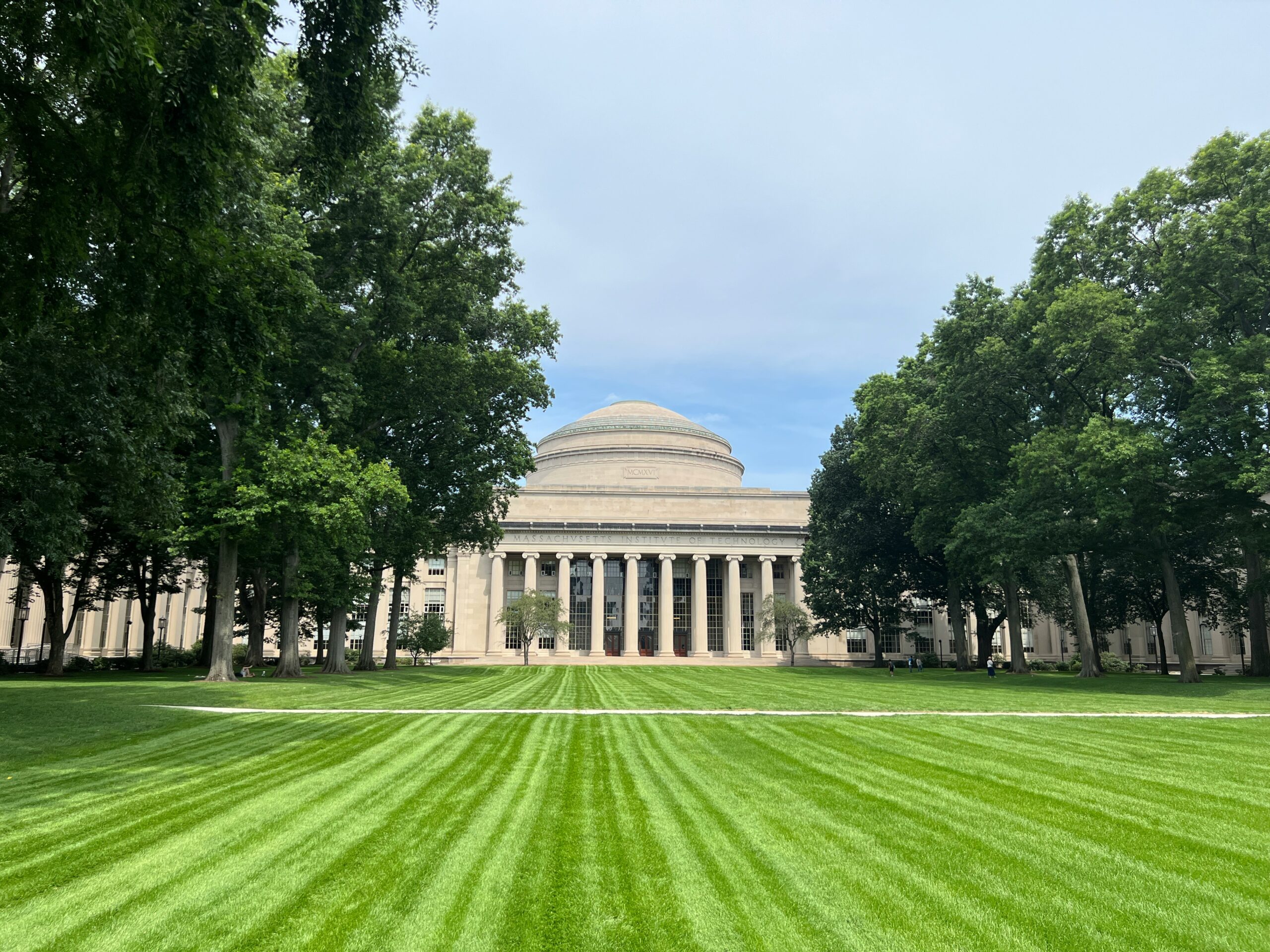
Massachusetts Institute of Technology is located in Cambridge, MA, across the Charles River from Boston, just 1.5 km from Harvard. The 67-hectare campus is defined by Killian Court, the Great Dome and "The Infinite Corridor" (a 251m corridor running through the main buildings). Unlike traditional Ivy collegiate campuses, MIT looks like an advanced tech research park.
MIT comprises 5 schools: the School of Engineering (the largest, 8 departments), the School of Science (Math, Physics, Chemistry, Biology, Brain Sciences, all top 3 globally), the Sloan School of Management, the School of Architecture and Planning and the School of Humanities, Arts, and Social Sciences (SHASS), plus the new Schwarzman College of Computing (launched in 2019, with a $350M donation). Course 6 (Electrical Engineering & Computer Science) is the most popular major, with about 40% of students. MIT Economics (Course 14) is ranked number 1 globally.
Unique MIT features: a numbered system of majors (students say "Course 6" instead of "CS", "Course 18" for Math, "Course 14" for Econ), GIRs (General Institute Requirements, the most rigorous core curriculum in the USA), P/NR grading for the first semester (freshman fall is Pass/No Record only, with no GPA), and IAP (Independent Activities Period, the month of January for experimental courses, projects, externships). Plus the tradition of "hacking culture": elaborate technical pranks (a police car on the Great Dome, an R2D2 dome).
How to apply to MIT
MIT uses its own application (MyMIT), NOT the Common App. EA is non-restrictive, so you can apply to Harvard/Princeton at the same time.
MIT's own application (MyMIT)
MIT does NOT accept the Common App or Coalition. You create an account at my.mit.edu and apply through the MIT platform, with a different interface, a unique form structure, and no standard Common App sections.
Deadline: EA Nov 1 (non-restrictive!) or RD Jan 1
Critical MIT advantage: Early Action is non-restrictive: you can apply EA to MIT AND simultaneously REA to Harvard, SCEA to Yale or Princeton. EA decision on December 17. EA rate: ~5%, RD: ~4%.
SAT/ACT required (since 2022)
MIT was the first selective university to reinstate required testing, announced in March 2022 for the Class of 2027+. Admitted profiles: SAT 1530+ (median 1550, math 780+), ACT 35+. For Romanians, the MIT code: 3514.
5 short MIT essays
Unlike the long Common App essay, MIT asks for 5 short essays (100-250 words each): why you want to study in your chosen field, describe a world that has shaped you (cultural, community, etc.), a problem you want to solve, a challenge you have overcome, and describe what you like to do for fun.
Recommendations (1 STEM + 1 humanities)
MIT requires 2 specific recommendations: one from a math, science or CS teacher (essential), and one from a humanities, social science or foreign language teacher. MIT wants to see that you are strong in both directions.
Interview with an Educational Counselor (EC)
MIT assigns a local Educational Counselor (EC) (an MIT alum from your region) for an informal interview (30-60 min). For Romanians there are ECs in Bucharest and online. The interview matters: MIT officially states that the EC report counts in the decision.
Costs and financial aid
MIT is need-blind for all applicants, including internationals. It is one of only 9 universities in the USA with this policy. Zero loans in aid packages. In November 2024, MIT significantly expanded financial aid: families earning under $200,000/year pay no tuition (effective from fall 2025).
Sticker price 2024-25
Average price paid (after aid)
$0 total
MIT covers tuition, housing, meals, books and personal costs in full. Zero family contribution.
$0 tuition
From fall 2025: tuition 100 percent covered. The family contributes only partially toward housing and meals.
Substantial aid
Families with incomes over $200,000 can still receive aid (depending on assets and specific needs). Calculated individually.
Want to apply to MIT?
Our mentors have been through the MIT application and know how the 5 short essays are written. The mentoring session is 100% free.
Talk to a mentorFrequently asked questions
What is the difference between MIT, Harvard and Stanford for a Romanian?
MIT is the only pure tech and science university of the 3, with a 100% focus on engineering, math, physics, CS, biology, plus Sloan business and solid humanities. Harvard is a generalist (any major, super-strong in government, law, medicine), Stanford is tech + entrepreneurship + business (Silicon Valley access). For a Romanian student oriented toward hard-core STEM, passionate about research and pure mathematics: MIT > Harvard > Stanford. For applied CS and startups: Stanford > MIT > Harvard. For mixed profiles (STEM + humanities or business): Harvard > MIT.
Why doesn't MIT use the Common App?
MIT has kept its own application (MyMIT) as a deliberate philosophical decision. It wants to evaluate students based on an application designed specifically for MIT: short essays, technical questions, a profile built for a STEM student. The Common App is too generalist for what MIT wants to see. The MIT application takes less time to write (5 short essays of 100-250 words each = far less than the 650-word Common App essay + supplements). The application is free for financially eligible applicants.
MIT non-restrictive Early Action: how does it work?
UNIQUE MIT advantage: EA is non-restrictive, unlike EA at Harvard, Yale, Princeton (restrictive REA/SCEA) or ED at Columbia/Penn/Brown/Cornell/Dartmouth (binding). You can apply MIT EA SIMULTANEOUSLY with REA Harvard, or SCEA Yale/Princeton, or ED at an ED university. MIT EA deadline: November 1, decision December 17. MIT EA rate: ~5%, RD: ~4%. Advantage for Romanians: you can bet on MIT and an Ivy in parallel.
What are the GIRs (General Institute Requirements)?
GIRs are the mandatory core requirements for all MIT students, the most rigorous core curriculum in the USA. You must complete: 2 semesters of Calculus, 2 semesters of Physics (mechanics + electromagnetism), 1 semester of Chemistry, 1 semester of Biology, 1 lab, plus 1 REST (Restricted Elective in Science and Technology). In parallel: 8 HASS courses (humanities, arts, social sciences). That is about 25% of the 32 total courses required for graduation. The GIRs guarantee that any MIT graduate, regardless of major, has a solid STEM + humanities foundation.
How does MIT Financial Aid work for Romanians?
MIT is need-blind for everyone, including internationals: financial policy does NOT influence the admission decision. It is one of only 9 universities in the USA with this policy (alongside Harvard, Yale, Princeton, Dartmouth, Brown from 2025, Amherst, Bowdoin, Notre Dame). The expansion announced in November 2024 (effective from fall 2025): families with incomes under $200,000/year (~RON 950,000) pay no tuition. Under $100,000/year, they pay $0 total (tuition + housing + meals + books). The packages are loan-free, grants only. Internationals admitted with aid receive on average ~$50,000-60,000/year.
What is the numbered system at MIT (Course 6, 18, etc.)?
MIT uses a system unique in the USA: majors are numbered, not named. Students say "I'm Course 6" instead of "I study Computer Science". The most popular: Course 6 (Electrical Engineering & Computer Science, EECS, ~40% of students), Course 18 (Mathematics), Course 14 (Economics), Course 9 (Brain & Cognitive Sciences), Course 8 (Physics), Course 7 (Biology). It is a legacy from 1865, when departments were numbered in the order they were founded. Engineering = 1-22, Sciences = 7-12, Architecture = 4, Management = 15.
What is UROP and how does it shape the MIT experience?
UROP (Undergraduate Research Opportunities Program) is MIT's undergraduate research program, founded in 1969 (the first of its kind in the USA). About 85% of MIT students take part in UROP at least once. You work with an MIT professor on a real research project (not "student work"), sometimes published in academic journals. You can do UROP for academic credit, for pay or as a volunteer. UROP is the main reason MIT students go on to PhDs and internationally recognized industry: they have real research experience from year 1.
How many Romanian students are at MIT?
MIT admits on average 3-6 Romanian students per year at the undergraduate level, among the highest figures of any selective university in the USA for Romanians, thanks to Romanians' strong STEM profile (math, physics and computer science olympiad medalists). The active Romanian community at MIT (undergrad + grad + PhD + postdoc) numbers 100-150 people, one of the largest in the USA. The Romanian Students Association at MIT (RSA-MIT) is very active, with regular events and a strong network with industry.
Our mentors for the USA
They studied in the USA, at universities like Harvard, MIT and Stanford. They have been through the process. Now they guide you.


