
Dartmouth College
The smallest Ivy and the 4th oldest university in the USA, founded in 1769. Almost exclusive focus on undergraduate education. The D-Plan: a unique quarter-based calendar that lets you study or do an internship in any part of the year. Need-blind for everyone, including internationals, from Class 2026.
About Dartmouth
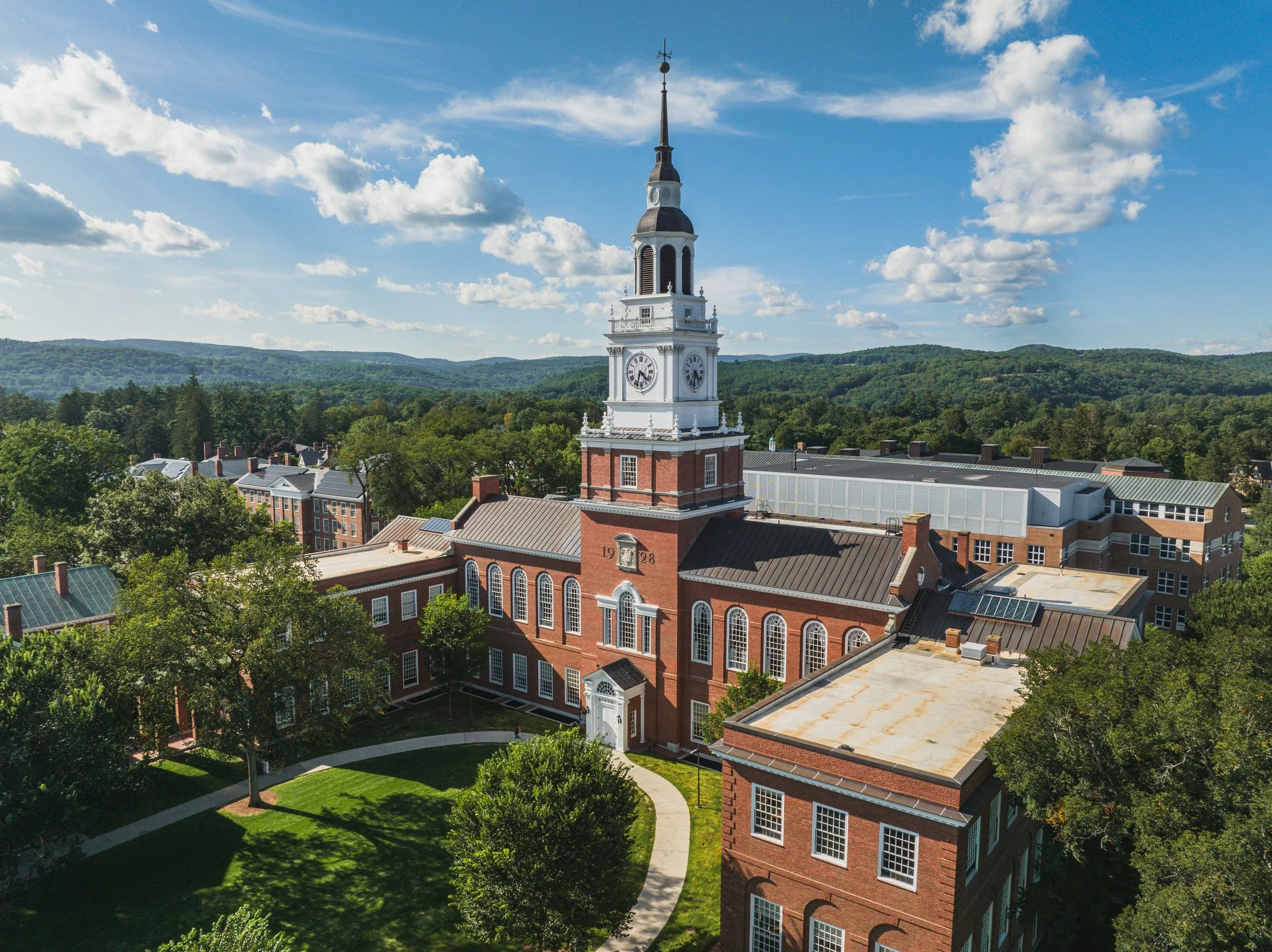
Dartmouth College was founded in 1769 in Hanover, New Hampshire, under a royal charter from King George III. It is the 4th oldest university in the USA (after Harvard, William and Mary, Yale) and has kept the word "College" in its name even after it became a full university. The 269-hectare campus sits on the border between New Hampshire and Vermont, surrounded by the White Mountains and Green Mountains, next to the Connecticut River. A 2-hour drive from Boston, 5 hours from Manhattan.
Dartmouth is the smallest Ivy (~4,500 undergraduate students, ~6,700 total including graduate) with an almost exclusive focus on undergraduate education. It has only 5 schools: Arts and Sciences plus the Thayer School of Engineering for undergrad, plus Tuck Business School, Geisel School of Medicine and the Guarini School of Graduate and Advanced Studies (all at graduate level). This means professors are accessible at a level rarely found at the other Ivies, with small class sizes: ~16 students per average class, more than 60 percent of classes have fewer than 20 students.
The defining feature is the D-Plan, the unique quarter-based calendar: 4 quarters per year (fall, winter, spring, summer), each 10 weeks. Students must be on campus 12 of 16 quarters to graduate, but they choose which quarters. This means unmatched flexibility: you can do an internship in spring (when there is no competition), study abroad in any quarter, or take breaks. More than 55 percent of students study abroad for at least one quarter.
Unique Dartmouth traits: strong Greek life (about 60 percent of juniors and seniors are in fraternities/sororities), an extraordinarily strong outdoor tradition (the Dartmouth Outing Club is the oldest and largest collegiate outdoor club in the USA), Big Green athletics, the Winter Carnival (a winter festival over 100 years old). For Romanian students: Dartmouth admits 1-2 Romanians per year, with the active Romanian community being ~10-15 people (the smallest among the Ivies but growing). Notable alumni: Daniel Webster, Robert Frost, Theodor Geisel (Dr. Seuss), Nelson Rockefeller, Henry Paulson.
How to apply to Dartmouth
Common App, Coalition or QuestBridge
Dartmouth accepts all three. You apply to Arts and Sciences or directly to the Thayer School of Engineering for those interested in the B.E. (5 years). Application fee $80, waiver available for those who demonstrate financial need. QuestBridge match record Class 2028: 47 students admitted.
Early Decision BINDING (Nov 1)
Dartmouth uses binding Early Decision, similar to Columbia, UPenn, Brown, Cornell. If you are admitted in ED, you are required to accept. ED decision on December 15. ED rate Class 2029: 17.07 percent (606 admitted out of 3,550 ED apps). Almost half of each year's class comes through ED.
Regular Decision (Jan 3)
For RD: deadline January 3, decision late March. RD rate Class 2029: ~4.44 percent (1,096 admitted out of ~24,680 RD apps). Total Class 2029: 1,702 admitted out of 28,230 total applicants (overall rate 6.03 percent).
SAT/ACT REINSTATED (Class 2029+)
In February 2024 Dartmouth announced it was reinstating SAT or ACT as required starting with the Class of 2029 (Fall 2025+). Admitted median: SAT 1500-1560, ACT 33-35. Dartmouth College Board code: 3351. ACT: 002572. For Romanians: TOEFL iBT minimum 100 or IELTS 7.0+ required.
Dartmouth Supplement: 3 essays
In addition to the Common App essay, Dartmouth asks for 3 short essays: 1) "Why Dartmouth?" (100 words), 2) a longer essay from a list of prompts (250-300 words), 3) a short essay from another list (250 words). Dartmouth's questions tend to be creative, about community, intellectualism, outdoor passions. Authenticity over cerebral posturing.
Recommendations and peer recommendation
2 teachers plus counselor. Unique to Dartmouth: PEER RECOMMENDATION: 1 recommendation from a classmate, friend, or another student who knows you well. This is very important to Dartmouth, because it reflects how you are perceived by people your own age. For Romanians: choose a peer who has worked with you on projects or on the olympiad team.
Costs and financial aid
Total cost of attendance 2025-26
Initial costs for Romanians
You pay $0
Zero parent contribution, no loans. Dartmouth fully covers tuition, housing, meals, books. Plus grants for off-campus and study abroad programs.
Free tuition
NEW Britt Scholarship: zero parent contribution PLUS free tuition for families with income between $65k and $125k with typical assets. They pay only housing and meals (partial).
Substantial aid
Aid calculated individually based on income, assets and multiple children. Average grant Class 2029: $70,607. Families up to $250,000 can receive considerable aid.
Want to apply to Dartmouth?
The smallest Ivy, focus on undergrad, flexible D-Plan, need-blind for internationals. Small classes, accessible professors, a close-knit community. If you want intimacy plus Ivy prestige, Dartmouth is the choice. Your first mentoring session is 100% free.
Talk to a mentorFrequently asked questions
What is the difference between Dartmouth and the rest of the Ivy League for a Romanian?
Dartmouth: the smallest Ivy (~4,500 undergrad vs ~16,000 at Cornell), with an almost exclusive focus on undergraduate education. Professors are accessible at a rare level, more than 60 percent of classes have fewer than 20 students. A close-knit community atmosphere, strong outdoor traditions and Greek life.
Vs Harvard, Yale, Princeton: Dartmouth is smaller, more relaxed, less formal. An authentic "college" atmosphere (it even kept the name).
Vs Brown: Both are small Ivies, but Brown is urban (Providence), Dartmouth rural (NH mountains). Brown has the Open Curriculum, Dartmouth has the D-Plan.
Vs Columbia, Penn, Cornell: Dartmouth is more personal, less pre-professional, but still offers Tuck (a top business grad school), Geisel (med), Thayer (engineering).
For Romanians who want a small community, real mentoring with professors, an outdoor atmosphere and need-blind aid: Dartmouth is clearly the first choice.
What is the D-Plan and how does the Dartmouth calendar work?
The D-Plan is Dartmouth's unique quarter-based calendar. The academic year is split into 4 quarters of 10 weeks each: Fall (Sep-Dec), Winter (Jan-Mar), Spring (Apr-Jun), Summer (Jun-Aug).
Students must be on campus 12 of 16 quarters to graduate (4 years x 4 quarters). They can choose which 4 quarters to be off campus, with some restrictions (they must be on campus in Fall of year 1, Spring of year 2 for sophomore summer, Fall of year 4 as a senior).
Unique advantages:
1) An internship in spring or winter, when there is no competition with students following the semester at other universities.
2) Study abroad in any quarter. More than 55 percent of Dartmouth students study abroad for at least one quarter.
3) "Sophomore Summer" - a unique tradition: in the summer after year 2, all sophomores stay on campus under special conditions, which strengthens the community bonding.
4) Flexibility for research, entrepreneurship, sabbatical breaks.
How does Dartmouth Financial Aid work for Romanians?
Excellent news: Dartmouth is need-blind for internationals from Class 2026 (since January 2022). This means a family's financial situation does NOT influence the admission decision for Romanians. Announced after a $40 million anonymous donation plus $90 million total fundraising, the largest scholarship gift in Dartmouth's 253-year history.
Plus the Britt Scholarship policy (new from Class 2028): the threshold for zero parent contribution doubled from $65,000 to $125,000. For Romanians, this means that families with income up to ~575,000 lei per year (~$125,000) with typical assets pay zero parent contribution and receive free tuition.
Tiers:
Family income under $65,000 (~300,000 lei): you pay $0. Dartmouth covers everything.
Family income $65,000-$125,000 (~300k-575k lei): full free tuition, plus zero parent contribution. You pay only partial housing and meals.
Income over $125,000: substantial aid calculated individually.
Average grant Class 2029: $70,607. Total scholarships offered Class 2029: $52.6 million.
Is SAT/ACT required at Dartmouth now?
YES. In February 2024 Dartmouth announced it was reinstating SAT or ACT as required starting with the Class of 2029 (Fall 2025 entry and after). For those applying now for Fall 2026 (Class 2030), testing is a required component of the application.
Median of admitted students Class 2029: SAT 1500-1560 (median 1530), ACT 33-35 (median 34). Dartmouth College Board code: 3351. ACT: 002572.
For Romanian students, the SAT/ACT score must be sent directly by the College Board or ACT, not by you. Plus TOEFL iBT minimum 100 or IELTS 7.0+ for those who do not study in English.
Dartmouth was test-optional only during the COVID period (Class 2025-2028). The reinstatement reflects the belief that a standardized score provides useful context in evaluating academic profiles, especially for international applicants from diverse education systems.
What does Dartmouth ED BINDING mean?
Dartmouth uses binding Early Decision, similar to Columbia, UPenn, Brown, Cornell, different from Harvard/Yale/Princeton/MIT (non-binding Early Action). Binding means: if you are admitted in ED, you are REQUIRED to accept the offer and withdraw all other applications.
The only exception: if the financial aid offered is insufficient to make Dartmouth possible. For Romanians applying now with need-blind plus the Britt Scholarship, this situation is unlikely for families with income under $125,000.
ED rate Class 2029: 17.07 percent (606 admitted out of 3,550 ED apps), almost 3x higher than RD (~4.44 percent). ED deadline: November 1. Decision: December 15. Almost half of each year's class comes through ED at Dartmouth.
For Romanians who are firmly convinced about Dartmouth: ED can be a strong strategy, especially with need-blind plus generous financial aid.
What is the peer recommendation required by Dartmouth?
Unique in the Ivy League: Dartmouth requires a recommendation from a peer (peer recommendation), in addition to the 2 required recommendations from teachers plus the counselor. This is a distinctive Dartmouth requirement that reflects the college's community culture.
Who can write a peer recommendation: a classmate, a close friend, a project teammate, a member of the olympiad team, a member of the sports team, anyone your own age who knows you well in an academic or extracurricular context.
What Dartmouth evaluates: how you are perceived by people your own age. How you collaborate in a team. How you react to stress. Who you are in "off-stage moments". Character beyond results.
Tip for Romanians: choose a peer who has worked with you on serious projects (olympiad, NGO, startup, sports team). Not parents, not relatives. Teachers cannot write a peer recommendation. The idea is the horizontal perspective, not the vertical one from teachers.
How many Romanian students are at Dartmouth and what is the Hanover atmosphere like?
Dartmouth admits on average 1-2 Romanian students per year at undergrad, with the active Romanian community being ~10-15 people (the smallest among the Ivies because of the college's small size). Internationals make up about 15 percent of Class 2029.
Hanover, NH: a rural town with about 12,000 inhabitants (dominated by Dartmouth), in the White Mountains on the border with Vermont. A 2-hour drive from Boston, 5 hours from Manhattan. The Connecticut River runs through the town, providing a setting for water sports.
The atmosphere: rural, outdoor, community-focused. Long winter (snow November - April), perfect for skiing (Dartmouth Skiway on campus). Beautiful summer (hiking, kayak, mountain biking). The Dartmouth Outing Club, the oldest collegiate outdoor club in the USA (1909), is the center of recreational life.
Strong Greek life: ~60 percent of juniors and seniors are in fraternities or sororities. Unique coed houses. Old traditions: Homecoming bonfire, Winter Carnival, Big Green athletics.
For Romanians: if you love nature, a small community, a long winter - Dartmouth is perfect. If you want a big city, Dartmouth may take some adjusting.
What are Tuck, Geisel and Thayer at Dartmouth?
Dartmouth has 5 schools in total, but only 2 for undergrad: Arts and Sciences (most students) and the Thayer School of Engineering.
Thayer School of Engineering: founded 1867, offers a B.A. in Engineering Sciences (4 years, part of Arts and Sciences) or a B.E. (Bachelor of Engineering) of 5 years (an additional year of specialization). Thayer is small but respected, with an interdisciplinary and entrepreneurial focus (the DEN program, MIT collaboration). A top engineering option for those who also want liberal arts.
Tuck School of Business: the first business school in the world (founded 1900). MBA only, NOT undergrad business. Undergraduate students cannot study business directly at Tuck, but Tuck Bridge (the summer program for juniors and seniors, ~24 days) offers a crash course in business fundamentals. For undergrads interested in business: Tuck Bridge plus economics or mathematics at A&S.
Geisel School of Medicine: the 4th oldest medical school in the USA (1797), named after Theodor Seuss Geisel (Dr. Seuss, a famous alumnus). MD only, NOT undergrad pre-med, but pre-med undergraduate students benefit from mentoring and research opportunities at Geisel.
Guarini: for graduate research programs (PhD, master).
What grades do I need for Dartmouth with the Romanian Baccalaureate?
There is no official cut-off. Admitted profiles generally have:
Baccalaureate average: 9.80+, with 10 or near 10 in the relevant subjects. IB diploma 41+, A-Levels A*AA or A*A*A. SAT 1500-1560 (median 1530) or ACT 33-35 (median 34) - required Class 2029+.
National olympiads (1st-3rd place) or international olympiads (any medal) are significant advantages. For Dartmouth specifically, the ideal profile is well-rounded plus distinctive: academic excellence plus deep passion in 1-2 areas (sport, art, entrepreneurship, community leadership).
Dartmouth values authenticity: passions for the outdoors (hiking, skiing), community, mentoring are seen positively. Dartmouth students typically have a clear identity, not just long lists of awards.
TOEFL iBT minimum 100, IELTS 7.0+, Duolingo 120+ for those who do not study in English. Many good Romanian high schools (Tudor Vianu, Mihai Viteazul, International Computer in Bucharest, Onisifor Ghibu in Sibiu, etc.) are known to Dartmouth.
Our mentors for the USA
They studied in the USA, at universities such as Harvard, MIT and Stanford. They went through the process. Now they guide you.
