
Columbia University
The only Ivy in the heart of Manhattan. A legendary Core Curriculum, two undergraduate schools (Columbia College and SEAS Engineering) and a network that dominates media, finance and international policy. 102 affiliated Nobel laureates.
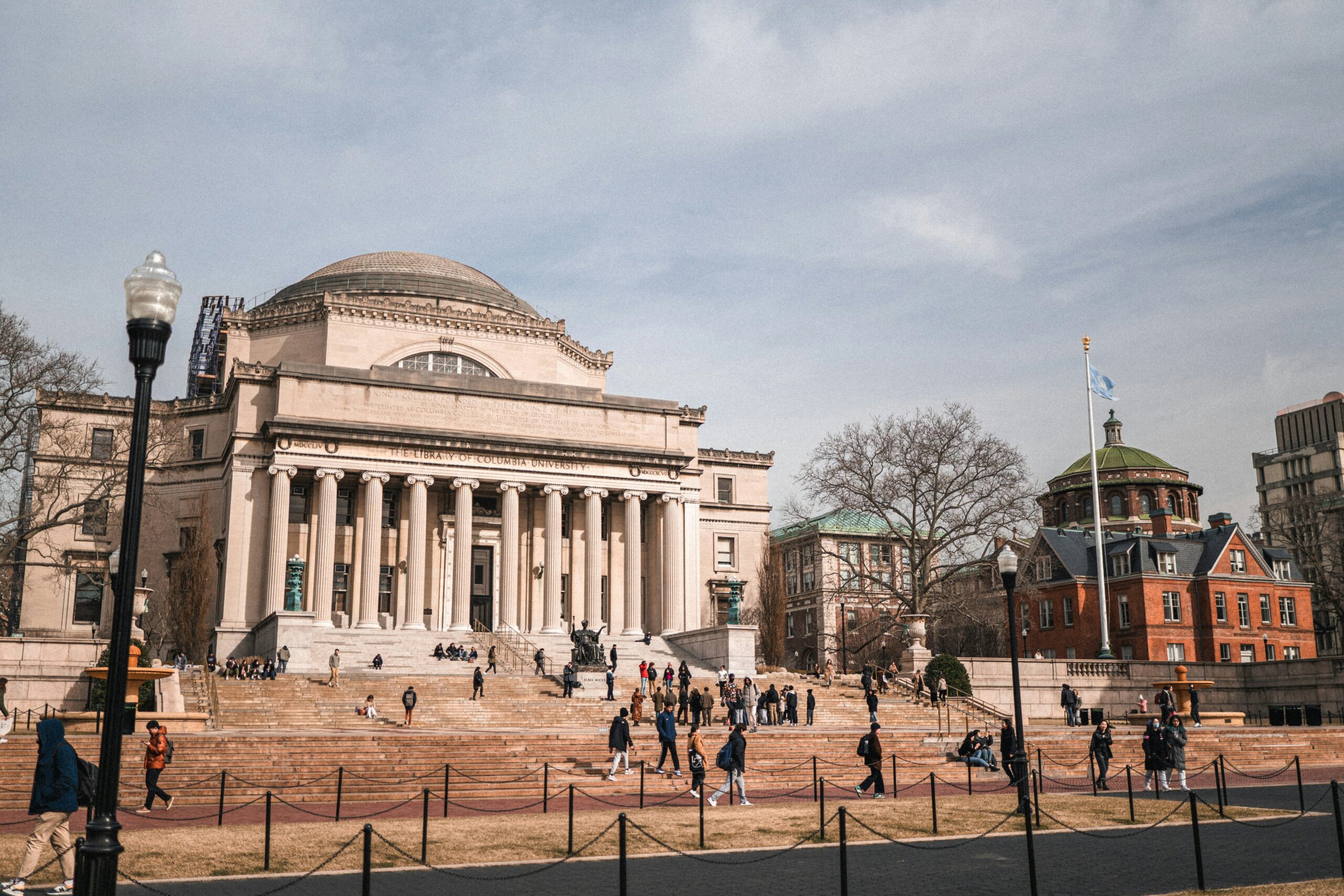
About Columbia
Columbia University was founded in 1754 as King's College and is the 5th oldest university in the United States. The main campus is in Morningside Heights, Manhattan, a 30-minute subway ride from Times Square. Low Library with its iconic steps (a filming location for dozens of movies and series), Butler Library, the Alma Mater statue and the Manhattanville expansion ($6 billion recent investment) form a distinct urban campus, without the suburban isolation of Harvard or Yale.
Two features define Columbia. First: the Core Curriculum, the set of courses required of every Columbia College student. Everyone reads the same books, in the same order: Literature Humanities (Homer, Plato, Virgil, Dante, Shakespeare, Woolf), Contemporary Civilization (political philosophy from Aristotle to Foucault), Art Humanities, Music Humanities, plus Frontiers of Science and University Writing. Nearly a third of the 4 years is spent in the Core. It is a shared intellectual experience unique among the Ivy League.
Second: Columbia has two distinct undergraduate schools you apply to separately. Columbia College (CC) has roughly 4,500 students and is the liberal arts school. Columbia Engineering (SEAS, Fu Foundation School of Engineering and Applied Science) has roughly 1,700 students. You apply to one of them at admission, you cannot apply to both at the same time. Plus Barnard College (the historic sister school for women, an academic partner but a separate institution) and General Studies (for non-traditional students).
For Romanian students: Columbia is the only Ivy in a major city, which means direct access to internships and networking in finance (Wall Street is 20 minutes away by subway), media (NYT, Bloomberg), policy (UN, Council on Foreign Relations) and the arts (MoMA, the Met, Carnegie Hall). The Romanian community in NYC is large (Sunnyside, Astoria), with direct Bucharest-JFK flights via TAROM. Note: Columbia is need-aware for internationals, which means your financial situation is taken into account in the admissions decision (see the Costs section). Notable alumni: Barack Obama, Warren Buffett (transferred), Madeleine Albright, Jake Gyllenhaal, Julia Stiles, Joseph Gordon-Levitt.
How to apply to Columbia
Common App, Coalition or QuestBridge
Columbia accepts all three. When you submit, you choose Columbia College (liberal arts) or Columbia Engineering (SEAS). You apply to only one, not both. Application fee $85, waiver available with demonstrated financial need.
Early Decision BINDING (Nov 1)
Columbia uses binding Early Decision, not Early Action. If you are admitted in ED, you are required to accept. The only exception: if the financial aid is insufficient. ED decision on December 15. ED rate ~10-12%. Apply ED only if Columbia is clearly #1 on your list.
Regular Decision (Jan 1)
For RD: deadline January 1, decision late March. The RD acceptance rate for the Class of 2029 was roughly 3.5 percent. Internationals have a significantly lower rate (Class of 2028: 2.46 percent vs 3.86 percent overall).
SAT/ACT permanently test-optional
Columbia announced in February 2024 that it remains permanently test-optional, being, alongside Cornell, the only Ivies that do not require SAT/ACT. If you have a competitive score (SAT 1500+, ACT 34+), send it. College Board code: 2116. For competitive internationals, a high SAT score is recommended.
Columbia Supplement: 4 lists + essays
In addition to the Common App essay (650 words), Columbia asks for: 4 short lists (books, journals and websites, films/art/music, specific things that interest you) plus 3 short essays (~150 words each): Why Columbia, a community that shaped you, your view of New York.
Recommendations and TOEFL/IELTS
2 teachers (preferably one in the sciences, one in the humanities) plus the School Counselor Report. For SEAS, an additional recommendation from a Math/Physics teacher. For Romanian students: TOEFL iBT minimum 100 (preferred 105+), IELTS 7.0+, Duolingo 125+. Columbia offers optional alumni interviews, not mandatory.
Costs and financial aid
Total cost of attendance 2025-26
Initial costs for Romanians
You pay $0
Families below $66,000 with typical assets pay zero parent contribution. Plus a $2,000 start-up grant for new admits from low-income families.
No tuition
Families between $66,000 and $150,000 with typical assets (up to $250,000) pay no tuition. They contribute partially toward housing/meals (~$21,400).
Individual aid
Families above $150,000 can receive considerable aid depending on assets, multiple children in college or special circumstances. No strict cutoff.
Want to apply to Columbia?
Tough decisions: binding ED, CC vs SEAS, how much aid to request as an international. Strategy matters a lot at Columbia. We help you with the strategy, the essays, the Supplement and the complete application. Your first mentoring session is 100% free.
Talk to a mentorFrequently asked questions
What is the difference between Columbia, Harvard, Yale and Princeton for a Romanian?
Columbia: the only Ivy in a major city (Manhattan). Direct access to internships on Wall Street, the UN, NYT, Bloomberg, MoMA. Mandatory Core Curriculum. Need-aware for internationals (be careful!). Binding ED.
Harvard: Cambridge MA, larger, the most diverse professional network. Need-blind intl.
Yale: New Haven CT, Gothic atmosphere, Yale Law #1. Need-blind intl.
Princeton: Princeton NJ, the smallest, focused on undergrad. Need-blind intl. The most generous FA.
For journalism, business, international relations, finance, performing arts: Columbia is ideal. For intensive pure liberal arts: Yale or Princeton. For a tech or medical career: Harvard.
What is the Core Curriculum at Columbia?
The Core Curriculum is the set of courses required of every Columbia College student (not SEAS). All students take the same subjects, in the same order:
Literature Humanities (full year): Homer, Greek tragedy, Plato, Virgil, Augustine, Dante, Shakespeare, Cervantes, Austen, Dostoevsky, Woolf. Contemporary Civilization (year): Plato, Aristotle, Machiavelli, Hobbes, Locke, Rousseau, Marx, Foucault, Du Bois. Art Humanities (semester): the history of Western art. Music Humanities (semester): Western classical music. Plus Frontiers of Science, University Writing, a foreign language and Global Core (non-Western texts).
Nearly a third of the 4 years is spent in the Core. Advantage: all your classmates read the same books, so you can discuss the Iliad with anyone on campus. Disadvantage: less flexibility than at Yale or Harvard.
Columbia College vs Columbia Engineering, what is the difference?
Columbia College (CC): roughly 4,500 students, liberal arts. You complete the full Core Curriculum and choose your major at the end of year 2 from roughly 80 options. Maximum flexibility in the first 2 years.
Columbia Engineering (SEAS, Fu Foundation School of Engineering and Applied Science): roughly 1,700 students. You apply directly to an engineering specialization (Computer Science, Biomedical Engineering, Electrical Engineering, Industrial Engineering and Operations Research, Mechanical, Chemical, Civil etc.). SEAS has its own shorter Core plus intensive math requirements.
SEAS is slightly more selective than CC. You apply to one, not both. Switching from CC to SEAS is very hard (it requires specific prerequisites). From SEAS to CC is easier. For Romanians interested in Computer Science, both have excellent departments.
What is binding Early Decision (ED) at Columbia?
Columbia uses binding Early Decision, unlike Harvard, Yale and Princeton, which use non-binding Early Action. Binding means: if you are admitted in ED, you are REQUIRED to accept the offer and withdraw all other applications you have submitted.
The only exception: if the financial aid offered is insufficient for you to afford Columbia, you can withdraw from ED. For need-aware Romanians applying with aid, this is a real option.
Columbia's ED acceptance rate: roughly 10-12 percent, significantly higher than Regular Decision (~3.5 percent). ED deadline: November 1. Decision: December 15. Apply ED only if Columbia is absolutely #1 on your list and you are financially prepared.
How does Columbia Financial Aid work for Romanians?
Important: Columbia is need-aware for internationals, unlike Harvard, Yale, Princeton and MIT. Your financial situation is taken into account in the admissions decision. The more aid you request, the stronger your academic and personal profile needs to be.
But for internationals admitted with aid, Columbia covers 100 percent of demonstrated need, with no loans. The average aid for internationals in 2023-24: roughly $79,000 per year. Total international aid: $19 million in 2023-24.
Tiers (from 2022-23, after the April 2022 expansion):
Families with annual income below $66,000 and typical assets: zero parent contribution. Plus a $2,000 start-up grant for new admits.
Families with annual income below $150,000 and typical assets (up to ~$250,000): no tuition. The family pays partially for housing/meals.
Families above $150,000: considerable aid depending on assets and specific circumstances. No strict cutoff.
CRITICAL for Romanians: you must apply for aid AT THE TIME OF APPLICATION. If you are admitted without having requested aid, you cannot request it in years 2-4. Decide in advance whether you will apply for aid.
SAT/ACT at Columbia, mandatory or optional?
Columbia announced in February 2024 that it remains permanently test-optional, being, together with Cornell, the only Ivies that do not require SAT/ACT (Harvard, Yale, Princeton, Brown, Dartmouth and UPenn require testing for the Class of 2029 onward).
If you have a competitive score (SAT 1500+, ACT 34+), you send it, it confirms your academic calibre. The median for Columbia students who submitted scores: SAT ~1530, ACT ~34. For highly competitive internationals, it is recommended to submit a good score, especially given the need-aware status.
Columbia's College Board code: 2116. ACT: 2717.
What do the 4 lists in the Columbia Supplement look like?
The Columbia Supplement has 4 list-type requirements (each roughly 75-100 words). These are unique among the Ivies and define Columbia as an institution obsessed with intellectual curiosity:
List 1: books read for pleasure in the last 2 years (not for school).
List 2: journals, magazines, newspapers, websites and podcasts you read or listen to regularly.
List 3: films, works of art, music, performance arts, novels, podcasts that impressed you.
List 4: 3-4 specific things you would discuss with new friends at Columbia.
Plus short essays: Why Columbia, a community that shaped you, your view of New York as an academic laboratory. The lists reveal who you truly are. Columbia looks for authenticity, not names dropped for effect.
What is life like at Columbia in New York?
Columbia is the only Ivy where the city is an integral part of the education. Internships at the UN (10 km away), JP Morgan, Goldman Sachs, NYT, Bloomberg, MoMA, the Met, Carnegie Hall, all reachable by subway in 30-45 minutes. Internships during the school year (not just summer), direct networking with industry, unmatched cultural events.
Trade-off: you live in Manhattan, on-campus housing is more cramped than at Yale or Princeton. The cost of living is the highest of all the Ivies. The university bubble life is less intense. Many Romanian students at Columbia have mentioned that the first year in Manhattan is overwhelming, but transformative.
For Romanians: the Romanian community in NYC is large (estimated at over 50,000 in the metropolitan area, in Sunnyside Queens, Astoria, Ridgewood). Romanian Orthodox church, restaurants, shops. Direct TAROM Bucharest-JFK flights or a short layover via Frankfurt/Vienna.
Our mentors for the USA
They studied in the USA, at universities like Harvard, MIT and Stanford. They went through the process. Now they guide you.
