
Study in the United Kingdom
Oxford, Cambridge, LSE, Imperial and the rest of Britain's elite universities. Three-year degrees, intensive academic specialisation and a global reputation that opens doors anywhere.
The United Kingdom offers a specialised academic model. You choose your field at admission and go deep into it intensively for 3 years (4 years in Scotland, at Edinburgh, Glasgow and other Scottish universities). A system with more than 800 years of tradition (Oxford founded in 1096) puts the emphasis on deep expertise in a single discipline, with weekly tutorials and dedicated mentors. The application is centralised through UCAS, with a maximum of 5 universities per cycle and a single Personal Statement for all choices.
For Romanian students, the essential part: after Brexit (January 2021), Romanians no longer qualify for the Home fee (GBP 9,535 per year). You pay the International fee, between GBP 15,000 and GBP 45,000 per year (more for medicine, up to GBP 67,000 per year at Oxford/Cambridge). The cost of living adds GBP 12,000-18,000 per year (London more expensive). The UK Student visa costs GBP 524 plus GBP 776 per year Immigration Health Surcharge (IHS), roughly GBP 2,850 for 3 years. The Romanian Baccalaureate is accepted (equated to A-Levels), with required averages of 8.50-9.50 for the best universities. The good news: the Graduate Route Visa lets you stay 18 months to work after graduation (reduced from 24 months in mid-2025), and the UK rejoins the Erasmus+ programme from January 2027.
Top universities in the United Kingdom
Two categories: Oxbridge and Russell Group. Choose the guide that interests you.
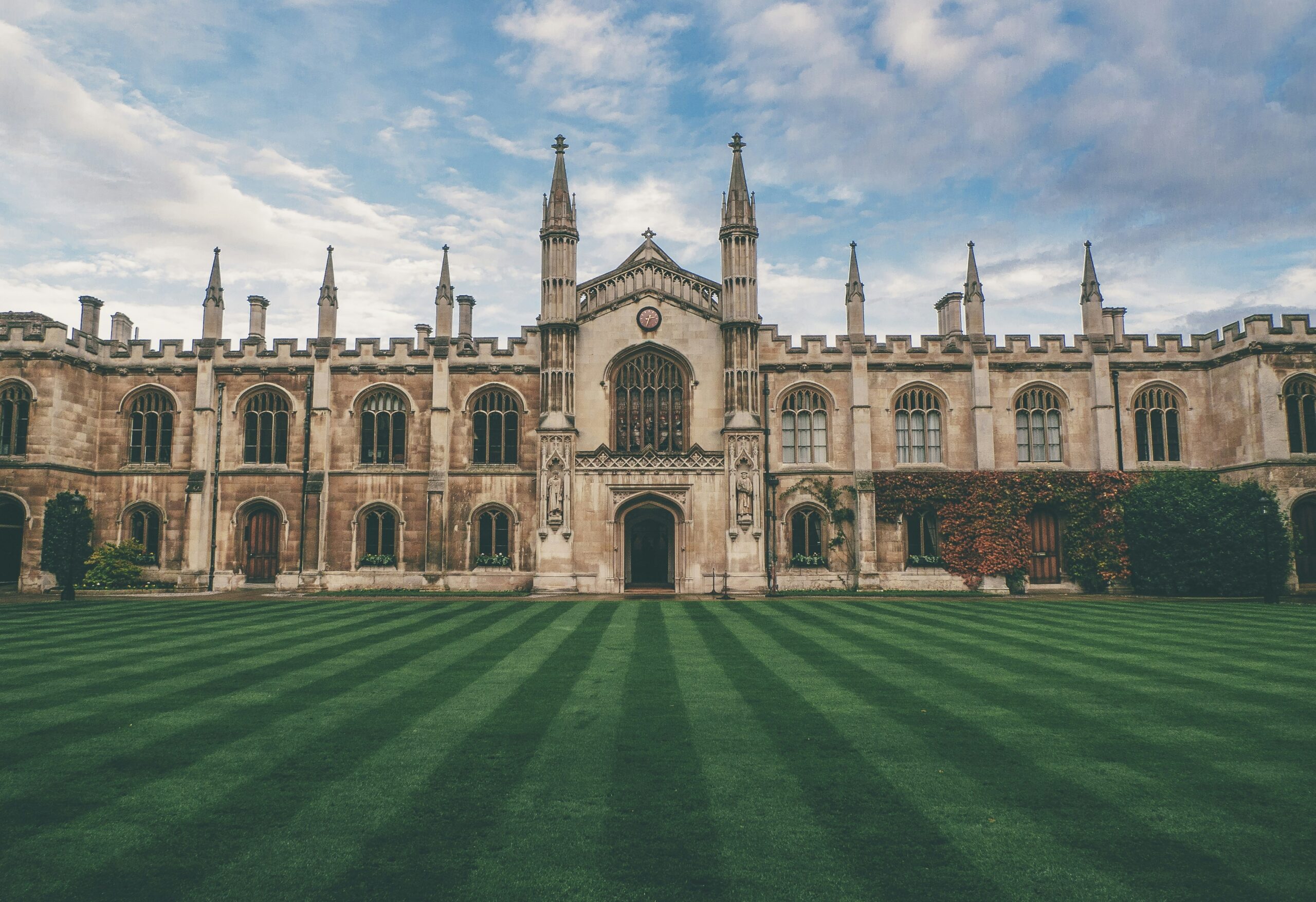
The 2 legendary universities
The oldest and most prestigious universities in the English-speaking world, with more than 800 years of academic tradition (Oxford 1096, Cambridge 1209). A unique system of weekly tutorials and supervisions. You apply to only one per cycle; you cannot apply to Oxford and Cambridge in the same year.
- University of Oxford
- University of Cambridge

The 24 research universities
The British equivalent of the Ivy League. Research-intensive universities with a global reputation in business, law, engineering, medicine and social sciences. They include Oxford and Cambridge plus another 22 prestigious universities. Typical requirements A*AA or AAA at A-Levels, or IB 38-42 points.
- Imperial College London
- LSE
- UCL
- King's College London
- Edinburgh
- Warwick
- Manchester
- Bristol
Want to study in the United Kingdom?
Our mentors studied at Oxford, Cambridge, Imperial and LSE. They guide you through the whole process, from choosing your 5 UCAS universities and the Personal Statement to admission tests and the UK Student visa. The first session is 100% free.
Talk to a mentorFrequently asked questions
What Romanian students and their parents ask most often about studying in the UK.
What is the difference between Oxbridge and the Russell Group?
Oxbridge means Oxford and Cambridge: the oldest and most prestigious 2 British universities, with a separate UCAS deadline on 15 October. The Russell Group is the alliance of the 24 research-intensive universities in the UK, including Oxbridge, the equivalent of the Ivy League: Imperial College London, LSE, UCL, KCL, Edinburgh, Warwick, Manchester, Bristol, Durham, St Andrews, Leeds and others. Standard UCAS deadline 14 January 2026 for 2026 entry.
How much does studying in the United Kingdom cost for Romanians after Brexit?
After Brexit (January 2021), Romanians no longer qualify for the Home fee (GBP 9,535). You pay the International fee, which varies between GBP 15,000 and GBP 45,000 per year (more for medicine, up to GBP 67,000 per year at Oxford or Cambridge). The cost of living adds GBP 12,000-18,000 per year (London more expensive). The UK Student visa costs GBP 524 plus GBP 776 per year Immigration Health Surcharge, roughly GBP 2,850 for 3 years. Merit-based scholarships are available at most universities.
When is the UCAS deadline for UK universities for 2026 entry?
The standard UCAS deadline is 14 January 2026 for most universities and programmes (it was 29 January until 2024-25). There is an earlier deadline: 15 October 2025, mandatory for Oxford, Cambridge and for medicine, dentistry and veterinary medicine programmes at any university. Applications are made centrally through UCAS, with a maximum of 5 universities per cycle and a single Personal Statement for all choices.
What are the admission tests for UK universities in 2026 entry?
For 2026 entry, the relevant tests are: UCAT for medicine at all UK universities (BMAT was discontinued in 2024); LNAT for law at Oxford, Cambridge, UCL, KCL, LSE, Durham, Bristol, Glasgow, SOAS, Nottingham; TMUA for mathematics and sciences at Cambridge, Imperial, LSE, UCL, Warwick; ESAT for engineering and sciences at Cambridge and Imperial; TARA for programmes at UCL. Oxford still uses MAT, PAT and TSA for 2026 entry (the last year), but from 2027 entry it will join the UAT-UK system with TMUA, ESAT and TARA. All are computerised and run through Pearson VUE.
What grades do I need for the best UK universities as a Romanian student?
The Romanian Baccalaureate is accepted at UK universities, equated to A-Levels. Typical requirements: for Oxbridge, an overall average of 9.50-9.80 with grades of 9-10 in the subjects relevant to your specialisation (equivalent to A*A*A); for the Russell Group, an average of 8.50-9.30 with grades of at least 8.50 in the relevant subjects (equivalent to A*AA or AAA). If you have the International Baccalaureate (IB), the requirements are 40-42 points for Oxbridge and 36-40 for the Russell Group. In Romania, many high schools such as International Computer High School in Bucharest, Tudor Vianu, Saint Sava and international schools have very competitive profiles. Some programmes (medicine, law, mathematics, engineering) require additional admission tests and/or interviews.
Do I need IELTS or TOEFL for applications to UK universities?
Yes, Romanians must prove their knowledge of English. IELTS Academic is the most widely accepted standard: minimum scores of 6.5 for most of the Russell Group, 7.0-7.5 for Oxbridge (with at least 7.0 in each component). Accepted alternatives: TOEFL iBT with 92-110 points, Cambridge English (CAE or CPE), Duolingo English Test at some universities. If you studied your entire high school in English (for example International School of Bucharest or British schools), some universities offer an IELTS waiver, but it must be checked case by case.
Can I stay and work in the UK after graduation as a Romanian?
Yes, through the Graduate Route Visa. It allows graduates to stay 18 months in the UK to work or look for a job, without sponsorship from an employer. Note: the duration was reduced from 24 months to 18 months from mid-2025. PhD students can stay 3 years. The application is made online for GBP 822 plus an IHS of GBP 1,035. After the Graduate Route, if you have found a qualified job, you can apply for the Skilled Worker Visa (sponsorship required). The UK also rejoins the Erasmus+ programme from January 2027, which will allow Romanians to do EU-funded mobility in the UK during their studies.
Our mentors for the UK
They studied at Oxford, Cambridge, Imperial, LSE and other UK universities. Now they guide you.